Li Kanquan Uses His Knowledge to Help Aquaculture Farmers Get Rich
"When you hit a problem in fish farming, quickly find Li Kanquan." For aquaculture farmers in Pingyuan County, Meizhou City, Guangdong, Li Kanquan, head of the aquaculture section of the county agriculture bureau, is both an expert and their free "technical director." Drawing on 33 years of continuous innovation in aquaculture technology, Li Kanquan has led the people to start businesses and get rich, and was recently named an outstanding Communist Party member of Guangdong Province for "innovation-driven development."
Serving as a volunteer aquaculture technical director
Walking into the Nantai Mountain Hot Spring Aquaculture Co., Ltd. in Zhongdong Village, Shizheng Town, Li Kanquan pointed to a stretch of breeding ponds of various sizes and told the reporter: "There are more than 20 ponds here, raising more than 10 kinds of fish. This pond raises white pomfret, that one raises tilapia, and some ponds raise eel, freshwater shark..." Then he squatted down to carefully observe the fish in the ponds, checking whether they were normal and had enough oxygen, and passed on hot-spring aquaculture techniques and experience to the company's head. "He is our free aquaculture technical 'director,'" said Qiu Xiaoyu, general manager of the aquaculture company, jokingly.
In 2009, after Qiu Xiaoyu and others took over the hot spring aquaculture base, they had intended to use the hot spring resource to develop leisure agriculture, but under Li Kanquan's "persuasion," they embarked on the path of professional aquaculture. Since taking over, they have consulted and sought help from Li Kanquan on all kinds of aquaculture technical problems, big and small, and Li Kanquan often comes over on weekends to provide technical guidance. Now, the company's fish are much sought after in the Pearl River Delta, the aquatic products it raises are increasing in variety, annual output can reach more than 200 tons, and output value is more than 10 million yuan.
"The resources here are uniquely favorable. The hot spring water is 28°C, contains no sulfur, and is one of the few places in the country suitable for raising warm-water fish. The fish raised here are high in calcium." Li Kanquan said that when recommending "rare" aquatic product varieties for farming, he first conducts experiments in advance to understand the fish's characteristics and the difficulties of raising them, so as to avoid causing losses to farmers.
Continuously introducing aquaculture varieties
"I just want to use the knowledge and experience I have learned to help farmers start businesses and get rich, and improve their lives," Li Kanquan said. Over 33 years, he has improved his knowledge and accumulated aquaculture experience by reading books and going from village to village and household to household, and he maintains the habit of keeping his mobile phone on 24 hours a day so that people can contact him at any time.
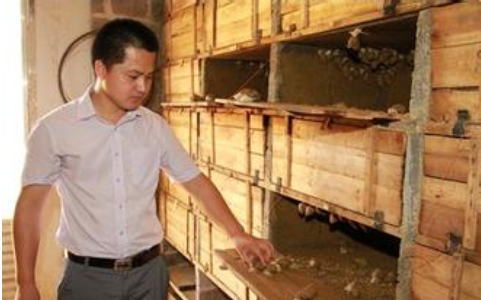
A relevant person in charge of the county agriculture bureau told the reporter that Li Kanquan dares to innovate. Based on the local characteristics of small, old, scattered ponds and the relatively low farming level of farmers, and combining the biological characteristics of relevant aquatic product varieties, he constantly "refreshes" the county's aquaculture varieties and has introduced new varieties such as freshwater white pomfret, Macrobrachium rosenbergii, high-quality crucian carp, and white jade snail. High-quality crucian carp has now become one of the county's main farmed varieties, and can increase fishery output value by nearly 10 million yuan each year for farmers in the county and nearly 50 million yuan for the whole city; Pingyuan has become Guangdong's first white jade snail breeding base, and over 5 years it has attracted 200 farming households to engage in breeding, with profits of 6.8 million yuan.
Li Kanquan has also actively promoted "fishery-livestock-biogas" ecological aquaculture technology to reduce production costs and improve economic benefits. The county's average pond yield per mu rose from 350 kg before 2004 to 695 kg, and output value per mu rose from 3,500 yuan to 7,000 yuan, which can increase output value by more than 8 million yuan each year for the county's farmers and save more than 2 million yuan in costs.