Mu Lihua, founder of Ziyun Qianhua Agriculture, and her stormy entrepreneurial journey
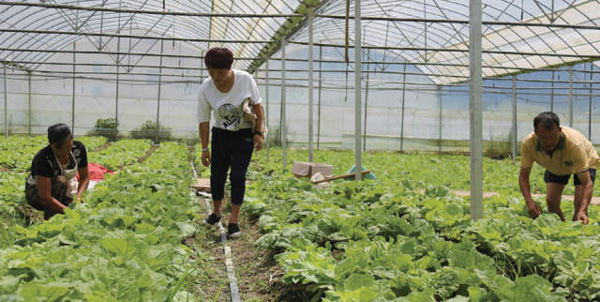
Mu Lihua (center) weeding together with villagers
The person before us is widely regarded as the most enterprising and most responsible entrepreneur around. She dresses plainly, has dark skin, looks a little weathered, and gives off a touch of rustic, down-to-earth simplicity.
At the provincial agricultural industry on-site observation meeting on April 9, 2016, the enterprise she founded was praised by Vice Governor Liu Yuankun as "the park with the most vitality."
Her name is Mu Lihua, and she is 39 this year. "I look like a spark vegetable, a bit early-maturing." That is how she jokes about herself. The Qianhua Agriculture she founded in 2013 covers more than 1,200 mu, has more than 30,000 sq m of greenhouses, and is the largest Hong Kong-supplying vegetable base in the Ziyun Autonomous County low-heat river valley early-maturing vegetable demonstration park. The "reverse lease and subcontract" model she explored has now provided employment for more than 60 villager households, with per capita monthly income exceeding 4,000 yuan.
Time and again she has risen from failure, always encouraging and inspiring everyone with firm faith and a radiant smile. Her smile is the most beautiful rainbow in the storm.
The interview with Mu Lihua lasted only a little over two hours, but her story lingers in the mind for a long time.
The transition from city to countryside
Mu Lihua grew up in a well-off family. Her father once served as a leading cadre in the county, but she did not develop a spoiled, ready-to-enjoy-the-fruits character. After marrying, she resigned from her job at a state-owned enterprise. Starting in 2005, she ran a supermarket and sold baijiu, accumulating valuable experience and her life's "first bucket of gold."
With the rapid development of online shopping and modern chain supermarkets, Mu Lihua's business took a considerable hit. "Supermarkets and baijiu sales, the further I walked, the narrower the road became. I always felt in my heart that this was not my true career." She began to think about transformation.
Hearing that Ziyun Autonomous County was vigorously developing efficient mountain agriculture and promoting the industrialization of agriculture, Mu Lihua smelled a business opportunity. "At that time I just felt agriculture was fundamental, that people would need it no matter when." Mu Lihua said.
After several rounds of investigation, in June 2013, Mu Lihua brought all her savings to what was then Huohua Township. The park construction here was in full swing, the atmosphere fervent, just like the high-temperature river valley climate here. "I put all my funds into it, and in the first phase transferred more than 900 mu of land."
The Ziyun Autonomous County low-heat river valley early-maturing vegetable demonstration park is one of Guizhou Province's 100 provincial-level agricultural demonstration parks, covering a total of 25,000 mu, with 46 enterprises and cooperatives currently settled there. Mu Lihua's is the largest and occupies the leading position.
Before entering this industry, Mu Lihua thought carefully about it and believed she was fully mentally prepared. But the harsh reality still caught her off guard. "I had not expected so many difficulties before. After entering, I tasted a lot of bitterness."
In just 3 months, the more than 1 million yuan Mu Lihua invested was all lost.
"It was still a lack of experience." Mu Lihua summed up the initial failure. "I did not consider costs, an 8-hour workday every day, clocking in and out on time." She joked that this model was "learning from Dazhai" and "all-round contracting," with everyone starting and finishing work together. Money was spent, time was spent, but output value simply was not produced.
From sowing to harvest in the first season of vegetables, over the 3 months more than 1 million yuan was paid out in wages, yet the products sold for only more than 200,000 yuan.
"Later we divided the land into blocks and had groups start work separately, but it still did not work. It still did not fit the laws of agricultural production." Mu Lihua said.
"Reverse lease and subcontract" opens up development space
"At that time I wavered a little inside, but only very briefly. I still firmly believed agriculture was a path with prospects." Mu Lihua said with a smile.
In 2014, Mu Lihua raised more than 2 million yuan for reinvestment in production, and the transferred land increased to more than 1,200 mu. With the county government's support, she also built more than 30,000 sq m of greenhouses.
"But 2014 was still a loss." Mu Lihua said as she stepped across the piers of the irrigation channel. That year there was a frost disaster, but the main problem was still that the issues of low labor efficiency and high labor costs had not been solved.
"From the moment I entered agriculture, I kept thinking about how to quantify labor costs onto the workers and reduce costs, but many methods I tried were not ideal." In the second half of 2014, Mu Lihua spent a lot of time going out to investigate and study, "sharpening the axe does not delay the chopping of wood." She said, "The tuition that should be paid cannot be skimped on." After returning, she convened company employees and some farming households for full discussion to choose a way out.
In early 2015, Mu Lihua proposed the "reverse lease and subcontract" smallholder model: transfer land out from farming households, level it uniformly, build greenhouses and other supporting facilities, then divide it into small plots and subcontract them back to farming households for management. Each household contracts 10 to 15 mu. Qianhua Agriculture Company is responsible for providing all production materials such as seeds and fertilizer as well as technical guidance, and arranges staggered sowing so that farming households have harvests every day. The farming households pick the agricultural products and deliver them to the company, and the company pays by weight.
"We calculate the common people's wages by finished product, so labor is not wasted." Mu Lihua said. Farming households arrange their time reasonably according to crop growth, "farming for their own family," labor efficiency is greatly improved, and company benefits rise noticeably.
The successful experience of Qianhua Agriculture's "reverse lease and subcontract" quickly spread through the park, and other companies adopted this model one after another, hailed as "the most effective model of company + farming households."
In the afternoon, Luocheng Village in Sidazhai Township was very muggy. At just after two o'clock, when the sun was at its strongest, villager Guo Xinghua and his wife came to the greenhouse they had contracted to work. "It is just right now for pulling weeds; the weeds pulled out will soon be scorched dead by the sun." Guo Xinghua said.
Mu Lihua went into the field to pull weeds and chat with them. Her hands moved nimbly among the vegetable seedlings, and handful after handful of weeds were tossed by her to the edge of the ridge, her movements very skilled.
Guo Xinghua used to work as a mason in the city. "I could also earn five or six thousand a month, but after deducting food and expenses, I simply saw no money." This middle-aged man is not tall, but very capable. He grinned, his face full of honest simplicity. "Our family contracted 15 mu of land." His wife Ren Chunhua told the reporter.
"It is the rainy season now, the fields are waterlogged, and the vegetables are not growing well. This month we only have a little over 5,000 yuan. At the highest, we had more than 14,000 yuan in a month. This model is very good." Guo Xinghua is very satisfied with his current income, especially since he works at his doorstep and can take good care of his elderly mother.
"There are now more than 60 farming households like Guo Xinghua, some poor households, some who came back after working elsewhere. We are still continuing to develop. The key is to first train them to master the techniques." Mu Lihua said.
"After the park was established, local people's incomes increased. There is land transfer fees, wages, and nearby work that also allows them to take care of their families. A preliminary estimate is that income is more than five times what it was before. Now in the areas driven by vegetables, for example Luocheng Village, everyone has already been lifted out of poverty." Said Wu Jiangtao, mayor of Huohua Town.
A strong woman who smiles in the face of storms
A collapsed steel-frame greenhouse by the roadside is shocking to see. This was the result of a recent storm. "There were several thousand square meters, all collapsed overnight. Repairing it would cost at least several million. I cried bitterly at the time." Mu Lihua looked a little shy, and one could not tell at all that she had been so grief-stricken.