Phoenix plum sells for 40 yuan per kilogram on the market
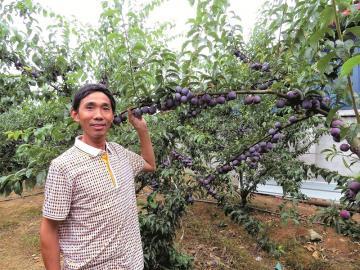
Li Shuangjun bred the new "Phoenix plum" variety.
New variety enters the market, high price and no worry about selling
On July 3, on a hillside planted all over with "Phoenix plums" in Yueying Village, Xiuwen Town, Dongpo District, Meishan City, a crowd was bustling, all customers who had come to taste, pick and buy plums. Standing to one side, orchard owner Li Shuangjun said happily: "My 10 mu of 'Phoenix plums' were planted only a little over two years ago, and this year they are expected to produce 7,500 kilograms of plums. Apart from the cheaper price for key out-of-town buyers, the rest are sold at 40 yuan/kg, so this year's plum sales income will be 200,000 yuan. If they fully enter the peak production period, the yield and returns per mu can still increase substantially."
Li Shuangjun, 48 this year, once worked at the Xichang Agricultural Science Institute, spending many years engaged in fruit production and the development and research of new varieties. Speaking of the experience of breeding and planting "Phoenix plums," Li Shuangjun told this writer that the reason he was willing to put effort into developing new plum varieties is that, compared with other fruit varieties, plums have stronger adaptability, lower technical requirements, and relatively extensive management, and the fruit suits consumption by all kinds of people. But the long-standing problems of backward plum varieties, too many ordinary "run-of-the-mill" types, inferior quality, poor taste and sluggish sales had restricted the development of the plum industry. In order to fundamentally change this situation, starting in 2005, Li Shuangjun carried out comparative planting trials combining the characteristics of various plums. After more than 5 years of devoted exploration, he finally selected the best mutated variety of crisp red plum and grafted it with a special seedling of wild peach from Yunnan, and from among them selected the best for breeding. By 2010, a unique new plum variety was finally successfully bred.
Li Shuangjun introduced that this plum tree has slender branches, shaped like a "phoenix tail," and was therefore named "Phoenix plum." Compared with similar plum varieties, its greatest advantage is the short production cycle: less than a year and a half after the saplings are planted in the ground, they can bear fruit and go into production, and after another two or three years they gradually enter the high-yield period, with the highest yield reaching more than 3,000 kilograms per mu. "Moreover, this plum has purple-red skin, a freestone pit, fine and tender flesh, a crisp and sweet taste, and a sugar content as high as 14%, 3% higher than similar plums. The fruits are large and uniform, ripen relatively early, and suffer little damage from pests and diseases. In quality, taste, appearance and time to production, it is greatly superior to similar varieties," he said.
In order to plant on a large scale, in the early winter of 2013, on land transferred in Yueying Village, Xiuwen Town, Li Shuangjun first trial-planted 10 mu of "Phoenix plums," 500 trees in total. By the spring of 2015, each tree produced 2.5-5 kilograms, and that year the yield per mu reached more than 2,000 kilograms. This year it entered large-volume production, with each tree producing 12.5-17.5 kilograms, for a total output of 7,500 kilograms of "Phoenix plums."
Li Shuangjun said that just as the fruit entered the harvest season, purchase inquiries kept coming, and buyers from Chengdu, Chongqing, Beijing and other places swarmed in, competing to buy the fruit while it was still on the trees. Although the retail price now reaches 40 yuan/kg, it is still in short supply, and in high-end markets in cities such as Beijing and Shanghai it even sells for 100 yuan/kg. "After another two or three years, once it enters the full high-yield period, each mu of 'Phoenix plums' can produce more than 3,000 kilograms. Calculated at the current minimum purchase price from buyers of 20 yuan/kg, each mu can bring in more than 60,000 yuan; if calculated at the retail price of 40 yuan/kg, the income per mu reaches more than 120,000 yuan."
At present, Li Shuangjun has expanded the "Phoenix plum" planting area to 220 mu, and has also led Yueying Village and surrounding villages to plant more than 1,000 mu of "Phoenix plums." "The 3 mu of 'Phoenix plums' I planted last year have already begun bearing fruit one after another this year. In two or three years, the income will really be considerable," said Huang Zhihua, a villager of Yueying Village.