Foreign trade elite returns home to grow oil tea, driving local people to prosperity
The photo shows the oil tea base in full bloom with oil tea flowers.
Vast Dongting waters, lingering Zhongzhou sentiment. Located in a hilly area of Renyi Village, Zhongzhou Township, Yueyang County, every October, white camellia flowers sway in the wind, filling the air with fragrance. The former barren hills have been turned into treasure, and the lives of local people are thriving day by day.
Foreign trade elite returns home to grow oil tea
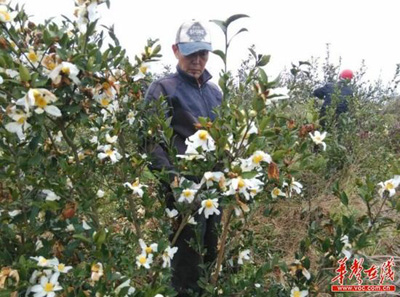
"This is our oil tea seedling planted 5 years ago. Don't be fooled by how small the tree is; with good care, our best plant last year yielded over 30 jin of oil tea fruit, and that wasn't even during the peak production period." Guo Xiang'an, approaching sixty, beamed as he showed his oil tea trees to the reporter.
Guo Xiang'an, a native of Yueyang County, worked in import and export foreign trade in Russia for 17 years. In 2008, upon learning that Liuyang had hosted the country's first national oil tea work on-site meeting, he went personally to investigate and learn, and immediately recognized the market potential of oil tea. He resolutely decided to return to China and start a business growing oil tea. In 2009, he established the Yueyang Haoran Oil Tea Industry Professional Cooperative, attracting 145 farming households to join, with an oil tea forest area reaching 3000 mu. In 2011, it was awarded the title of "Provincial-Level Demonstration Cooperative for Delivering Practical Results to the People" by the Provincial Party Committee and Provincial Government. Oil tea begins to bear initial fruit after 5 years of planting, and reaches peak production in the 8th year. One mu of oil tea forest can produce 2000 jin of tea fruit, with a per-mu yield of 75-80 kg of tea oil, and the gross income per mu of oil tea forest exceeding 4000 yuan.
Primary, secondary and tertiary industries flourishing across the board
"The government guides us to develop the primary, secondary and tertiary industries comprehensively, and we are also advancing in this direction." Guo Xiang'an outlined the cooperative's development plan for the next five years.
The primary industry is to do well in oil tea cultivation. "Our cooperative is also an oil tea training base. Friends in Yueyang County who are interested in oil tea cultivation often come to our base to visit and learn. We all provide technical support free of charge, and even go to other oil tea bases to provide technical guidance."
The secondary industry is to do well in deep processing. In 2015, the cooperative invested 25.5 million yuan to settle in the Hunan Yueyang Taiwan Farmers Entrepreneurship Park, establishing an oil tea processing enterprise, forming a company + cooperative + farming household business model. It is expected that after production begins, annual sales will reach 120 million yuan, with an annual profit of 50 million yuan.
The tertiary industry is to develop tourism. Oil tea blooms while bearing fruit, with a flowering period lasting 2-3 months, commonly known as "carrying offspring while pregnant." "Here we can not only admire the camellia flowers, but right next to the camellia there is also a 60,000-mu lake. Boating on the lake and admiring flowers, fishing and strolling, a one-day trip here on weekends to see the pastoral scenery and eat farm food is quite pleasant." Speaking of the tourism prospect plan, Guo Xiang'an talked on and on.
Driving local people to prosperity
The prospects and benefits of oil tea are good, and the cooperative's oil tea seedlings are growing smoothly, attracting a group of villagers to join, visit and learn techniques, and grow oil tea together. Zou Xianwen is one of the large-scale growers. In 2014, he was still working elsewhere. After returning home, he recognized the prospects of oil tea and contracted nearly 800 mu of barren hills to grow oil tea, investing nearly 2 million yuan. This year he also tried forest understory economy, planting watermelons under the seedlings, which not only saved fertilizer and reduced the number of pesticide applications, but also prevented grass from growing. Besides the considerable watermelon yield, the seedlings also grew very vigorously.
"Initially I took a fancy to the fact that oil tea yields returns every year. With good care, the returns can last as long as 80 years. I often go to the cooperative to learn techniques, and seeing their planting results, I feel even more confident." Facing the future, Zou Xianwen looked resolute.