Shaanxi's First Greenhouse Peach Is Born: Zhao Zhihong's Peach-Growing Story
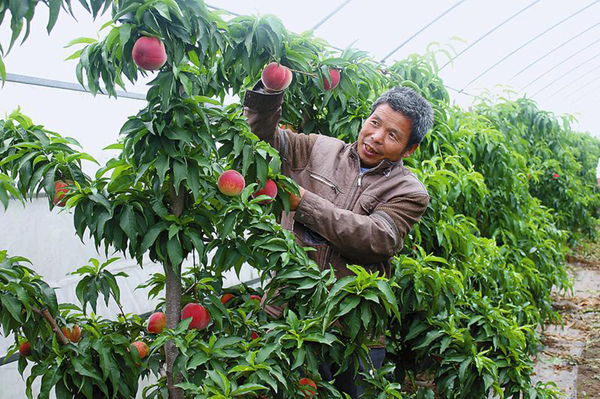
"Pay attention! Row spacing 1.8 m, plant spacing 1 m." Zhao Zhihong was directing more than 100 cooperative members from the village to build a new peach orchard, with each tree spaced 1 m apart. "You're making a mess of this!" member Yang Weiguo strongly objected. Old Yang, who had grown peaches his whole life, simply could not understand: "Laobaozi has a history of planting peaches going back over a hundred years. For how many generations have people used 6 m row spacing and 5 m plant spacing? With your 1 m plant spacing, how will the trees bear peaches?"
Seeing the members' faces full of incomprehension, doubt and hesitation, Zhao Zhihong realized this was certainly not Old Yang's idea alone. He thought: seeing once is better than hearing a hundred times. Rather than fretting, it would be better to let them see it with their own eyes. Without explaining, he directly contacted people and found a vehicle. In July 2013, two thoroughly unwilling villagers were dragged by Zhao Zhihong into the car to observe in Yangling...
Searching for a Good Variety
Laobaozi Village is located in Zhongnan Town, northeast of Zhouzhi County at the foot of the Qinling Mountains. Its peach-growing history began in 1633 AD, and in 2011 "Laobaozi Village Peach" was certified as a geographical indication. Many villagers have made a living growing peaches for generations, and the whole village has more than 2,000 mu of peach orchard land. Despite the amount of land, before 2013 they grew the "Shahong" peach, a mid-season variety that came onto the market all at once at the end of June, so it could not fetch a good price at all - about 1 yuan per jin. Calculating it out, income per mu was only six or seven thousand yuan, and after deducting costs there was not much profit left. Village Party secretary Zhao Zhihong saw this and worried deeply.
During those few days at the end of May 2012, Old Zhao seized every opportunity to run to Xi'an, and discovered that apart from southern nectarines, there was almost no seasonal fruit on the market. He spotted the opportunity and thought that if he could find a variety with better taste than "Shahong," larger fruit and an earlier market date, it would surely sell for a good price. Old Zhao heard people say that Lianhuashi Town in Hua County had a peach variety called "Chunmei," with large, sweet fruit, and most importantly an early-maturing variety that could reach the market on June 20. So without another word he grabbed his bag and hurried to Hua County. "When I first arrived in Hua County and saw Huang Mingxi, he was selling peaches to a trader at 3 yuan per jin. I was very interested right away," Zhao Zhihong said.
In July he brought back a cartload of "Chunmei" scion wood from Lianhua Town, ready to go all out, but the villagers poured cold water on him with a few words. "Old Zhao, grafting is so troublesome, and it only sells for 2 yuan more per jin than before. How do you expect us to do it?" "Exactly, in this blazing heat..." Just then, villager Old Li woke him up: "If it could bear more fruit, that would work too - more fruit means more money." So what to do? He remembered that during a village study session, Professor Wang Anzhu of Yangling had mentioned that Li Chengxing of Caojiagou Village, Wuzong Town, Yangling, had researched a high-density peach planting method that was not only easier to manage but also produced more fruit. Half-believing, Old Zhao set off on the road to Yangling...
Arriving in Yangling, Old Zhao learned that Li Chengxing, after many trials, had developed his own set of management methods. In March 2013, after returning from Yangling, he carried a loudspeaker around the fields all day, and also invited Li Chengxing to provide technical guidance for Laobaozi Village, instructing members that they must plant trees according to the specified row and plant spacing, and prune the original "three forks, six fillers, twelve branches" tree shape in layers. "Teacher Li, how does this work? If the trees are short, they bear fewer peaches. With branches this dense, how do they get sun? What exactly is the principle behind your method?" Many members, led by Yang Weiguo, began to make a fuss. "Teacher Li, what principle?" Li Chengxing, who had only practical experience and no theoretical knowledge, was momentarily left speechless by the members' questions. "The principle... there's no principle... anyway, I guarantee you will get fruit."
If he could not explain it clearly, how could the members believe him? After the peaches ripened that June, Zhao Zhihong took his 150 members in 3 groups to Caojiagou Village, Wuzong Town, Yangling, to visit and learn Li Chengxing's tree-shape pruning method. Hearing is false; seeing is true. After returning, the members who had seen the model followed Old Zhao in planting high-density orchards.
At the Agricultural High-Tech Fair that November, Old Zhao encountered the "one-sided" greenhouse peach technique of Liu Chengde from Shouguang, Shandong. Learning that "greenhouse peaches" could reach the market a month earlier, he had a flash of inspiration and followed Liu Chengde to Shandong to study.
Technology Is the Key
On May 3, 2015, Zhao Zhihong kept running to the fields, and after returning home he paced in circles, as anxious as an ant on a hot pan. "Those few days I really could not eat or sleep," Old Zhao said. After one year of planting and two years of fruiting, the "Chunmei" was finally about to show results, and Zhao Zhihong had been full of confidence, ready to go harvest peaches in the field. Unexpectedly, as soon as he entered the field, he saw that the peaches on the trees were only as big as ping-pong balls, nothing like the one-jin-per-peach size originally promised.
It turned out that in November 2012, Zhao Zhihong had gone to Shouguang to learn advanced techniques and found that although dwarfing technology was good, "one-sided" training was not feasible: the backs of the peaches could not get sun, so the taste was not sweet, and vigorous branches formed easily. After bringing the technology back to Laobaozi Village, Old Zhao improved it himself, organized villagers to plant high-density "Chunmei," and put up greenhouses, until May 2015.
"But why exactly won't the peaches grow big? How should it be solved?" Having no solution, Old Zhao thought of Boss Huang, who sold seedlings. Sure enough, the one who tied the bell must untie it. "I heard from a peach trader that greenhouse peaches in Laoting County, Tangshan, are very large. If you go there and take a look, maybe there will be a solution." Upon getting the news, Zhao Zhihong thought nothing of it and immediately took two villagers to Xi'an Xianyang International Airport. This was the first time three farmers from Laobaozi Village had come to an airport and the first time they had boarded a plane. On May 8, 2015, as soon as Old Zhao and his two companions returned to the village with the true method, they hurriedly applied high-potassium fertilizer to the peach trees, and within a few days the peaches indeed grew large.
Watching these peaches grow bigger day by day, Old Zhao's anxious heart was finally put at ease.
A "Timely Rain" of Funds
Around May 25 last year, traders kept coming to buy peaches. The greenhouse peaches of Laobaozi Village reached the market a month earlier than open-air peaches, at 6 yuan per jin, fully 6 times the original price. This was a market situation unprecedented in Laobaozi Village's several-hundred-year history of growing peaches, and Laobaozi peaches also opened the prelude to Shaanxi's first greenhouse peaches.
Last winter, as Zhao Zhihong walked through Laobaozi Village, he suddenly found that the village had become lively. Villagers who had previously worked elsewhere had all come back and begun buying seedlings and building greenhouses.
Old Zhao did the accounts for the reporter: "Now one tree can bear 30 jin of peaches. One mu is one greenhouse, with 350 trees, and the annual output is over ten thousand jin. At the lowest purchase price of 6 yuan per jin, that brings in 60,000 yuan. After deducting costs, one greenhouse can earn at least 30,000 yuan. What's more, sales channels are broad now, and this year they were all sold at 7 yuan per jin."
Zhao Zhihong, who had already won the members' trust, looked back and saw that without the "timely rain" of funds, Laobaozi's greenhouse peaches could never have succeeded.
"Building one greenhouse costs 26,000 yuan, and 150 greenhouses cost more than 3.9 million yuan." Looking back now, Old Zhao still clearly remembered that astronomical figure. He calculated that among the village's 100 low-income households, according to the industrial poverty alleviation policy of the Xi'an Poverty Alleviation Office, each household could receive 10,000 yuan, amounting to 1 million yuan. Everyone said Old Zhao was a capable man, able both to handle technology and to wear down people with talk. After returning from the Xi'an Poverty Alleviation Office, he also applied for 570,000 yuan in family planning industry development project funds for Laobaozi Village. A total of 1.57 million yuan became the startup capital for building greenhouses.
"I'm just bold. I only wanted to develop the greenhouses; I didn't worry much about anything else," Zhao Zhihong said. In 2014, when he came to the Xi'an Municipal Agriculture Committee to apply for funds, "Can your village succeed? Weiyang District previously wanted to build a modern agriculture park and never succeeded, ending up deep in debt. Is your village going to repeat the same mistake?" The staff even half-jokingly, half-teasingly advised Zhao Zhihong to just grow peaches honestly and stop making pointless trouble. Facing doubts and hesitation from many sides, he chased after the municipal agriculture committee staff and said over and over: "We made a special trip to Yangling and Shandong to look, and what we learned is proven, successful technology. We even invited the Yangling teacher to guide us. Our village can definitely grow them well." Zhao Zhihong's pestering wore the municipal agriculture committee staff out, but he was not discouraged. In 2015, when the first batch of greenhouse peaches from Laobaozi Village reached the market, he once again walked through the door of the municipal agriculture committee: "Leader, our village's peaches are already on the market, a month earlier than open-air peaches, and they can now sell for a good price on the market. The income of our village's 150 poor households has risen from six or seven thousand yuan to twenty-six or twenty-seven thousand. In the future we also plan to give all 700 households in the village one greenhouse each."