A leader in lifting a jujube-growing village out of poverty raises bees and grows jujubes without neglecting either
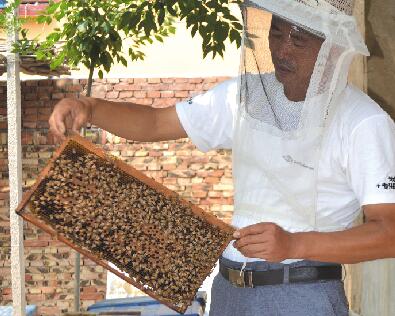
"After hard work gathering flowers, it finally becomes honey, brewed sweet to send to countless homes." When people talk about Jiang Zhutang, a beekeeper in Panjia Village, Huangsheng Town, Zhanhua District, the people of the surrounding villages have nothing but praise for him. His family's honey is high quality and reasonably priced, and using the connections he built through beekeeping, he led more than 20 households to establish the Binzhou Zhanhua District Zerunyuan Winter Jujube Professional Cooperative so they could all prosper together.
Jiang Zhutang, 47 this year, once worked in construction and grew crops, but neither brought good development, and his life never improved much. In 1998, seeing the honey market rising steadily, Jiang Zhutang finally set his sights on beekeeping. Spotting the opportunity, Jiang Zhutang sold his family's two head of cattle, one big and one small, for 1,800 yuan that year and bought 5 boxes of bees and other equipment. Because his skills were not yet proficient, he was stung often that year and did not collect enough honey, so he basically did not make much money the first year. By the second year, he subscribed to magazines to study and went out to apprentice with older beekeepers, and only then did things gradually improve. In the second year he had a net income of five or six thousand, which was considered very high in rural areas at that time.
In recent years, the honey market has gotten better and better, especially after more and more local winter jujube trees were planted, winter jujube honey became a hot seller on the market. At present, Jiang Zhutang keeps 14 boxes of bees. When asked why he does not expand the scale even more, Jiang Zhutang said that beekeeping is like growing winter jujubes: only with fine management can high-quality honey be produced. Jiang Zhutang did the math: these 14 boxes of bees can produce 2.8 jin of propolis each year, currently 2,000 yuan per jin, for an income of 5,600 yuan; they can produce 100 jin of pollen, 50 yuan per jin, which sells for 5,000 yuan; they can produce 50 jin of royal jelly, 150 yuan per jin, which sells for 7,500 yuan; and they can produce more than 600 jin of honey, 30-50 yuan per jin, selling for at least 20,000 yuan. These 14 boxes of bees can bring in a gross income of 38,000 yuan each year. The main expense is that each box of bees needs four or five dozen jin of sugar for overwintering and for the nectar-scarce period in mid-to-late July (the time when all kinds of flowers are at their fewest). After deducting all expenses, beekeeping alone can bring a net income of more than 30,000 yuan each year.
Besides beekeeping, Jiang Zhutang and his wife Zhou Shumei also planted eight mu of winter jujube trees, which can sell for more than 60,000 yuan each year. Through a chance encounter while selling honey, he got to know Boss Gong, who runs a supermarket chain in Zhejiang. Starting in 2015, Jiang Zhutang began supplying winter jujubes to Zhejiang. Because of the high quality and good reputation, Boss Gong would transfer the cash first each time before the goods were shipped. Because the demand was too great, Jiang Zhutang also sent the high-quality winter jujubes of his nearby neighbors to Zhejiang to sell to Boss Gong. The average unit price was 1 yuan per kilogram higher than the market price. Since everyone benefited, these more than 20 jujube farmers got together, with Jiang Zhutang taking the lead, and established the Binzhou Zhanhua District Zerunyuan Winter Jujube Professional Cooperative, with unified management and unified sales, contract-based planting, and a guarantee of 1 yuan per jin higher than the market price.
Speaking of future development, Jiang Zhutang hopes that the cooperative members will also join in beekeeping, so that while growing winter jujubes well, they can also add an extra income and prosper together.