20,000 mu of small fruits in Guangyuan, Sichuan, becomes a new path to boost farmers' incomes
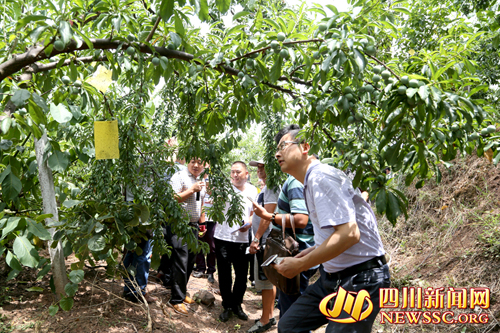
Visit the orchard site
Practice has proven that developing the small fruit industry has an obvious effect on boosting farmers' incomes. Our city has good climate and soil conditions, and developing small fruits has great prospects. Each county and district also has some successful examples. The Municipal Agriculture Bureau is requested to earnestly summarize this and hold an on-site meeting to promote it.
At the end of June, the information "Chaotian District develops the small fruit industry on a one-township-one-industry basis to boost farmers' incomes" received written instructions from Zou Zijing, Deputy Secretary of the Guangyuan Municipal Party Committee and Mayor.
Walking into the orchard, the fragrant scent of fruit rushes to greet you, and what meets the eye are clusters of heavy plums hanging all over the branches, red and green, too many to count……"These are crisp red plums after four rounds of fruit thinning, and each tree yields around 150 jin." said the owner Chen Fei.
Red plum
At the foot of Nanshan in the suburbs of Guangyuan City, the fruit at the Wanyuan crisp red plum base is ripening one after another, amazing the delegates attending the Guangyuan City small fruit industry development on-site meeting.
In order to earnestly implement the spirit of Mayor Zou Zijing's instructions, from July 5 to 6, the Guangyuan City small fruit industry development on-site meeting was held in Zengjia Town, Chaotian District, aiming to discover typical examples of the small fruit industry in poverty alleviation and boosting farmers' incomes, summarize typical experience in the development of the small fruit industry, and make the city's small fruit industry bigger and stronger.
Before the meeting, the participants successively visited small fruit planting bases such as the Wanyuan crisp red plum base in Lizhou District, the Dashiyou peach production base, and the Wangjia blueberry production base in Chaotian District. One township, one product: Chaotian's "small fruit" experience is recognized.
Crisp peach
In Wangjia Township, Chaotian District, amid towering mountains and dense forests, the first high-altitude open-field blueberry planting park in northern Sichuan——the Wangjia Township Modern Leisure Agriculture Blueberry Demonstration Park——was built on the mid-slope beside the market town.
In 2013, Wangjia Township successfully introduced Sichuan Jinqiule Industrial Co., Ltd. to invest in the construction of the blueberry agricultural sightseeing park. It now has an initial scale, with 280 mu of blueberry park built, and all 80,000 blueberry plants planted have come into production, with an annual output value of 45 million yuan and more than 10,000 tourists received annually, driving the rapid development of the entire township's economy.
High-altitude open-field blueberry
"Wangjia has a relatively high altitude and a large temperature difference between day and night, which is inherently an excellent place for high-altitude open-field vegetable cultivation. The introduced blueberries are of even better quality than those in other places." said Yang Xiaobo, Deputy District Mayor of the Chaotian District Government. In recent years, Chaotian District has taken the "one river" (Jialing River), "two rivers" (Yudong River and Yangmu River), and "three lines" (National Highway 108 Second Special Line, Chaoxiao Line, and Chaochen Line) as the core, vigorously developing characteristic small fruit industries such as cherries, blueberries, and small crisp plums, and has established a cherry demonstration base, a blueberry sightseeing park, a small crisp plum demonstration base, and a kiwifruit demonstration area, with obvious results in boosting farmers' incomes.
At present, the district has built 15,000 mu of small fruit industry bases, achieving an output value of nearly 200 million yuan and driving growers to increase their incomes by more than 2,000 yuan.
"Chaotian District adapts measures to local conditions according to the local natural conditions, with leading varieties, leading regions, leading models, leading technologies, and leading entities. It develops cherries in Shahe, crisp plums in Chaotian Town, blueberries in Wangjia…… forming a one-township-one-product characteristic." He Zhi introduced that in developing small fruits, the primary, secondary and tertiary industries should integrate and promote each other, and while the small fruit industry develops, rural tourism should also keep up.
At present, the Shahe Cherry Picking Festival and Wangjia Blueberry Picking Festival in Chaotian District, led by the government, hosted by enterprises, and with social participation, attract tens of thousands of tourists every year, which not only makes the small fruit brand known but also promotes the deep integration of agriculture and tourism, further boosting farmers' incomes.
200,000 mu of "small fruits" with output value exceeding 1 billion yuan
"Guangyuan is located at the junction of Sichuan, Shaanxi and Gansu, and the small fruits produced under its unique climate and soil also have unique quality advantages!" introduced He Zhi, member of the Party Leadership Group and Deputy Director of the Guangyuan Municipal Agriculture Bureau.
Guangyuan City is located in the northwestern part of the Sichuan Basin, between east longitude 104`37`~106`47` and north latitude 31`22`~32`56`, adjacent to the three provinces of Sichuan, Shaanxi and Gansu, bordering southern Shaanxi to the north, connected to Longnan to the west, controlling Jianmen to the south, and drawing in Bashan to the east. It stands astride the upper reaches of the Jialing River, a tributary of the Yangtze River, belongs to the low mountain area of northern Sichuan, and has a subtropical humid monsoon climate. It is rich in light and heat resources, with abundant rainfall, four distinct seasons, a relatively long frost-free period, obvious vertical climate, and complex and diverse mountain climate types, suitable for the growth of small fruits.
In recent years, since Guangyuan has focused on developing modern agriculture, it has always adhered to the path of ecological agriculture development, taking the rational use of natural resources and the protection of a good ecological environment as the premise, following the principle of "adapting measures to local conditions, highlighting advantages, strengthening the foundation, and expanding the industry", taking scientific development as the theme and adjusting and optimizing the industrial structure as the main line, focusing on building characteristic fruit brands, and comprehensively improving the overall level and comprehensive benefits of agricultural production.
The unique high-quality fruits within its territory, "Cangxi snow pear" and "red-fleshed kiwifruit", have obtained national geographical indication certification and become Guangyuan's leading characteristic industries, with products exported abroad. "In addition to 'big fruits' such as snow pears and kiwifruit that have already formed 'big industries', the planting area of small fruits such as peaches, plums, cherries, loquats, apricots, strawberries, and blueberries has also reached 200,000 mu, with output value exceeding 1 billion yuan, becoming a breakthrough for boosting farmers' incomes and escaping poverty toward prosperity." He Zhi introduced.
"Small fruits" become a new path to escape poverty and become rich
Huangmao Township, Cangxi County, at the junction of the three counties of Cangxi, Wangcang and Nanjiang in Bazhong, is famous worldwide for the famous Huangmaoya Battle. Because it is located deep in the Daba Mountains, with poor natural conditions, backward transportation, and a low level of economic development, young people go out to work, and abandoned land can be seen everywhere.
In 2014, successful entrepreneur Luo Hong, a native of Huangmao, gave back to his hometown, invested and started businesses in his hometown, and helped the local people escape poverty and become rich. He successively invested 60 million yuan to establish Sichuan Huangmaoya Agricultural Biotechnology Co., Ltd., transferred 3,000 mu of abandoned mountainous land, planted peach trees, loquat trees, kiwifruit, crisp plums, snow pears, and apricots, and built an ecological tourism industry sightseeing park; invested more than 6.7 million yuan to build a rapid corridor connecting Huangmao to Wangcang Mumen and the expressway, benefiting more than 100,000 people in 9 townships; invested 2 million yuan to build a 200-mu kiwifruit industrial park and return it to the local people……
A series of grand moves has turned Huangmao deep in the mountains into a "Shangri-La" and a "Flower and Fruit Mountain".
At the symposium held in Zengjia Town, Chaotian District, Mr. Jiang from the Huangmaoya White-fleshed Loquat Professional Cooperative introduced the construction of the sightseeing park.
Just like the construction of the Huangmaoya park, many entrepreneurs in Guangyuan City have invested funds in the four counties and three districts to build small fruit sightseeing parks, allowing local villagers to receive dividends as shareholders and poor villagers to work in the parks. "Small fruits" have become a new path for local people to escape poverty and become rich.