Xiangzhou's Small Chili Peppers Make a Big Contribution to Poverty Alleviation in Guangxi
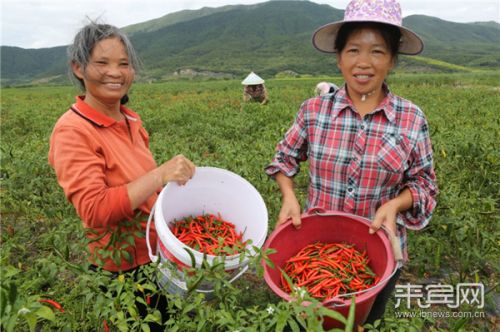
Impoverished household Wei Shuifen (right) and villagers help Wu Ji pick chili peppers.
Recently, in a large chili pepper field in Mengling Village, Baizhang Township, Xiangzhou County, Wei Shuifen, an impoverished household from Mengling Village, and more than 10 villagers were busy picking red chili peppers, with laughter and cheerful voices drifting from the fields. At the edge of the field, Wu Ji was busy packing and loading the chili peppers onto a truck, preparing to ship them to Guangdong for sale.
It turns out that Wu Ji is a villager from Dengzhan Village, Zhongping Town, and also a people's congress representative of Zhongping Town. This year, he planted over 500 mu of chili peppers in Mengling, Xinzhai, Nadan and other villages in Baizhang Township and hired villagers to help manage them, increasing their income. In addition, he also planted over 150 mu of chili peppers in Zhongping Town, also hiring villagers to help manage them. Among these villagers, more than 20 households are impoverished households.
When it comes to growing chili peppers, Wu Ji speaks with great familiarity, talking knowledgably about everything from linear chili, rice chili to pointed chili. Several years ago, while working away from home, Wu Ji saw that chili pepper prices were good in the market. After research, he found that chili peppers have strong adaptability and are a “short, flat, fast” wealth-building project, so he gave up working away from home and returned to start his own business. He never expected that this venture would succeed. In recent years, with the help of the county's agricultural department, he solved the technical difficulties of planting, and also obtained loan support from a rural cooperative bank, making his chili pepper business grow bigger and bigger. This year, the total area of chili peppers he planted in Baizhang Township and Zhongping Town reached over 650 mu. “This year, the 650 mu of chili peppers will yield about 350,000 kg, with estimated sales of about 2.8 million yuan.” Wu Ji said that although this year's weather greatly reduced chili pepper yields, because early-season chili pepper prices reached as high as 16 yuan/kg, and now late-season prices have also reached 6-8 yuan/kg, his income from growing chili peppers this year did not decrease.
Wei Shuifen said that now Wu Ji hires more than 60 villagers from the village every day to pick chili peppers, and she and more than 10 impoverished households in the village have also joined the ranks of chili pepper pickers. “Because the weather is hot, we start harvesting at 6 a.m. every day and rest at 11 a.m. In the afternoon, we pick from 3 p.m. to 6 p.m., and can pick over 60 kg per day.” Wei Shuifen said that Wu Ji pays them 2-2.4 yuan per kg in wages, and her daily income is about 120-150 yuan.
Chen Juming, an impoverished household who was picking chili peppers that day, said that in the first half of this year, from helping Wu Ji plant chili peppers to finishing the chili pepper harvest, her income is estimated at about 5,000 yuan. In addition, she rented 3 mu of land to Wu Ji for growing chili peppers, with a rent of 1,000 yuan per mu, so her income from chili pepper planting alone reached 8,000 yuan. Chen Juming also said that in the second half of the year, Wu Ji will need workers again for growing other crops, and they will have income when they come to work then.
“It is meaningless for me to be rich alone; only when everyone is rich is it truly wealth.” When talking about his future plans, Wu Ji said that after this crop of chili peppers is harvested, he will use these farmlands to grow selenium-rich rice, and next year he plans to adopt a land shareholding approach to invite impoverished households to participate in building 500 mu of greenhouses for growing chili peppers. “I will be responsible for funds, seedlings, technology and sales, while management will be handled by the villagers. One impoverished household can manage 10 greenhouses. If each greenhouse generates 5,000 yuan in income, one impoverished household can earn 50,000 yuan per year.” Wu Ji said with full confidence.