Is Mountain Betel Nut Actually Betel Nut? Differences and Characteristics Explained
Betel nut is a plant name that everyone is familiar with, and it is also a plant that many people chew. The appearance of the betel nut tree is also widely known, so when the name "mountain betel nut" appears in books, most people naturally associate it directly with betel nut, and even think it is simply betel nut that grows on mountains. The two are also extremely similar in appearance, which easily causes confusion in identification, but they are actually completely different species.
Mountain betel nut (Pinanga tashiroi Hayata) and betel nut (Areca catechu L.) are both plants of the palm family (Arecaceae). Although their Chinese names are very similar, they belong to two different genera.
Betel nut belongs to the genus Areca (betel nut) and is not a native plant of Taiwan, China. It originated in the tropical Asian regions of Malaysia and the Philippines, was introduced and cultivated by the Dutch in the 16th century, has a long history of existence in Taiwan, China, and has now become one of the indispensable plants in many people's lives. Along with the humanistic development of Taiwan, China, many place names named after betel nut are commonly seen, and in the culture of eating betel nut, different regions have also developed different characteristics.
However, mountain betel nut belongs to the genus Pinanga (mountain betel nut). It is not only a native plant of Taiwan, China, but also an endemic species. In the whole world it is distributed only on Orchid Island, with a narrow habitat distribution. The plants grow sporadically in river valleys or from moist slopes to ridge lines in the primitive forests of the mountainous areas of Orchid Island. The "2017 Red List of Vascular Plants of Taiwan, China" has assessed mountain betel nut as Nationally Endangered (NEN), making it one of the species on the brink of extinction in Taiwan, China. Although the name mountain betel nut rolls off the tongue, not many people have actually seen it, and those who can identify it are even fewer.
Mountain betel nut is an upright tree plant. The tree height can reach several meters. The trunk is thornless and unbranched. The upper part is green, and the lower part turns grayish brown after aging. After the leaf sheaths fall off, obvious grayish brown ring marks remain on the stem, and the very base of the plant is obviously swollen; the leaves are clustered at the top of the plant, with leaf length of about 1 to 2 m, forming a once-pinnate compound leaf. Several leaflets at the tip are fused and then irregularly split. Each leaflet is lanceolate-linear, and the leaflets closest to the leaf base are slender and filamentous, as if green ribbons were tied to the rachis.
Unlike the leaf characteristics of betel nut, the leaf surface of mountain betel nut is smooth and hairless, but on the veins of the leaf underside of the leaflets, rusty-colored hairy scales are densely covered. The rachis is triangular in cross-section, and the petiole extends downward to form a large leaf sheath. Layer after layer, these overlap and wrap around the stem. The leaf sheaths are green to yellowish brown, and the surface is obviously covered with rusty-colored or golden dot-like scales. This is one of the important characteristics of mountain betel nut.
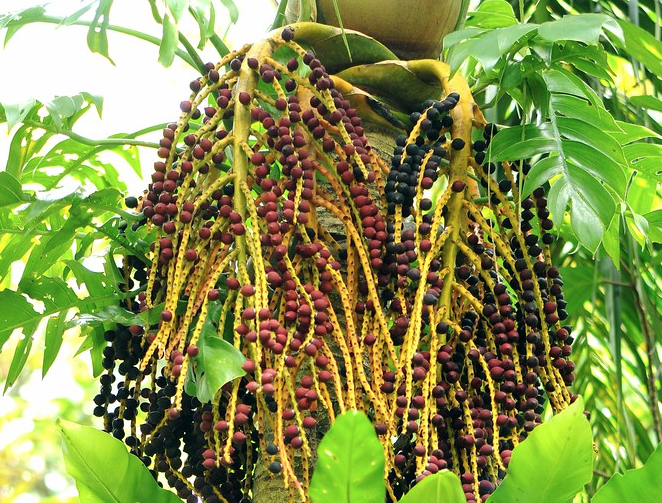
In the inflorescence of mountain betel nut with mature female flowers, the male flowers are not yet mature, arranged neatly in a tooth-like shape; on the leaf sheaths, the rusty-colored or golden dot-like scales can be seen.
The inflorescence of mountain betel nut is borne at the base of the lowest leaf. It is a fleshy compound spicate inflorescence, covered by a huge obovate spathe. When flowering, the bright yellow spathe falls off, and the entire inflorescence droops and opens; the flowers are unisexual and monoecious, growing on the same inflorescence. Every 2 male flowers are neatly arranged below each 1 female flower. The male flowers have 3 petals and 3 sepals. The petals are obviously larger than the sepals, milky white, arranged in imbricate fashion, shaped like teeth. Each male flower contains several stamens. The female flowers are obviously much smaller than the male flowers. The purplish red petals and sepals surround the lower edge of the female flower, arranged in imbricate fashion, and the stigma is 3-lobed, maturing before the male flowers. The male flowers open in the morning when mature, and the flowering period is very short. By the afternoon of the same day they all fall, leaving only the female flowers on the inflorescence axis.