Post-85 Young Man Returns Home to Become the Village's Leader in Prosperity
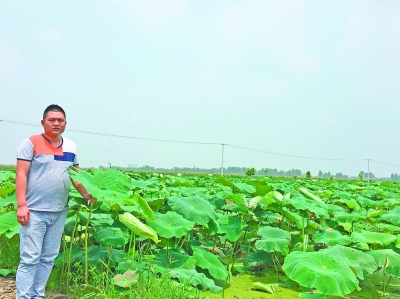
Pictured: Wu Shuang and his lotus root base
He worked as a migrant laborer, sold vegetables, and drove long-haul trucks, but ultimately chose to return to the land where he was born and raised. Wu Shuang, a "post-85" migrant worker who returned home, founded the Green Ark Agricultural Products Cooperative in Xinbang Village, Caidian, in 2014, opening up a 2,800-mu lotus root industrial park to grow Caidian lotus root. Last year, the cooperative produced and sold 3 million kg of lotus root, with sales revenue of 12.17 million yuan, helping more than a hundred farming households increase their income.
Founding a Cooperative to Lead Fellow Villagers to Prosperity
At the age of 19, Wu Shuang, a secondary vocational school graduate, began working away from home, toiling for many years without earning much money. Later he returned to his hometown of Caidian, gritted his teeth and spent 28,000 yuan on a farm vehicle, and went to the Baishazhou wholesale market to do a vegetable wholesale business, which he did for 5 years.
Because they had no vegetable base, Wu Shuang and his partners had no guarantee of supply and mostly bought goods by following the crowd; the purchase price was often decided by the seller, and if the market was bad, a single loss could run to tens of thousands of yuan. "Depending on others for a living just doesn't work." Wu Shuang conceived the idea of building his own growing base and creating a one-stop industrial chain of growing, transport and sales.
After 10 years of hard work, Wu Shuang already had a modest fortune at the time. When word got out that he was going to "return home to farm," many relatives and friends were not optimistic, thinking farming had no future and worrying that he would throw away the money he had earned. But Wu Shuang steeled himself, put in 2 million yuan of his own money, and brought in friends who had previously done the vegetable business together with him as shareholders. In December 2014, they established the Green Ark Agricultural Products Cooperative. The cooperative has 5 shareholders in total, and Wu Shuang is the board chairman. Through land transfer, they consolidated the scattered plots farmed by households into larger units, established growing bases, and achieved large-scale operation.
"At that time my thinking was simple: I wanted to make money myself, and I also wanted my fellow villagers to make money together with me." What Wu Shuang said was very down-to-earth.
Caidian Lotus Root Sold to **Urumqi
Caidian is a hometown of lotus root, so the first thing Wu Shuang thought of was growing lotus root. Which kind of lotus root was suitable? Wu Shuang made a special trip to the Hubei Academy of Agricultural Sciences and the Wuhan Aquatic Vegetable Research Institute to seek advice from experts. On the experts' recommendation, he trial-planted four or five varieties of lotus root, and finally selected "Elian No. 5." "This kind of lotus root is crisp and white, and after several days of long-distance transport it won't turn black, so it's very suitable for opening up markets outside the province." Wu Shuang said they had wanted to sell Caidian lotus root to other places from the very beginning.
The land transferred by the cooperative was originally dry land and could not be used to grow lotus root. Wu Shuang hired people to convert the dry land into paddy fields, built roads in the fields that vehicles could pass through, and put up utility poles. "Before the lotus root was even planted, the early-stage investment had already cost more than 8 million yuan." Speaking of that period at the beginning of the cooperative's establishment, Wu Shuang's feeling was that it was tiring but full of hope.
In April 2015, the cooperative planted its first batch of lotus root, about 1,500 mu. Wu Shuang ran to the fields almost every day, guarding the lotus root fields and cultivating them carefully. When the rain was heavy, he feared flooding; when the sun was strong, he feared drought; when there were too many flowers, he feared they would rob the lotus root of nutrients...
In October of that year, the lotus root was harvested one after another. Wu Shuang took the lotus root to trade fairs, gauged the market, sought sales channels and looked for customers. Because of the good quality of the lotus root, the lotus root produced by the Green Ark Cooperative quickly entered markets in Taiyuan, Shanxi, **Urumqi and other places. That year, lotus root sales reached 3 million kg.
Plans to Build a Lotus Root Processing Factory
At present, the land transferred and used by the Green Ark Cooperative comes from more than a hundred farming households in Caidian. These households used to farm themselves, and one mu of land could bring in an income of about 1,000-plus yuan a year. After transferring the land, their rental income from one mu of land is about 900 yuan a year, and they also plant and harvest lotus root at the cooperative in their spare time, earning wages. "All told, annual income can increase by about 50%." Wu Shuang said in his calculations.
Driven by the Green Ark Cooperative, some farmers around the plantation who previously grew corn and rice also began trial-planting lotus root. Wu Shuang readily provided them with technical support and also helped purchase their lotus root for outside sales. At present, the lotus root plantation area of the Green Ark Cooperative has increased to 2,800 mu, and this year's lotus root output is expected to exceed 5 million kg.
Next, Wu Shuang plans to build a lotus root agricultural products processing factory to produce lotus root powder, dried lotus root slices and so on. In Wu Shuang's plan, Green Ark will create a "new world of lotus root."