Yang Zaiwen: Golden Tea is a big industry that makes us farmers rich
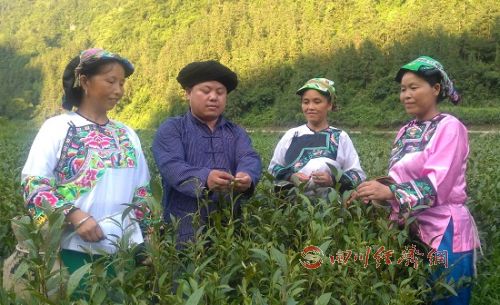
Yang Zaiwen guides tea farmers in picking tea leaves
In July, western Hunan is bathed in golden sunlight. At the tea garden of the Xingfu Valley Tea Professional Cooperative in Pingnian Village, Aizhai Town, Jishou City, Xiangxi Tujia and Miao Autonomous Prefecture, Hunan Province, this reporter had the good fortune to meet Yang Zaiwen, chairman of the cooperative, who was discussing autumn tea-picking plans with tea farmers. Normally a man of few words, Yang Zaiwen, once he opened up, spoke with sparks of passionate ideas in every sentence.
Reporter: Hello, Mr. Yang! May I ask how you first came to be connected with tea?
Yang Zaiwen: "A child without a mother - it's a long story." Pingnian Village, where my family lives, is a typical poor Miao village, and agricultural production there was primitive simple reproduction with very low capacity for capital accumulation, so farmers themselves simply did not have the economic conditions to build an industry. But our village borders the Golden Tea production area of Baojing County, where clouds and mist swirl year-round, mysterious and ancient, and the special geographical conditions and fine ecological environment are suitable for the natural growth of tea. According to the Veritable Records of Emperor Shizong of Ming, Jiajing Reign, Golden Tea was a tribute tea, and the earliest ancient tea trees can be traced back to 402.
"Golden Tea" is an ancient and rare local tea tree variety resource of western Hunan. It has the quality characteristics of "high amino acids, high tea polyphenols, high water extracts" and "fragrant, green, refreshing, strong", and is known as one of the best green teas in China. Everyone knows that Hunanese people have the character traits of "enduring hardship, bearing annoyance, fearing no death, and being fiercely tenacious", and the people of western Hunan are even more representative of this, which is closely related to the fact that the people of western Hunan have loved drinking Xiangxi Golden Tea since ancient times.
Yang Yuebin, commander of the Hunan Army naval forces in the late Qing Dynasty, had to drink Golden Tea from his hometown every day. After drinking it, his spirit was roused, and he led the Hunan Army naval forces, killing in all directions and repeatedly winning battle honors.
Long Yingtang, the first-generation Miao female drum king, whose masterful drumming skill was the crystallization of more than sixty years of diligent study and hard practice, always drank a cup of Golden Tea when practicing the drum. In 1957, Long Yingtang went to Beijing to take part in a special performance arranged for Chairman Mao and other central leaders. After the evening party ended, Chairman Mao came on stage to meet the performers, and Long Yingtang even recommended her hometown tea to Chairman Mao, receiving great praise from him.
Especially when I was very young, I heard the song "Carrying Tea on a Shoulder Pole to Beijing" sung on the radio. The first time I heard this song, I, who had never even left my small mountain village, actually developed the desire to carry my family's tea to Beijing for the central leaders to drink when I grew up, and thus was deeply moved by the song's beautiful melody, which left a deep mark on my young heart.
On November 3, 2013, Chairman Xi came to our western Hunan for an inspection and put forward "targeted poverty alleviation". "Targeted poverty alleviation" means using one key to open one lock; poverty alleviation must be suited to local conditions. Today I especially want to thank Chairman Xi. It is Chairman Xi's targeted poverty alleviation policy that has made me the greatest beneficiary. Chairman Xi has brought a happy life to us Miao people. I am just an ordinary tea farmer, and I have no other way to express my thanks. I just want to carry tea on a shoulder pole to Beijing and present my best tea to Chairman Xi. Just as the song I love goes: the mulberry shoulder pole is light, oh so light, I carry tea on a shoulder pole out of the mountain village...
Reporter: Mr. Yang, you say it was Chairman Xi's targeted poverty alleviation policy that helped you escape poverty and become rich. Please tell us the details.
Yang Zaiwen: I am 41 this year. Before planting Golden Tea, I worked away from home for 12 years, and my income was only enough to barely keep body and soul together. In 2010, considering that my parents were already over 80 and my child was in primary school and needed someone to care for them, and that my older brother and sister were both working away from home, I decided to return to my hometown to honor my parents and raise my child. In 2011, I learned that the government was going to carry out poverty alleviation and development and strongly support the tea industry, and that our village's soil and climate were very suitable for planting Golden Tea, so I planted all 7 mu of my family's farmland with tea seedlings. In June 2012, I wanted to expand the scale, so I rented 100 mu of village land at a price of 1,200 yuan per mu. With government support for technology and tea seedlings, I hired more than 40 people to level the land, dig trenches, open beds, stretch lines, and plant seedlings. It took more than a month of hard work to finish planting. By then, my savings from working away from home had paid the rent and wages and were almost used up. At that time, several families in the village were going out to work and were willing to rent me 50 mu at 500 yuan per mu, but they required all 15 years of rent to be paid in full up front. The 15-year rent came to 270,000 yuan. I borrowed here and scraped together there, and in the end even got a bank loan, barely managing to rent the land. It was like a gamble. When I think back to those years of borrowing money to rent land, I still get a little excited. If that planting had failed, then I would have lost everything and would also be up to my ears in debt. But with such a good business opportunity in Golden Tea, I absolutely could not miss it, and I also believed it would not fail!
You could say I gambled right. At the end of 2013, Chairman Xi put forward targeted poverty alleviation, and I benefited from the targeted poverty alleviation policy, expanding from 180 mu to 350 mu. In February 2014, all the tea-growing households in Pingnian Village formed the Xingfu Valley Tea Professional Cooperative, and the villagers elected me as chairman. At present, the total planting area has already reached more than 1,600 mu, with an annual output of nearly 2 tons of dry tea. In order to reduce the transport time for fresh leaves, the cooperative built a factory building, purchased equipment, and processed the fresh leaves itself, raising the added value of the tea products. Moreover, my "Xingfu Valley Miao Drum King" trademark has already been registered, and the brand is gradually becoming known.
Reporter: Mr. Yang, how do you ensure the quality of the tea, and how is business now?
Yang Zaiwen: The quality of tea is very important. We do not use pesticides or chemical fertilizers. We mainly apply farmyard manure such as tea seed cake, tung seed cake, and sheep manure, and uniformly use solar insect-killing lamps to control pests and diseases, raising the degree of intensification. Planting is advancing toward park-style, large-scale, standardized, and high-grade development, and cultivation, prevention, and management are carried out strictly according to organic tea standards. I track every step. I think this is the key. What I make is a high-quality product. A high-quality product requires high-quality management and requires starting from every detail in order to maintain a high-quality brand.
Tea picking is done with careful selection. Spring tea is picked once every 3 to 4 days, and summer and autumn tea is picked once every 15 days. Picking in batches and stages many times not only makes the picked buds and leaves neat and uniform in size, ensuring and improving the quality of tea making, but also, because of the effect of picking in batches many times, can promote the continuous sprouting of tea buds and increase tea yield. Picking quality requires buds and leaves to be complete, fresh, and even, without stems, tea fruit, old leaves, diseased leaves, or insect-damaged leaves.
The heat for frying tea is accurate, tea is rubbed with light rolling and fine kneading, and baking uses firewood and charcoal, so the tea tastes especially mellow when drunk. If a certain batch of product is not good, I would rather throw it away or make it into a specimen. I keep work records, recording the characteristics of each batch of product. Every time tea comes out, I personally taste it, striving for a fine product.
Product promotion is also very important, but do not seek speed, and do not blindly pursue economic benefits. Only things of good quality can gain a firm foothold in the market. For every one of my products, I guarantee its quality.
Therefore, our tea is now mainly sold to Beijing, Shanghai, Inner Mongolia, Suzhou, Wuxi, Guangzhou, Wuhan, and Changsha. Last time, several people from Shenzhen drove a car specially to buy tea, saying they were taking it to the UK. To be honest, my tea really is in short supply.
Reporter: You have run your business very successfully. Where is the core value of your success?
Yang Zaiwen: One fence needs three stakes, and a good man needs three helpers. My success would not have been possible without the help of the local government and the bank, which gave great support in my marketing and in promoting my products. Also, when some bosses go out to discuss business, they take some tea with them to help promote it for me. I think this is also very important.
Reporter: Competition in the tea industry is fierce now. What is the greatest advantage of your product?
Yang Zaiwen: My product's advantage is quality. I think it should be put first. Everyone is doing it now, and there will be pressure. The whole of Xiangxi Golden Tea is a big brand, but our market shares are different. My current output is not very large, but sales have been successful. This relies on the charm of my own "Xingfu Valley Miao Drum King" brand, which has attracted a large number of consumers. I think competition is not dragging a company backward; it is a stimulant that encourages you to move forward. We should be the people who make the cake, not the people who eat the cake.
Reporter: Competition in the tea industry is very fierce, and there is also the phenomenon of price competition. How do you view this? Also, how do you manage the tea brand and guide it toward healthy development?
Yang Zaiwen: I took part in a tea expo in Changsha and gained a lot. A good enterprise should value corporate culture and management. Only in this way can it ensure that quality and brand gain a firm foothold in the market. Competition in the tea business is now very fierce. But I will not compete on price with farmers' products, because what I make is a high-end product.
Reporter: At the time, did you ever think about what you would do if you rented so much land and failed?
Yang Zaiwen: I was very confident. At the time I felt that as long as I worked hard and truly gave my all, I could run this Xingfu Valley Tea Cooperative well.
Reporter: Where does this confidence come from?
Yang Zaiwen: It comes from the fact that our tea quality itself is very good, with a uniquely favorable climate and natural environment. This is one of the best places for making tea. I had first-hand information, and with my own marketing ideas, I firmly believed I should be able to sell tea to other places. I have also compared our tea with that of peers across the country, and I think our tea is not inferior to tea from any other place. So I am very confident. In my life dictionary there is no such word as "failure".
Reporter: I heard that you have also arranged for many left-behind elderly people to work in the tea garden, is that right?
Yang Zaiwen: Yes. I recruited 25 women and elderly people in the village who have family difficulties and cannot go out to work into the cooperative's tea garden, letting them pick tea and do odd jobs, with a monthly wage of more than 1,000 yuan, so that they neither neglect farm work nor fail to increase their income. Therefore, this has been affirmed by the local government.
Reporter: From 2011 to now, it has been 5 years. What is your next development goal?
Yang Zaiwen: Western Hunan has rich tourism resources as a backdrop, and what I make is "Xingfu Valley Miao Drum King" Golden Tea, which can be displayed as a local brand of western Hunan. I want to make a brand store with my "Xingfu Valley Miao Drum King" Golden Tea. Because I have started by strictly controlling the source, I believe in its quality, and I also want to have my own chain stores, that is, my own directly operated stores, in every county and city around western Hunan. This somewhat imitates the approach of a marketer in Taiwan, China. He said that if your product can occupy a market in a certain place, then after a completely new method appears, you should do it in a completely new way. In this way, this high-quality tea, "Xingfu Valley Miao Drum King", will certainly become even more popular. In addition, some bosses have advised me to do e-commerce sales, and we will certainly do that too. I am very clear in my heart that planting, researching and developing, producing, and processing Golden Tea is in fact a big industry, a big industry for us farmers to escape poverty, become rich, and strive for a moderately prosperous life.