Returning home to start a business and develop ecological agriculture: Tu Zhiping leads farmers to activate the mountains and countryside
Profile: Tu Zhiping, male, 51 years old, a native of Pingjiang County. He graduated from Tongji Medical University in 1990 and is the chairman of Hunan Ruidan Technology Co., Ltd. In 2009, he returned to his hometown to found Hunan Ruidan Technology Co., Ltd., focusing on supporting local impoverished farmers in developing four major industries: oil-tea camellia, high-mountain organic tea, rice-field fish farming, and Lianyun black chickens. He has invested a total of more than 15 million yuan to help 6 villages improve infrastructure and develop agricultural industries. The number of beneficiary farming households reached 4,000 people, including 436 people in targeted poverty households.
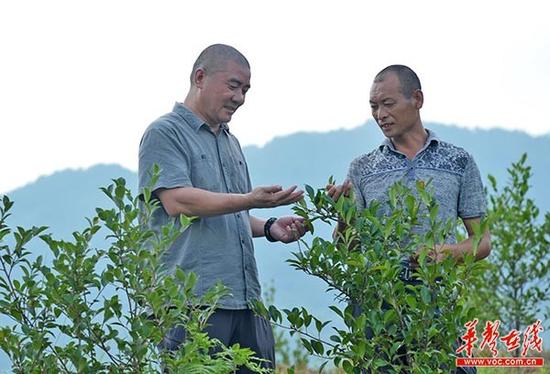
Tu Zhiping (left) discussing the growth of oil-tea camellia with villagers at the oil-tea camellia base.
Hongqiao Town in Pingjiang County, located in the Mubu Mountain area, is more than a two-hour drive from Pingjiang county town. The winding mountain roads have deterred many villagers from summoning the courage to leave the mountains, but Tu Zhiping is the one who left the mountains and then returned to them. In the 7 years since returning home, he has invested in building roads and repairing water conservancy projects, and led his fellow villagers to plant oil-tea camellia and organic tea and to raise fish and chickens. He has invested more than 15 million yuan and experimented with multiple poverty-alleviation models. His persistence and refusal to give up are little by little changing the poverty-stricken face of the local countryside and renewing the villagers' concepts and ways of thinking.
Unforgettable hometown ties: spending his own money to build roads for the village
"I still like it here. Hiking up the mountain or taking a walk in the fields, the air is fresh and my mood is relaxed." Tu Zhiping, dressed in light casual clothes, wandered around several nearby villages, walking steadily and comfortably at every step. The place where he lived since childhood is one he could not know better.
Tu Yiping was born into a poor family in Hongqiao Town, Pingjiang County. His father moved here from Nanchang with his grandfather. Because he had been sent down here back then, the family had few relatives locally, little labor, and a tight financial situation. At a young age, Tu Yiping had to help the family with farm work and plant sweet potatoes in the fields. Nearby villagers would always take the initiative to help his family after finishing their own farm work, and when food was scarce they would quietly bring food over. "Only if you have experienced it yourself can you understand that feeling. I have always kept their help in my heart," Tu Yiping said.
After graduating from Tongji Medical University, Tu Yiping gave up a comfortable job and went to Guangdong to make a living. In 2009, he finally returned to this native land that he had been longing for and founded Hunan Ruidan Technology Co., Ltd. He has never forgotten to repay the kindness of his fellow villagers. The number of poor students he has sponsored has reached more than 100 so far, with donations totaling more than 1 million yuan. Wei Qiang, a poor student from Daxing Village, Hongqiao Town, received Tu Yiping's support for 7 consecutive years from attending Peking University through graduate school graduation, totaling 140,000 yuan. Every Spring Festival, Tu Yiping brings consolation gifts to visit households enjoying the five guarantees and families in difficulty in poor villages, and has donated more than 100,000 yuan in total. When poor villagers lack money to build houses, he provides money to sponsor them. When anyone in the village is ill and has no money for treatment, he proactively sends medical expenses.
In 2009, Renyi Village had less than 1 km of cement road in the whole village. Tu Zhiping coordinated and integrated more than 1.2 million yuan in funds, including more than 500,000 yuan donated personally, to build 4 km of new basic roads and harden more than 10 km of village roads. At the same time, he repaired 6 water conservancy projects in Dong'an Village and Renyi Village of Hongqiao Town, improving the irrigated area by more than 100 mu.
"These infrastructure investments have changed the backward transportation situation in our area, solved the most urgent problems for the people, made travel more convenient, improved the people's production and living conditions, and laid a good foundation for poor people to escape poverty and become prosperous," said Hu Yanbing, Party branch secretary of Renyi Village.
Industrial poverty alleviation delivered to villagers' doorsteps
Hongqiao Town is remote, with many mountains and little farmland. For many years it has been constrained by a lack of funds, technology, and markets. Apart from growing grain, local people had not developed other industries, agricultural industries were single, and channels for increasing farmers' income were narrow. Although changes to infrastructure changed the appearance of the mountain area, they did not directly increase the income of poor farming households. Tu Yiping believed: "To become prosperous, we must drive farming households to develop industries."
In order to develop industries and lead villagers to prosperity, Tu Yiping plunged into the farmland and mountain forests. At the beginning, he was not familiar with agriculture and did not avoid detours. He planted cordyceps and experimented for a year, but in the end, because the climate was unsuitable, the entire investment was lost. Later, he invited experts to conduct on-site investigations and, combining them with local realities, decided to develop the oil-tea camellia industry.
Since 2009, Tu Yiping has invested more than 8 million yuan, rented 2,200 mu of mountain land, and led 156 households and 580 people in Renyi Village to develop high-yield "Dezi No. 1" oil-tea camellia. Villagers can not only receive forest land rent every year (19 yuan per mu per year), but also work at the oil-tea camellia base and earn 150-200 yuan per day. Deng Ziqing, a villager from Renyi Village, transferred 20 mu of forest land, and he works at the oil-tea camellia base, earning more than 2,000 yuan per month in wages. Deng Ziqing said: "My family has 6 people. In the past we relied on farming to support the family. Now in my spare time from farming I go to work at the base. Calculating it, my annual income is 3 times what it was before."
Oil-tea camellia needs at least 8 to 10 years to reach mass production, and the early-stage continuous investment needed for tending and weeding is relatively large. Up to now, Tu Yiping's investment in oil-tea camellia has not yet produced returns. But Tu Yiping still persisted. In order to give villagers more opportunities to increase income, he invested another 1.45 million yuan to develop 150 mu of high-mountain organic tea in Renyi Village, driving employment for 52 households and 209 people.
Helping farmers change their thinking and transform into their own bosses
The paddy fields under the sun are full of life, and the newly built ditches beside the fields are filled with water. This is the rice-field fish farming base of Qingyangfeng Agricultural Professional Cooperative. Li Helai, a member of Qingyangfeng Agricultural Professional Cooperative, pointed to the wide furrow in the middle of the paddy field and said: "Increasing the spacing between rice plants can strengthen ventilation in the paddy field and also free up more space for the fish to move. Rice yields will not decrease, and there is no need to fertilize or use pesticides."
In February this year, Tu Yiping invested more than 300,000 yuan to support 12 targeted poverty-alleviation recipients in Renyi Village in establishing the Qingyangfeng Agricultural Cooperative, transferring 160 mu of farmers' fields and developing rice-field fish farming. Looking at the well-growing rice and the small fish that occasionally surfaced, Li Helai was full of expectation. "The 3 cm fish fry had grown to 30 cm in just over 20 days after being put in." Li Helai said while gesturing that generally after 7 or 8 months, one mu of land can produce 500 jin of fish without a problem. Over a year, each mu of land can increase income by an average of 1,000 yuan, and the annual income from 160 mu of rice-field fish farming can reach at least 1.6 million yuan.
"All the first year's returns go to them. I do not want any." Tu Yiping refused the dividend from Qingyangfeng Agricultural Professional Cooperative. He said: "The key is to build up the industry, let the villagers see the benefits, and let more farmers become their own bosses and develop together."
Tu Zhiping's supported localentrepreneurship projectswere not limited to Qingyangfeng Agricultural Professional Cooperative alone. In 2011, Tu Yiping invested 1 million yuan to support college student Li Gaofeng in returning home to start a business, building a chicken farm in Guilin Village, Shiniuzhai Town, and leading more than 1,000 poor households to develop Lianyun black chickens, with an annual output of more than 150,000 birds. "What Boss Tu brings us is not only material support, but also a change in thinking and concepts. Under his leadership, everyone participates in the cooperative, starts businesses with their own hands, and works hard together to become prosperous," Li Gaofeng said.
For leading villagers out of poverty and toward prosperity, Tu Zhiping still has a longer-term plan: develop ecological agriculture and ecological tourism, rely on the two major tourist attractions of Shiniuzhai and Mubu Mountain National Forest Park, build a leisure farm brand, attract tourists with distinctive agricultural products, become a dedicated service station for the two major tourist attractions, and then develop special farm experience programs such as catching fish in the fields and picking tea in tea gardens. This will certainly retain tourists and lead villagers toward true prosperity.