Ruhu Dragon Fruit Rivals Guiwei Lychee: Villagers Grow Exceptional Flavor
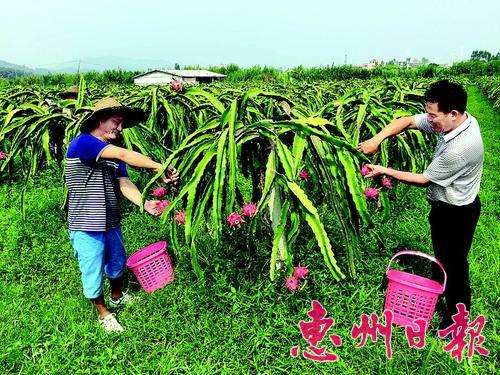
Zhang Yongxiang picking fruit (right).
Under the bright July sun, it is exactly the season for harvesting dragon fruit. In Ruhu Town, Huicheng District, grower Zhang Yongxiang has studied dragon fruit cultivation for nearly ten years, planting nearly 250 mu of dragon fruit across the Ruhu area, the Rengtu area, and Taimei Town in Boluo, making him a well-known large-scale dragon fruit grower in Huicheng District. Brilliant red fruits hang all over the branches, and Zhang Yongxiang is harvesting the sweetness of his hard work.
Daring to Think and Act, Returning to the Farmland to Start a Business
"My dragon fruit base yields up to 4,000 jin per mu at its highest. In the past two years, everyone says dragon fruit is hard to sell, but my fruit is of good quality -- even at 10 yuan per jin, it still sells out." The honest and straightforward Zhang Yongxiang is usually a man of few words, but when it comes to dragon fruit, he opens up.
Don't be fooled by the fact that Zhang Yongxiang has now built houses and bought a car thanks to dragon fruit. Over the years, as a true country boy who went out to "conquer the world," it was not easy.
More than 20 years ago, Zhang Yongxiang, having just graduated from high school, did not want to spend his whole life toiling in the fields like his parents, "face to the yellow earth and back to the sky." He had a gentle nature, but inside he was someone who dared to think and act.
For six or seven years after graduation, Zhang Yongxiang kept working with vehicles -- he repaired cars and also ran a passenger transport business. "In the late 1980s, there weren't that many cars on the road, so getting into the vehicle business was quite trendy at the time." Working from dawn to dusk, Zhang Yongxiang earned his first pot of gold in the "vehicle" business and opened a hardware store with his brothers in Xiaojinkou.
After years of making his way in the outside world, Zhang Yongxiang's horizons broadened. When he returned home and saw the family farmland, he thought about how to make these lands generate higher value. "Returning to the farmland," Zhang Yongxiang set up a flower and tree nursery in his hometown. Due to a lack of technical skills and excessive rain that year, his nursery was flooded, and his investment went down the drain.
But Zhang Yongxiang firmly believed that "there is a golden house in the fields" and wanted to achieve something in agriculture, so he tried planting lychees and longans.
Opportunity indeed favors the prepared. By chance, Zhang Yongxiang met an agronomist specializing in Taiwan dragon fruit. With guaranteed guidance on dragon fruit cultivation techniques, Zhang Yongxiang found his way into farming entrepreneurship.
Bitterly Cutting Down Low-Quality Seedlings, Buying New Ones at a High Price
Zhang Yongxiang invested 200,000 yuan to trial-plant 15 mu of dragon fruit, and recouped his investment the very next year after fruiting. Having tasted success, Zhang Yongxiang decided to continue with this fruit variety. But at this point, problems with dragon fruit cultivation also began to surface.
The dragon fruit from Zhang Yongxiang's first investment required manual pollination, and fruit cracking would occur whenever it rained, seriously affecting the taste of the dragon fruit. Zhang Yongxiang painfully cut down all 15 mu of dragon fruit and, with the financial support of his siblings, invested in a batch of new seedlings.
When choosing the seedlings, Zhang Yongxiang wavered between two types for some time: one type sold for 8 yuan per branch and required manual pollination; the other, imported seedlings, sold for as much as 100 yuan per branch but did not require manual pollination. Considering later management and fruit quality, Zhang Yongxiang gritted his teeth, increased his investment, and chose the imported seedlings -- and the result surprised him greatly.
The new seedlings did not require manual pollination, saving on labor costs; the new seedlings produced fruit that was crisp and sweet, cold-resistant, and could be stored for half a month after picking (ordinary ones could only last ten days), with a long fruiting period and strong disease resistance. "Many returning customers say my dragon fruit is 'the Guiwei of dragon fruit.'" Hearing consumers' praise, Zhang Yongxiang couldn't help but laugh out loud.
Applying for a Trademark to Strengthen Brand Influence
After years of operation, Zhang Yongxiang's dragon fruit base has grown larger and larger, with annual revenue exceeding one million yuan, and he has been invited multiple times to exhibit at the city's agricultural expo.
During this period, Zhang Yongxiang also continuously found ways to expand the scope of his business. Along Huimin Avenue, a dragon fruit picking sign stands out prominently. During picking season, wave after wave of tourists from the Pearl River Delta, Hong Kong, China, and Macao, China come to pick fruit, and box after box of dragon fruit is loaded onto tour buses. "Now, I work with travel agencies to boost sales volume and brand influence." Zhang Yongxiang applied for a trademark for his dragon fruit and established the Huizhou Shihong Dragon Fruit Farmers' Professional Cooperative.
He also set up a dragon fruit agritourism farm. "While picking fruit, everyone can enjoy authentic Ruhu farm dishes. Setting up a sand court and a lotus-viewing garden for leisure and entertainment is quite nice."