The Story of Yang Zhifen's Dream-Fulfilling Ecological Farm
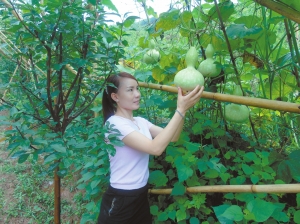
Yang Zhifen's leisure time at the ecological farm
"If you want something you've never had, you have to do something you've never done." This is the resounding vow that has always spurred Yang Zhifen on through her arduous entrepreneurial journey to success. It was precisely because of this vow that she steeled her resolve to return to her hometown to start a business, determined to give her hometown a new look.
Starting a market venture with 1,000 yuan
Behind every success lies untold hardship and sweat. In 2005, Yang Zhifen, a 21-year-old young woman from Shangcun Group, Shuidong Village, Xiangjiaba Town, Shuifu County, slung a bag over her shoulder, took the 1,000 yuan she had painstakingly saved, and reluctantly left her parents and hometown. Alone, she arrived in Shanghai, taking her first step as a migrant worker. At that time she was still a young girl, and facing this dazzling metropolis, she felt lost and helpless. After some wandering, she applied for a job as a sales assistant at a clothing store. After a year of tempering and having gained some clothing sales experience, she boldly borrowed 100,000 yuan from all her relatives and friends, rented a 30 sq m storefront, and began running her own clothing store. To keep the 100,000 yuan she had invested from going down the drain, she left early and returned late every day, toiling away at her business, sometimes so busy she could not even find time to eat. Imperceptibly, her weight dropped from 50 kg to 40 kg. She grew thinner, but the clothing store's business flourished. A year later, she used the money she earned to expand the storefront to 60 sq m. In this way, 6 years in the clothing business earned her more than 1 million yuan, but even more than that, it earned her the thinking and concepts of a coastal open city.
Returning home to fulfill her dream of building a farm
In the second half of 2011, Yang Zhifen transferred her hard-built clothing store, resolutely left Shanghai, and returned to her hometown Shuifu, which she had missed day and night. Back in Shuifu, while caring for her son, she invited a close friend, Sun Jieping, to jointly raise 400,000 yuan to take over a supermarket. Through their painstaking management and care, the supermarket's business grew better and better, and in just 3 years the two of them earned more than 2 million yuan.
Whenever Yang Zhifen returned to Shangcun Group, Shuidong Village, her hometown, and saw the picturesque Shangcun with its green mountains and clear waters alongside the worried faces of her impoverished fellow villagers, her homesickness welled up in her heart. How could she change the impoverished appearance of her hometown and stop her fellow villagers from living in poverty? Shuidong Shangcun is 9 km from Shuifu county town and 5 km from the Shuima Expressway exit. Shangcun is surrounded by green mountains, with babbling brooks, a beautiful environment, convenient transportation, and uniquely favorable natural conditions. All at once, the idea of returning home to establish an agricultural ecological park was born in her mind, to lead her fellow villagers out of poverty toward prosperity. This idea received strong support from the Party committee and government of Xiangjiaba Town, which helped coordinate and transfer land. Before long, Yang Zhifen registered and established Shuifu Huicheng Agriculture Co., Ltd., and invited several good friends to invest and develop ecological planting, breeding, winemaking, and sightseeing, tourism and leisure agriculture in Shangcun, building an ecological farm and forming a model of building a base through the farm, leading farming households through the base, and radiating to drive the development of the ecological farm economy for villagers in the village and surrounding areas, achieving harmonious development and shared prosperity of ecological, economic and social benefits.
At present, the agricultural farm has built a pure-grain distillery, a large-scale pig breeding facility, an ecological cattle farm, free-range native chickens under the forest, ecological duck raising, and ecological fish farming in the stream, and grows honey peaches, YinHong plums, kiwifruit and grapes. With the goal of realizing an ecological circular economy, the farm uses high-quality grain and high-quality mountain spring water to brew Longtan baijiu, uses the distiller's grains to make feed for cattle, pigs, chickens, ducks and fish, uses the manure of the farmed animals through septic tanks and other means to produce biogas and organic fertilizer under the forest, and provides breeding and planting techniques free of charge to surrounding farming households for scientific management and raising. At the same time, it develops catering, tourism and leisure projects such as fishing, a game-food restaurant and a tea house. In turn, tourism and leisure can absorb the farm's products and save a great deal of costs for picking, transport, sales and losses, so as to develop agriculture toward the catering, tourism and leisure industries, forming a grand cycle among industries, fundamentally solving the problem of selling agricultural products and maximizing benefits.
After more than a year of effort, to date a total of more than 6 million yuan has been invested, 500 mu of land has been transferred with a lease term of 20 years, benefiting more than 130 farming households and over 500 people. More than 300,000 yuan in land rent is paid to farming households each year, and more than 30 farmers are hired for long-term work, giving the people not only rental income from the land but also a stable income from work.
At present, the company has built an 800 sq m baijiu distillery with an annual output of more than 80 tonnes of baijiu and annual sales output value of more than 1.6 million yuan; a 1,500 sq m pig breeding facility with an annual slaughter of 1,200 pigs; terraced stream fish ponds of 3,000 sq m with an annual output of 7,500 kg of live-water fish; 200 mu of honey peaches planted; and a farmhouse leisure estate of more than 900 sq m, forming an ecological agricultural estate that integrates rural tourism, farmhouse dining, ecological planting and breeding, and entertainment, leisure and sightseeing.