The road of poverty alleviation and agricultural assistance of a fruit tree expert from Hebei
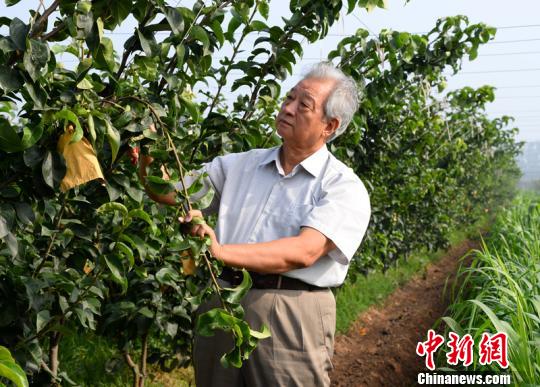
Qu Xianzhong inspecting the growth of fruit trees.
Although it was raining heavily, Qu Xianzhong still traveled by car to Wei County, Hebei Province, as usual. This time, he planned to stay here for more than ten days.
Qu Xianzhong is 71 years old this year and is a famous fruit tree expert in Hebei Province. Before retiring, he served as deputy director and inspector of the Hebei Provincial Forestry Department. In 2013, Qu Xianzhong, who had intended to spend his later years at home in comfort, came to Wei County, Hebei Province. He had not expected this place to become somewhere he could not bear to leave. He poured his lifetime of experience and effort in fruit tree cultivation into this place, leading local farmers to build pear orchards and plant pear trees. In 3 years, tens of thousands of mu of barren riverbank land were transformed into 68,000 mu of modern high-standard orchards.
A village made rich by pears
Wei County is under the administration of Xingtai City, Hebei Province, and is a national key county for poverty alleviation and development. Located in the southern part of the North China Plain, it belongs to an alluvial plain area formed by long-term flooding and siltation of the ancient Yellow River and ancient Zhang River, and is a typical agricultural county. The county has a large area of river wasteland, and the land is barren.
Yuanzhuang Village, Heying Town, is located on the bank of the West Sha River in Wei County, and is a poor village known far and near.
Village Party secretary Zheng Jikui said that most of the village's land is river beach land, seriously desertified, with poor water and fertilizer retention, and unsuitable for growing crops. Villagers used to rely on growing cotton to make a living, with an income of less than 1,000 yuan per mu. If costs and labor were included, they would even lose money.
According to Zheng Jikui, in the past, young people in the village could not endure a life of poverty and fled one after another to work in the city. The village's cultivated land was farmed only by elderly people, and some cultivated land had to be left fallow because there was really no one to farm it.
A local doggerel describes Yuanzhuang Village this way: "Honglongji Yuanzhuang has low-lying land, with two hundred and eighty bachelors. Girls from other places would rather rot into mud than marry into Yuanzhuang Honglongji."
Now, a beautiful scenic road links several large modern high-standard pear orchards and leads directly to Yuanzhuang Village. Driving on the highway, the vehicle seems to enter a sea of pear trees. The trees are covered with pears wrapped in paper bags, foretelling this autumn's harvest. Entering Yuanzhuang Village, the village roads are broad, and the roadsides are shaded by green trees. Guangheli, Fulai Lane... these street names all embody the villagers' hopes for a better life.
All of this comes from the village's pear industry. Through land transfer, dividend participation, and working in pear orchards, the villagers of Yuanzhuang Village have gradually become better off. At present, more than 20 households have bought apartments in the county town, and the village has gained more than 100 private cars. Yuanzhuang Village was also successfully selected as a "Beautiful Village" in Hebei Province.
When talking about pears, Zheng Jikui immediately became animated. "The pears produced in our village are 'parade pears'!"
Zheng Jikui said that on August 29, 2015, Wei County, as an old revolutionary base area, went to the Beijing parade village to console the officers and soldiers of the parade commemorating the 70th anniversary of the victory of the War of Resistance, and sent new varieties such as Xueqing pear and Qiuyue pear, all of which passed inspection by the food testing laboratory of the Chinese Armed Police Disease Control Center.
Life is getting better day by day, but in the hearts of Zheng Jikui and other villagers, what is unforgettable is Qu Xianzhong and his scientific research team, who led the villagers to plant pear trees.
An elderly man in his seventies in the pear orchard
Qu Xianzhong, already past seventy years old, is full of energy, tall and stalwart. Although his hair is completely silver, when he walks in the pear orchard, his steps are vigorous and he walks like the wind.
In September 2012, Qu Xianzhong came to Wei County as a special guest to attend the Hebei Province pear and fruit on-site exchange meeting. During the visit, he found that Wei County's soil, water quality, and climate were suitable for planting fruit trees. However, large tracts of land in the county were barren, and farmers planted only some cotton with extremely low returns, living in poverty.
Qu Xianzhong, wanting to put his "residual heat" to use, came to Wei County and became a senior consultant for local economic forests. However, although he had planned to stay here for one year, once he started, he worked for three years.
On January 4, 2013, Qu Xianzhong came to Wei County with simple luggage. On the day he arrived, Qu Xianzhong did not go to his residence to rest, but went directly to the bank of the West Sha River in the west of the county town to conduct on-site investigations and test the soil, water quality, and climate.
Through extensive research, he found that Wei County had a historical tradition of pear industry cultivation, and that the soil, water quality, and sunlight were all very suitable for growing pears. After investigation, the market prospects for pears were also becoming broader and broader, especially in the high-end market, where economic benefits were increasingly considerable.
In order to demonstrate the feasibility of growing pears, Qu Xianzhong visited many pear-producing areas in Hebei Province. Gaoyang, Shunping, Wei County, Xinji, Zhao County... Subsequently, he invited many domestic experts to conduct demonstrations. Finally, it was determined that a 100,000-mu pear industry belt would first be built in Wei County, combining afforestation with industrial development to achieve a "win-win" of ecological and economic benefits.
After research by Qu Xianzhong and many well-known fruit tree experts, and after comprehensively considering Wei County's soil conditions and international market factors, four main cultivars were established: Xueqing pear, Qiuyue pear, Xinli No. 7, and Hongxiangsu pear.
From then on, this elderly man in his seventies plunged into the pear orchard, pouring years of effort into this barren land.
A different kind of "consultant"
Starting in 2013, Qu Xianzhong, whose home is in Shijiazhuang, spent more than 300 days a year in Wei County. In Wei County, the place Qu Xianzhong visited most often was the pear orchard.
Walking in the orchard, Qu Xianzhong walked swiftly, often leaving the staff and his students far behind. Whenever he saw that fruit farmers were pruning or fertilizing in the wrong way, he would stop and teach the fruit farmers the correct methods hand by hand. In order to complete the pear orchard as soon as possible, he even went to inspect the construction of the pear orchard at 4 a.m. Stories like this happened every day, and the pear farmers also became familiar with his figure.
Qu Xianzhong's student Sun Shenghao said that in order to complete a high-standard orchard one day earlier, Qu Xianzhong raced against time every day.
In Wei County, Qu Xianzhong selected 10 mu of wasteland in a village as a test field. A villager jokingly said to Qu Xianzhong, "Old Qu, when can we eat pears?" Qu Xianzhong became anxious as soon as he heard it. "I'll let you eat pears this year!"
In order to save planting time, Qu Xianzhong broke conventional planting methods and adopted Hebei Duli for orchard establishment, planting in winter and grafting in March of the following year, completely breaking the previous production method of spring planting. Planting by this method not only gave a high survival rate for pear seedlings, but also advanced fruiting by one quarter. In the autumn of that same year, fruit was produced in Qu Xianzhong's 10-mu test field.
"At that time, the yield was 3,600 jin of pears per mu. When I called the villagers to eat pears, they could not believe it," Qu Xianzhong said.
In order to build a high-standard pear orchard, Wei County attracted investment and introduced a listed company to build a high-standard modern pear orchard. This company is a key leading enterprise in domestic agriculture and also an authority in the industry, but the design drawings for this company's pear orchard construction and pear tree planting were rejected outright by Qu Xianzhong from the very beginning.
"No matter how big the company is, building a pear orchard must conform to natural laws and adapt to local conditions," Qu Xianzhong said. After many meetings and discussions, Qu Xianzhong always insisted on his own views and pear orchard construction plan. After several days and nights of discussion, Qu Xianzhong did not yield an inch.
"In their plan, the tree pits were dug very narrow, and the fruit trees were headed at more than 80 cm. How could the saplings survive? The pear orchard is the hope for local prosperity, and no carelessness is allowed," Qu Xianzhong said.
In the end, Qu Xianzhong reached an agreement with the company: two-thirds of the pear orchard would be built according to Qu Xianzhong's method, and one-third of the pear orchard would be built according to the company's original method.
The company hired Japanese experts to build the pear orchard, and after the pear orchard was completed, the survival rate of pear trees in the pear orchard built according to Qu Xianzhong's method far exceeded that in the pear orchard built according to the company's original method.
According to Liu Mingliang, an agricultural technology extension researcher in Wei County, the company's Japanese experts were full of admiration after seeing Qu Xianzhong's pear tree cultivation method and acknowledged that they were inferior.
The students who had always followed him often urged him, saying that as a man of 70, he lacked neither food nor clothing, and the work of a consultant could have been very easy. What was he striving so hard for?
Qu Xianzhong never regarded himself as a consultant, nor did he regard pear tree cultivation as a job. The pear trees planted here were already the result of a lifetime of his experience and effort. The farmers here were all his friends, and helping them escape poverty and become rich had already become his heartfelt hope.
He already regarded the pear orchard as his hometown
Qu Xianzhong's home is in Shijiazhuang. His wife is in poor health, and he also has a 95-year-old mother in his hometown in Dingzhou. His little granddaughter in elementary school often talked with him on the phone because she missed her grandfather. He always said he would go back once he finished being busy, but he never had time.
During the day, Qu Xianzhong was busy doing experiments in the orchard and training fruit farmers. At night, he began sorting out materials, busy until late at night every day. "Get up at four o'clock, do not go home at noon, and keep working at night" was a true portrayal of his work.
The fruit farmers of Wei County all knew Qu Xianzhong's phone number and often called him for advice, and he patiently answered each one. Once, he received a call for help from a fruit farmer and immediately drove to the scene, but unexpectedly the car broke down halfway. He still walked more than ten li to reach the orchard and helped the fruit farmer solve the problem.
This elderly man always kept two "treasures" close at hand: one was a camera, and the other was a notebook. No matter where he went, he would photograph things he saw that were worth learning from, burn them onto CDs, and keep them for future research. When he encountered problems he could not solve, he would record them in his notebook and ponder them carefully after returning.
There was a cabinet in Qu Xianzhong's residence, and the cabinet was full of CDs he had burned in recent years. These CDs were also teaching tools he used. In Wei County, every time Qu Xianzhong gave a lecture, thousands of people attended, including farmers, technicians, and township officials.
At the 18th China Agricultural Products Trade Fair, the Xueqing pear grown under Qu Xianzhong's guidance won the title of "Pear King," and pears of other varieties also won multiple awards.
During the 2014 Spring Festival, Qu Xianzhong was hospitalized because of a stroke. After only 5 days, when his condition improved somewhat, he secretly slipped out of the hospital and went straight to the orchard. When others asked him when he would go home to enjoy his old age, he always said to wait a little longer, until the pear orchard was completed. In fact, in his heart, he had long regarded the pear orchard as his hometown.
In more than 3 years, Wei County has built 68,000 mu of high-standard pear orchards, involving 104 administrative villages in 7 townships and towns, introduced 35 leading enterprises such as Shaanxi Haisheng, Lipaier Technology, Hebei Qiuyue, Hebei Longji, and Hebei Guoli, established and improved 63 farmers' cooperatives, developed 13 large planting households, and built 136 standardized pear orchards. According to the plan, by 2020, the pear tree planting scale will reach 100,000 mu, pear fruit output will reach 264 million kg, fruit product output value will reach 1.8 billion yuan, foreign exchange earned by export will reach 48 million USD, and the per capita net income of farmers in the planned area will reach more than 10,000 yuan.