Why is Liu Zhifang's transformation story worth reading?
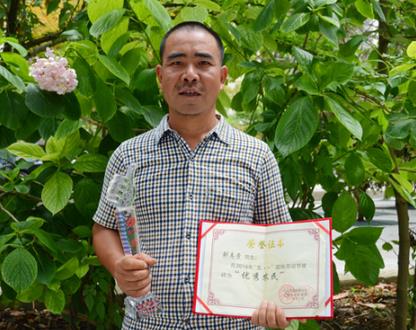
Yesterday's Liu Xiaozai, today's Boss Liu, tomorrow's "Liu Guangbiao" - this is the "transformation" story of an outstanding farmer.
He is very busy, going in and out of his own factory, and after being busy for a while he goes into his neighbors' homes to check on their progress toward prosperity. With a face full of beard and a humorous way of speaking, he is somewhat famous locally. His name is Liu Zhifang, a member of the Communist Party of China, 44 years old this year, head of the Xinqiao group of Linjiang Village, Jinhua Town, Fenggang County, and a true tea farmer.
When Liu Zhifang was a child, apart from herding cattle and gathering firewood each day, he spent all his time wandering idly around the village, and the villagers nicknamed him "Liu Xiaozai."
After marrying, Liu Zhifang became much more hardworking than before. Besides planting crops properly, he also carefully managed one mu of local tea on his private plot, and in the slack farming season he processed and sold the tea to supplement the family income.
The transformation from "Liu Xiaozai" to today's "Boss Liu" began in 2000.
In April 2000, with the spring plowing finished and nothing to do, Liu Zhifang went to browse the fresh tea leaf market in Yongxing Town in neighboring Meitan County. Seeing the bustling scene stirred his heart, and after returning home he discussed with his wife the idea of making something of his tea garden.
At first, having no money, he went again and again to the home of a large tea-growing household in Yongxing Town to buy tea seedlings on credit, picked up some tea-growing experience, and even made a special trip to a bookstore in the county town to buy professional books on tea cultivation. By day he worked busily in the tea garden, and by night he pored over his books. Gradually, a whole set of tea care techniques - weeding and loosening the soil, applying bud-promoting fertilizer, pruning, frost protection, clearing ditches and draining water, and pest control - became thoroughly familiar to him.
More than a year of painstaking effort was not wasted, and Liu Zhifang actually made a net profit of more than 1000 yuan. Growing tea was far more profitable than growing corn, so the next year he tried planting 7 mu. His tea garden grew promisingly, and his care techniques became even more advanced.
After the Fenggang County Party Committee and County Government introduced the strategy of "building an ecological homeland and developing green industries," Liu Zhifang's confidence in growing tea on a large scale was strengthened. He expanded from his original one mu of tea garden to more than 30 mu by 2008, with annual income reaching more than 50,000 yuan.
If he himself had become rich, he still had to let his neighbors become rich too. In order to strengthen the tea industry and lead the people to prosperity, Liu Zhifang wore his lips thin and ran his legs off. By day he worked on plans around the land, and by night he went to his neighbors' homes to talk heart to heart. Through countless days and nights, he mobilized villagers to grow tea and provided free technical assistance. Under his leadership and help, more than 70 households in Shuangqiao group now all grow tea, forming a contiguous tea garden of more than 700 mu. Villagers with little land even rented more than 20 mu of land in Yongxing Town to grow tea.
Zhang Wenquan's family of four was in particularly difficult economic circumstances and had no money to buy tea seedlings, so Liu Zhifang lent him 3000 yuan and encouraged him to grow tea. His wife worried that if Zhang Wenquan failed at tea growing, the money would not be repaid. He comforted his wife, saying: "Don't worry, believe that he will make money." Just after the spring tea season ended in 2007, Zhang Wenquan returned the money, thanking Liu Zhifang profusely.
As the tea industry developed, Liu Zhifang focused his energy on improving tea quality and building roads through the tea production area. However, some villagers were always unwilling to give up land or tea gardens for road construction. He mediated and did the work, and reluctantly gave up 3 mu of his own most carefully tended and most flourishing tea garden in exchange with the villagers. At that time, each mu of the exchanged 3 mu of tea garden brought in at least more than 3000 yuan a year, and over 10 years that would be more than 30,000 yuan.
In 2006, Jinhua Town developed a contiguous tea garden in Linjiang Village. On the recommendation of the village Party branch and village committee and with the support of the people, Liu Zhifang was elected head of the Xinqiao group, responsible for developing tea.
In order not to disappoint everyone's expectations, he led by example, planting tea on his own best soil and closest land. The villagers saw it and remembered it in their hearts. Just like that, that year the Xinqiao group added more than 120 mu of tea garden, completely beyond the expectations of the Party committee and government.
In early 2007, then Deputy Town Mayor Yang Yong said to Liu Zhifang: "Can the tea garden area of the Xinqiao group reach 500 mu this year?" "Rest assured, with me here, there should be no problem!" Liu Zhifang answered full of confidence. 2 excavators, 10 days, more than 300 mu - with courage and boldness, Liu Zhifang got it done.
Over several years, Liu Zhifang, as an experienced tea farmer, was invited by the county agriculture and animal husbandry bureau onto the podium to teach tea-growing techniques to the people through his own example, giving more than 130 on-site lectures (sessions). In 2008, as one of Fenggang's first batch of modern new-type farmers, he was selected by that bureau to receive special tea-growing training at Zunyi Agricultural School, becoming a true "local expert."
In August 2011, he was elected as a Party representative for the sixth term of Jinhua Town, and in December of the same year he was elected as a representative of the fifteenth People's Congress of Fenggang County.
At the end of 2011, he planned to process tea himself to increase the output value of the tea, and with a loan plus more than 300,000 yuan of his own funds, he set up a tea factory.
Speaking of his future plans, Liu Zhifang said happily: "I admire Chen Guangbiao the most. When I have money, I will be a philanthropist just like him."
In fact, Liu Zhifang really has done many good deeds, practical deeds and charitable deeds. Since becoming group head in 2006, he has secured 340 bags of fertilizer for the villagers, worth more than 30,000 yuan, while he himself took not a single bag; he secured more than 50,000 yuan in "Four in the Farm Home" renovation funds, while his own household used only 8 bags of cement; and in order to build an industrial road, he provided more than 7 mu of land free of charge to compensate the villagers whose land was occupied.
"Under Liu Zhifang's leadership, the people of the Xinqiao group have grown tea and become rich. They actively pay their rural cooperative medical fees, with a participation rate of 100%, and at the same time they are even more supportive of the village's public welfare undertakings," said Jia Yin, secretary of the Linjiang Village Party branch.
Today, Liu Zhifang helps neighboring farmers seek a path to prosperity while expanding the scale of his tea factory and founding the Fenggang County Fengxing Tea Factory, further strengthening its radiating and driving effect. He has become a locally well-known leader in helping farmers get rich.