They grow lotus roots, raise ducks and loaches in their lotus pond, earning hundreds of thousands a year
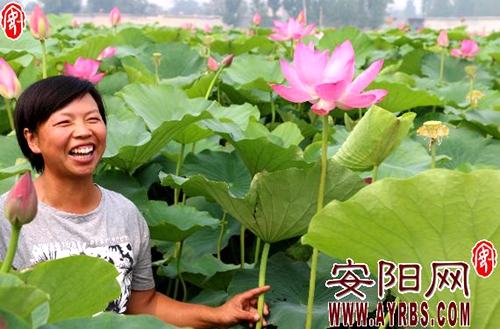
The 35-mu lotus pond in Sihe Village, Binjiang Community, Shuiye Town, Anyang County, Henan Province, has now become the treasure bowl of grower Gao Junqing. The lotus roots in their pond can be sold, as can the lotus seeds and lotus seedlings, loaches are raised under the water and ducks above it. "Don't underestimate my 35-mu lotus pond. One mu of lotus pond can earn 10,000 yuan." The hostess, Gao Junqing, said happily.
Lotus leaves stretch to the horizon in endless green, lotus flowers glow redder still in the sunlight. Walking into the Kenong Snow Lotus Plantation in Sihe Village, Binjiang Community, Shuiye Town, Anyang County, lotus flowers interweave with lotus seed pods and lotus leaves, and the croaking of frogs fills the lotus pond, presenting a beautiful midsummer scene. "Don't underestimate my 35-mu lotus pond. One mu of lotus pond can earn 10,000 yuan." The hostess, Gao Junqing, speaks frankly.
The lotus flowers stretching as far as the eye can see are in full bloom. Gao Junqing told the reporter that pink lotus flowers only produce lotus seeds and do not form lotus roots. The seeds can be eaten raw and are called fruit lotus. The flowers are many and the seed pods large, and both their ornamental and economic value are high. One mu of lotus pond can produce 6,000 to 7,000 lotus seed pods, and one seed pod can sell for 2 yuan.
Only under the white lotus flowers do lotus roots grow. The variety is Snow Lotus, and one mu of lotus pond yields an average of 2,000 kg of Snow Lotus. Calculated at 4 yuan per kg, selling the Snow Lotus alone brings in at least 8,000 yuan. "But we only sell lotus seedlings here, not lotus roots, and even then we can't keep up with demand." Gao Junqing said proudly.
Farmers who grow lotus roots all know that lotus roots are an above-water economy, while loaches are a below-water economy. The farmyard manure used for growing lotus roots releases microorganisms for the loaches to feed on, and the loach droppings in turn nourish the growth of the lotus roots, achieving two benefits at once. However, wild loach fry need a growth cycle of at least two years before they become marketable adult loaches, and because the wild living environment differs from the breeding environment, the survival rate drops and investment costs rise. Gao Junqing's husband, Niu Yunshu, after many years of practice, mastered the technique of artificially breeding loach fry: 1 kg of artificially bred loach fry, after a six-month growth period, can become 4 kg of adult loaches. Therefore, Niu Yunshu's artificially bred loach brood stock, adult loaches and artificial loach fry are in short supply, sold to Lianyungang in Jiangsu, Hangzhou in Zhejiang and other places.
At the Kenong Snow Lotus Plantation, besides the three-dimensional farming model of raising lotus and fish together, the reporter also saw a flock of ducklings beside the lotus pond. Niu Yunshu casually grabbed a handful of aquatic plants, and the flock of ducklings chased him to snatch the plants and eat them. At first, Niu Yunshu and his wife also worried about removing the duckweed from the lotus pond. If the duckweed was not cleaned up in time, it would not only affect water quality but also consume oxygen in the water, leaving the underwater area short of light and affecting lotus root yields. By chance, Gao Junqing discovered that the ducks raised by relatives were eating aquatic plants, so she bought 100 ducklings to raise. Unexpectedly, the method of raising ducks on duckweed not only solved the water pollution problem in the lotus pond, but the ducklings that ate duckweed also grew especially robust.
Now, seeing that Niu Yunshu and his wife's 35-mu lotus pond has become a "treasure bowl," the surrounding villagers also come to buy lotus seedlings and loach fry, driving farmers in Lunzhang Town, Shanying Town, Beiguo Township and other townships in Anyang County to develop 500 mu of lotus root planting. "Kenong Snow Lotus sends fragrance for ten li, Brother Niu's loaches fly out of the country." Talking about the future of the Kenong Snow Lotus Plantation, Gao Junqing takes a sip of tea brewed with lotus leaves and lotus flowers, sweetness in her heart.