Peach prices are twice the market rate; the secret lies in the fertilizer for the peach trees
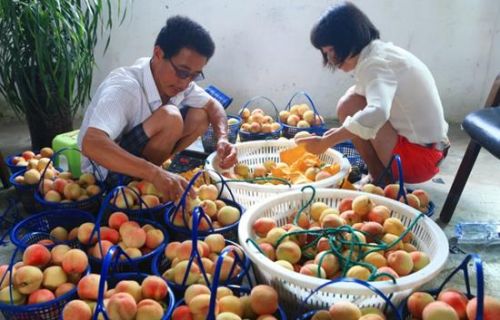
Since the start of summer, as large quantities of local fruit have hit the market, fruit prices have fallen accordingly. Yet the price of the "Honey Peach" grown by Lin Jianfa, head of the Dinghai District Haixue Angora Rabbit Breeding Professional Cooperative located in Ma'ao Subdistrict, is a full twice as expensive as the market price, and it still sells faster than it can be supplied. Just why is that?
Recently, the reporter came to this professional cooperative, where Lin Jianfa and his wife were busy sorting and basketing freshly picked "Honey Peaches." These "Honey Peaches" were uniform in size, yellow with a blush of red, plump and enticing. Lin Jianfa told the reporter that these peaches had all been reserved by customers, and that with the weather so hot now, they could not even pick them fast enough.
"Peaches on the market sell for 5 yuan a jin, so why do you sell yours for 10 yuan a jin?" the reporter asked. Lin Jianfa smiled without answering, and pulling the reporter along, headed toward his Angora rabbit breeding shed. Once there, he pushed out a small cart, picked up a shovel, and loaded onto it the rabbit manure the workers had swept up. Waving the shovel, he said to the reporter, "This is my magic weapon. Don't underestimate this manure; once it goes into the ground, it turns into treasure."
Lin Jianfa explained that this rabbit manure must be fermented for more than 20 days before it can be used. Rabbit manure is a highly efficient, high-quality organic fertilizer; its content of elements such as nitrogen and phosphorus is higher than that of other livestock manure, and it is easily absorbed and used by plants. A single adult rabbit can produce about 100 kg of manure a year, and the manure from 10 adult rabbits is equivalent to the manure output of one pig, while his farm has more than 2,000 Angora rabbits. "In the past, this manure was all sold elsewhere, and regular customers would come to collect it, mainly growers from Shaoxing and Xinchang," Lin Jianfa said. He recounted that once, when he visited the home of fruit growers elsewhere, he found that these growers all operated on a large scale, and the fruit they grew tasted especially good, which sparked the idea of using rabbit manure as fertilizer to grow fruit.
In 2014, Lin Jianfa contracted more than 30 mu of land next to the Angora rabbit farm and began growing peaches, loquats, pears and other fruits. After this year's first batch of "Honey Peaches" ripened, he invited villagers to come and taste them, and the villagers praised his peaches without end. The villagers' praise gave Lin Jianfa confidence, and this year's "Honey Peaches" also sold faster than they could be supplied. He plans to add more varieties and expand the planting area. "In recent years, Ma'ao has been building a base for fruit-picking tours, and there are many fruit-picking orchards around us too. I hope to use fruit grown with rabbit manure as fertilizer to play my own distinctive card," Lin Jianfa said, beaming with delight as he looked forward to a bright future.