Farmers moving to cities gain ten policy guarantees - will housing prices really rise?
Recently, the State Council issued the "Notice on Implementing Several Fiscal Policies to Support the Citizenization of Agricultural Transfer Population," proposing ten specific policy measures to fundamentally resolve the various worries farmers have about buying homes after moving to cities. As soon as the news came out, the real estate market was abuzz again - are housing prices going to rise?
Ten policies let farmers move to cities without worry
In the citizenization of agricultural transfer population, the bottlenecks that have stood out in practice in recent years are shown in the low proportion of those who settle in cities and become urban citizens, while those transfer population who enter cities as migrant workers also lack institutional acceptance.
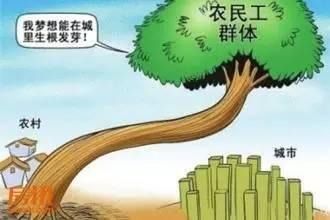
Many previous news reports have covered this, for example, regarding the enrollment of children of rural transfer population in kindergartens and schools. The vast majority of migrant workers' children can only enter unlicensed "black childcare" facilities, and then when it comes time for primary school they have no choice but to return to their place of origin. The occurrence of such things is due to the lack of relevant fiscal fund arrangements, so the schooling needs of this group cannot be resolved, and if they cannot be resolved, these people cannot be allowed to settle down in the city with peace of mind.
In addition, there are basic guarantees closely related to people's livelihood such as medical treatment and healthcare. If these problems cannot be solved, the rural transfer population cannot be treated equally in the city and cannot settle down there with peace of mind.
The recent introduction of ten policies provides solutions to these problems at a deep level. The "Notice" proposed ten specific policy measures in total, covering the children's education of agricultural transfer population, medical care, training for the unemployed, and the provision of basic public services to people who have obtained residence permits.
The "Notice" not only clearly proposes solutions to issues such as schooling for children, medical care and social insurance after farmers move to cities, but also gives clear provisions on employment support. After all, only by letting farmers who move to cities have stable employment, and obtaining relevant training sufficient for stable employment, can there be a home where there is work.
Relevant experts believe that if farmers entering small cities cannot find stable employment, then they will certainly not dare to make the major decision to settle in the city. To solve this problem, on the one hand, local economic development is needed, and through industrial transfer or attracting investment, local industries can be developed.
On the other hand, by letting more farmers enter cities, if the urban population scale grows and expands, then local demand for the service industry and local industry development will also arise. In this way, finding a stable job for farmers in the city forms a relatively favorable condition, and a virtuous cycle can be formed.
Land rights not being deprived makes farmers willing to enter cities
Previously, many farmers did not dare to enter cities, and were unwilling to enter cities. Besides the fact that many public services in the city were not provided to farmers, the biggest worry after entering the city was whether, after switching to an urban household registration, they would be forced to have those original rights of farmers taken away.
Several years ago, a nationwide research report pointed out that 84% of farmers hoped to still retain contracted land after settling in cities, while 67% of migrant workers hoped to retain their homestead land. It can be seen that land rights not being deprived was the foundation for persuading more farmers to enter cities and safeguarding the rights of farmers who enter cities.
This document truly gave farmers a "reassurance pill" for citizenization. The "Notice" clearly states that it will "safeguard the land contracting rights, homestead use rights, and collective income distribution rights of farmers who settle in cities." This means that after farmers enter cities and become urban citizens, their original property rights remain unchanged, and this point has steadied people's hearts.
Relevant experts believe that "there are many reasons why many farmers do not dare to enter cities and are unwilling to enter cities. One is that many public services in the city are not provided to them, and their biggest worry is whether after switching to an urban household registration, they will be forced to have those rights taken away. Now the State Council document clearly tells them that they will not be taken away, and that rights will be safeguarded. Undoubtedly, this makes farmers' entry into cities more secure and more reassuring."
How big is the housing demand market behind this
As far as the real estate market is concerned, for the citizenization of farmers, housing is the primary need. After all, only after settling down can one establish a career. How big is the housing demand market for farmers becoming urban citizens?
The "China Housing Development Report 2015-2016" estimates that based on 100 million people urbanizing in the next 5 years, if 70% of household members buy homes in cities and towns (33.3 sq m per capita), the annual housing demand mainly from migrant workers can reach 460 million sq m, totaling 2.33 billion sq m over the next 5 years. It can be seen that the demand for housing in the citizenization of farmers is indeed very large.
However, for farmers to enter cities and buy homes to achieve citizenization is not something that can be solved by one policy alone. It requires the further implementation of multiple supporting policies so that farmers' rights and interests and their lives after entering cities are truly guaranteed in all respects.
Migrant workers entering cities may become the main force in future home purchases
Regarding the introduction of the State Council's ten latest policies, Zhang Xin of a sector institution believes that the main benefits are in two major aspects.
From the perspective of the national economy, compared with other developed countries, China's current urbanization rate of about 50% still has room to rise by about 20%. Once this 20% of the rural population can be promoted to enter cities and settle down, bid farewell to a self-sufficient life, take root in cities, find employment, consume, and enter the secondary and tertiary industries, it will produce major benefits and impetus for the national economy.
In addition, for the real estate industry, against the background of destocking, how to promote farmers to enter cities and buy homes has become the ultimate goal. The latest policies introduced this time provide clear guarantees for the employment and income issues that farmers care about most, social insurance and pension issues, supporting issues such as medical care and education, as well as land rights issues.
Once these resistances are removed, it is believed that a large number of farmers will be willing to enter cities and buy homes in the future, but whether they can afford them will become another threshold. Under such comprehensive factors, some rural household registration personnel who have already entered cities to work and have income as a foundation may become the target customer group that the housing market will need to absorb in the coming years.
Shen Guangming, chairman of Chongqing Youdimei Marketing Agency, believes there will be certain benefits, but it will not be a very big stimulus point. He said that in fact, for rural household registration population with ability and strength, buying homes in cities is already nothing rare. In some currently selling projects in Chongqing, homebuyers with rural household registration can even reach 30-40%.
(The images in this article are all from the internet. If there is any copyright issue, please contact us as the author.)