Henan woman who built a fake city government has been released from prison
A rural woman built a fake "city government" to defend her rights, appointed several "people's representatives," made "official seals," and even openly recruited "civil servants" from society; several university students sent in their resumes...
Even now, after she has served her sentence and been released, villagers occasionally still come to her for help defending their rights. They still believe that "Zhang Haixin has connections in the central government" and that "the seals are useful," and they feel she was wrongly imprisoned.
(For more news, please search "The Beijing News" on WeChat and follow The Beijing News WeChat official account)
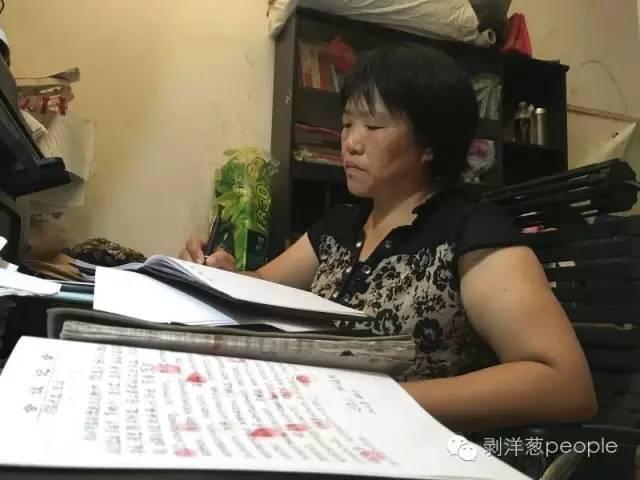
▲Zhang Haixin writing materials in her "office." Photo by Tang Ailin, The Beijing News reporter
The rented room of 48-year-old rural woman Zhang Haixin is located in an alley in Dengzhou city, Henan province.
This is a storefront room of about 40 sq m. A grease-stained hot water kettle and a rice cooker are scattered atop a discarded freezer; the peeling walls show a grayish-yellow like water stains; hanging on the wall is a map of Henan province that has yellowed with age.
This is the home of Zhang Haixin's family of five, and also the storefront for her dried fruit and candy wholesale business.
It was also here that, 3 years ago, Zhang Haixin, who had been petitioning for years over a land dispute, announced the establishment of the "Dengzhou City People's Government," under which three township "governments" were tentatively set up, each with its own "official seal" carved, and she wrote and issued more than 20 documents, official letters, and appointment notices stamped with the "Dengzhou City People's Government Seal."
The targets of the "government's" services were all farmers petitioning over land issues, just like Zhang Haixin.
The "fake people's government" not only existed for several months, but also openly recruited "civil servants" from society, and several university students sent in their resumes.
Because she issued a "work suspension official letter" to a developer and was exposed by the latter, in November 2013, Zhang Haixin and others were criminally detained by the Dengzhou City Public Security Bureau, and later, for the crime of forging official documents of a state organ, Zhang Haixin was sentenced to a fixed-term imprisonment of two years.
On November 28, 2015, Zhang Haixin was released from prison.
In the more than half a year since regaining her freedom, she has continued to write petition materials over the land disputes of farmers who lost their land; she admits all the facts she was accused of, but does not plead guilty. Zhang Haixin believes that forging official documents was a helpless move to protect farmers' farmland from being seized.
This slightly dark-skinned, short and stout rural woman often gets agitated, her voice rising unconsciously; she frequently has words like "representative" and "the people" on her lips; when speaking of "corrupt officials" and "corruption," she will curse, or become so angry she cannot continue.
In the view of defense lawyer Gao Chengcai, Zhang Haixin firmly believes in the law, "but only understands a certain part of the law."
This is the weapon of self-recognition for rural woman Zhang Haixin, and also the source of her tragedy.
The world has changed
After serving two years in prison, Zhang Haixin's world had already changed.
During her imprisonment, her eldest son Wu Yang took on the task of caring for his 10-year-old younger brother, and because of this, he and his girlfriend of 2 years broke up unhappily; her daughter Wu Nan, who had originally been in her first year of university, dropped out and returned home under financial pressure, "the family felt like they had lost their souls."
"Everything is gone," Zhang Haixin feels she has dragged her family down badly. Zhang Haixin, who dropped out of school in the fourth grade of primary school, had always hoped her children could attend university.
▲Items are placed messily in Zhang Haixin's rented room, which is also where her "office" is located. Photo by Tang Ailin, The Beijing News reporter
Being sentenced also reduced her prestige among the villagers: many villagers began to keep their distance from Zhang Haixin, doubting whether she really had connections in the central government. They felt she could only write materials and mail them upward, and had solved nothing at all.
(For more news, please search "The Beijing News" on WeChat and follow The Beijing News WeChat official account)
4 months ago, when villagers came to her to raise issues, she convened the first "Jiangzhuang Collective Economic Organization" meeting since her release from prison, with only about 20 people attending - the smallest turnout ever; of the five representatives she had previously appointed, only two attended.
The "Jiangzhuang Collective Economic Organization" was an "organization" established by Zhang Haixin before her imprisonment for the purpose of land confirmation.
Zhang Haixin's loyal follower Ma Xianglan, who was imprisoned in the same case, complained to Zhang Haixin, "You have no prestige left at all."
Zhang Haixin did not feel disappointed, believing this was due to "farmers' weak legal awareness."
Former village party secretary Wu Zhende, who had a debt dispute with Zhang Haixin, spoke of her with disdain, "Didn't she build her own government? She was even sentenced; who still believes her?"
Wu Zhende believes Zhang Haixin "has mental problems."
Now, villagers from Jiangzhuang Group Six occasionally still come to Zhang Haixin for help defending their rights. They still believe that "Zhang Haixin has connections in the central government" and that "the seals are useful," and they feel she was wrongly imprisoned.
They are mostly farmers who have petitioned for many years or are unfamiliar with the petition process.
After Zhang Haixin completed her sentence and was released, villagers complained to her: "When you weren't here, no one cared about defending rights; others can't speak and can't write."
On the evening of July 27, villager Chen Fuzhi from Jiangzhuang Group Six in Dengzhou came to Zhang Haixin's rented room. Her family's 5 mu of peanut field had been requisitioned, and after negotiations with the village came to nothing, she asked Zhang Haixin to help defend her rights.
After listening to Chen Fuzhi's account, Zhang Haixin said firmly: "I have already reported it to the central government."
In fact, Zhang Haixin had only mailed Chen Fuzhi's petition materials to Beijing.
After hearing this, Chen Fuzhi said, "Then let's wait a bit longer."
Representative
Before the matter of forging official documents of a state organ, Zhang Haixin was just an ordinary rural woman.
She was born in Jiangzhuang village, Dengzhou city, the fourth of 7 children. Her family was so poor they had only a few beds, and all year round they never ate fine grains.
Because she could not afford school fees, Zhang Haixin dropped out in the fourth grade of primary school.
In 1987, Zhang Haixin married her husband Wu Zhentian. They successively ran a small millstone sesame oil workshop and a restaurant. In 1996, her husband went south to Guangdong to work, and for nearly 20 years, he rarely came home.
In the eyes of the villagers and her daughter, Zhang Haixin is strong-willed and fierce. After her husband went south, Zhang Haixin opened a restaurant by herself at the edge of the village, serving hu la tang (spicy pepper soup), fried dough sticks, steamed buns, home-style dishes, and more. The restaurant was beside Provincial Highway 249; she alone bought supplies, cooked, and received drivers from all over.
When the village committee at the time came to eat, they often ran up a tab.
Zhang Haixin went to village party secretary Wu Zhende to collect the debt, but could not get it back. So, when the village was building a road and reached the entrance of her home, she blocked the workers from starting work, demanding "pay back the meal money first, then build the road."
This matter made the villagers feel that Zhang Haixin "does not fear power."
▲Zhang Haixin often reads and studies. Photo by Tang Ailin, The Beijing News reporter
In September 2007, in order to supervise her daughter's studies while she attended school in Dengzhou city, Zhang Haixin closed the restaurant and moved the whole family to Dengzhou city. She found a rented room in an alley and began selling dried fruit and candy from a stall.
A land dispute in the village changed Zhang Haixin's fate.
Jiangzhuang village Group Six, where Zhang Haixin belongs, had 8 mu of land that was originally a pig farm. In 2009, the village allocated it to a villager surnamed Wu from Group Five to build a factory in order to repay the village committee's external debt.
Group Six villagers believed this 8 mu of land was the collective land of their group and had only been lent to the village for pig farming, while the village committee insisted it was village collective land and that there was no problem now in giving it to the Wu family to build a factory. The two sides argued without resolution.
The Group Six villagers hoped to find someone to lead them in lodging complaints, and they quickly thought of Zhang Haixin, a Group Six villager who was "capable" and lived in the city.
On an afternoon in the spring of 2009, villagers from Jiangzhuang village Group Six came to the county town to ask Zhang Haixin for help.
That afternoon, Zhang Haixin agreed to act as a representative and "fight the village committee to the end." After seeing the villagers off, she turned around and went to the Xinhua Bookstore to buy a copy of the "Regulations on Letters and Visits" and began studying it on her own.
Starting in April 2009, she led Group Six villagers to petition in Dengzhou, Zhengzhou, and Beijing, among other places.
Villager Chen Fuzhi said that every time they went to Beijing to petition, the ticket money, food, and lodging expenses were all paid by Zhang Haixin. As a result, Zhang Haixin's family fell deeply into debt, owing more than 200,000 yuan before she was imprisoned.
After the petitions, construction on the 8 mu of pig farm land never began, and Zhang Haixin established prestige among the Group Six villagers. The villagers felt Zhang Haixin was very impressive - articulate, fierce, loud-voiced, and able to find her way in Beijing.
(For more news, please search "The Beijing News" on WeChat and follow The Beijing News WeChat official account)
"Organization"
Afterward, it was not just the pig farm matter; villagers with other land disputes also came to her, and even some trivial family matters.
Zhang Haixin never refused anyone. She gradually stopped doing housework and selling dried fruit and candy; in those years, the rented room in the Dengzhou alley was like a busy market, receiving more than ten people a day at most, "never stopping for a single day."
Jiangzhuang is about 20 km from Dengzhou, with more than 4,000 people in the whole village. Most of the men go out to work, while the women stay in the village, taking on farm work and caring for the old and young. Most of them had only a few years of schooling, and when they encountered land disputes, most did not know how to handle them; many did not even know where to go to petition.
In September 2011, Zhang Haixin held a villagers' group meeting on the disputed 8 mu of land in Jiangzhuang village, proposing the establishment of the "People's Republic of China Jiang Collective Economic Organization."
This was an "organization" aimed at land confirmation. Because the petition process only allowed 5 people to act as representatives, the "organization" set up 5 representatives. The villagers elected her as "group leader." Within the "organization," a one-vote veto system was implemented, and meetings handled matters one by one.
Zhang Haixin recalled that at the time, this "organization" was quite large, with about 50-60 members, most of them women from Group Six, mostly aged between 40 and 70.
According to Zhang Haixin's account, she intended to use this organization to bypass the Jiangzhuang village committee in order to carry out land confirmation.
Land confirmation requires seals and approval from township, county, and city-level departments. After years of petitions, they had still not been able to get the seals.
One day in October 2011, Zhang Haixin returned from petitioning in Beijing with a seal, engraved with "Special Seal of the People's Republic of China Jiang Collective Economic Organization."
It was a round seal the diameter of the bottom of a water glass, with a red handle and gold characters. Zhang Haixin told the villagers, "This was given by the central government, it has been filed, and with this seal, we can confirm the land to households."
The villagers were filled with awe toward this golden seal.
Zhang Haixin also cherished the seal greatly: afraid that the heavy materials in her bag would crush the seal, Zhang Haixin never put the seal in her bag; even though it was wrapped in several layers of paper, when riding in a vehicle, Zhang Haixin still held the seal in her hand. "What if a character falls off."
"Absolutely do not do anything illegal," 66-year-old rights-defense partner Liu Jinlan said to Zhang Haixin when she saw Zhang Haixin take out the seal.
Zhang Haixin assured her: "I know."
▲After release from prison, close friend Liu Jinlan said to Zhang Haixin, "In the future, absolutely do not do anything illegal again." Photo by Tang Ailin, The Beijing News reporter
Four years later, Zhang Haixin said that the seal was carved at a street stall in Beijing, and "filed" meant that she had submitted petition materials to the petition office of the Central Commission for Discipline Inspection. "Jiang" was the abbreviation of "Jiangzhuang."
Under Zhang Haixin's guidance, from the second half of 2012 to the summer of 2013, the "collective economic organization" model was also copied to two other townships, and Ma Xianglan and Wang Liangshuang were respectively "appointed" as "people's representatives" of Jitan town and Gaoji township.
(For more news, please search "The Beijing News" on WeChat and follow The Beijing News WeChat official account)
At the same time, the news that Zhang Haixin "had connections in the central government" spread quickly through the village, and there were even rumors that she could connect with the United Nations.
Zhang Haixin once convened a meeting of Group Six villagers. The meeting record shows that on June 20, 2013, they met at the "northeast corner of the pig farm," and the speech content stated:The village land confirmation case was sent to the "United Nations Morning Post," exposing the criminal facts of corrupt elements.
In fact, the "United Nations Morning Post" was Lianhe Zaobao, and she had only added some materials to the reporting section of the Lianhe Zaobao website.
"Lianhe Zaobao certainly has a connection with the United Nations, otherwise how would it dare to be called 'Lianhe'?"
Seal
One thing led to another, and from street stall small advertisement booths, Zhang Haixin successively carved more than a dozen township and city-level seals, including the "Dengzhou City People's Government Seal."
In 2013, Zhang Haixin announced the establishment of the "Dengzhou City People's Government" in her rented room.
The "organization" quickly issued a construction suspension notice to the Wu family, who were building a house on the pig farm - ordering them to immediately stop the illegal act and await handling.
The "organization" also issued construction suspension notices to other villagers who were building houses in violation of regulations. Many villagers asked Zhang Haixin to intercede, and some even came to visit with fruit.
During several months of "office work," she accepted contract certificate application materials from a total of 274 farming households in Wenqu township, Gaoji township, and Jitan town.
"The government believes in seals, and I believe in seals too." In Zhang Haixin's understanding, "a seal is the mark of a unit, meaning legal responsibility and standardization."
Zhang Haixin's understanding of the important role of seals can be traced back to 2005, when she registered her daughter's household registration.
Her daughter was a child born in violation of the family planning policy. Without the seal of the police station, she could not be registered. That was the first time Zhang Haixin realized the importance of an official seal: "It works."
Several years later, when Zhang Haixin took a fully completed land confirmation application form to the petition office of the Ministry of Agriculture, she was once again reminded: without the seals of the township, town, and city governments, it would not be accepted.
Zhang Haixin's obsession with seals is also reflected in the book "Special Textbook for Henan Province Civil Servant Recruitment Examination: Public Basic Knowledge." She only did the after-class exercises about "official seals and official documents."
In the section "Official Documents and Official Seals," one multiple-choice question was:
The marks on an official document that can verify the author's legality, authenticity, and the document's validity are:
A Document header B Issuer C Seal D Signature
Zhang Haixin had done this question before. When the reporter asked again, she chose issuer and seal. After learning that the correct answer was seal and signature, Zhang Haixin asked what "signature" was, "We only stamp seals, not sign names."
▲The "Special Seal of the People's Republic of China Jiang Collective Economic Organization" carved by Zhang Haixin. Photo by Tang Ailin, The Beijing News reporter
In November 2013, the "Jitan Town People's Representative" Ma Xianglan, whom she had appointed, issued a "work suspension official letter" to the developer of a project, was exposed by the latter, and the latter reported the case. Ma Xianglan was arrested.
Three days later, Zhang Haixin held an emergency meeting in the rented room to discuss a plan to rescue Ma Xianglan. Law enforcement personnel arrived and took away Zhang Haixin and Wang Liangshuang, the "person in charge" of Gaoji township whom she had appointed. The police seized more than a dozen seals and various documents, filling a van.
(For more news, please search "The Beijing News" on WeChat and follow The Beijing News WeChat official account)
Serving the sentence
At trial, Zhang Haixin admitted all the facts but did not plead guilty. She believed that forging official documents was a helpless move to protect farmers' farmland from being seized."Serving the people, what crime have I committed?"
In the view of defense lawyer Gao Chengcai, Zhang Haixin firmly believes in the law, "but only understands a certain part of the law." Carrying the banners she had learned, such as "democracy and self-determination," "serve the people," and "power comes from the people," she "defended" herself.
Liu Jinlan was also sitting below. Seeing Zhang Haixin in handcuffs, she could not help but shed tears: "Everyone believed her and counted on her, who could have thought she would go in." Liu Jinlan knew Zhang Haixin usually read law books, and had not expected her to make such a "low-level mistake."
For the crime of forging official documents, Zhang Haixin was sentenced to 2 years, while Ma Xianglan and Wang Liangshuang received sentences of 10 months and 8 months respectively.
Wang Liangshuang recalled that during a trial recess, Zhang Haixin once sighed with emotion: if they had not issued the construction suspension notice, perhaps they would not have stirred up all this trouble.
Prison life became a brief pause in Zhang Haixin's life, and even became a life she now misses.
"If only I had come to serve two years in prison earlier." For Zhang Haixin, prison was like a good university. The police officers there were highly competent. They worked diligently; when it snowed in winter, they laid anti-slip straw mats on the roads; in summer, soaked with sweat, they still held their posts; whenever there was a conflict, the officers patiently guided them.
In prison, an officer jokingly called her "hero" using an online term; the district chief of the prison area celebrated a birthday for Zhang Haixin, and she saw the largest cake she had ever seen up to then. More than 400 trainees were gathered in the meeting room, and on the cake were written the words "Happy Birthday."
The district chief of the prison area asked Zhang Haixin: Today is your birthday, are you happy?
This moved Zhang Haixin very much. She was stunned for a moment: Happy.
Afterward, Zhang Haixin wrote two articles recalling this birthday: "A Meaningful Birthday" and "An Unforgettable Birthday."
On July 1, the founding day of the Party, the prison organized the trainees to watch CCTV news for a whole day. Zhang Haixin was somewhat excited; she saw that the Communist Party "serves the people wholeheartedly."
She compared herself with the figures in the news. Zhang Haixin, who had once submitted an application to join the Party, began to lose a bit of confidence, "After going out, I am no longer qualified to join the Party."
In prison, she also figured out that on the seal "Special Seal of the People's Republic of China Jiang Collective Economic Organization," she should not have abbreviated Jiangzhuang as "Jiang," because it was "the Jiang of old Chiang; adding the character 'zhuang' would have been better."
▲The official letter Zhang Haixin sent to Jiangzhuang villager Wu Jiamin in the name of the "Collective Economic Organization." Image from the internet
"To the point of madness"
In recent days, her daughter Wu Nan has been expressing her protest to Zhang Haixin by refusing to eat. Wu Nan once dreamed that after her mother was released from prison, she would stop petitioning and the family could "live a good life."
To pursue her petitions, the family has already gone more than 200,000 yuan into debt. They have owed 5 years of rent; because of photocopying materials, they owe the copy shop tens of thousands of yuan.
But in Zhang Haixin's vision, the "Jiangzhuang Collective Economic Organization" will continue to exist forever.
A month ago, Zhang Haixin sent petition materials to six central ministries and commissions, demanding the "return to the people" of 5 seals including the "Special Seal of the Jiang Collective Economic Organization of the People's Republic of China" and the "Seal of the Wenqu Township People's Government." She firmly believes that these seals are all "real and useful."
This time, however, she did not apply to get back the "Dengzhou Municipal People's Government Seal"; she plans to work only at the township level.
At the same time, she is thinking about finding a "successor." She hopes the "successor" will be male, have appeal, be able to speak and write, get things done quickly, have good character, and withstand tests. Most importantly, this person must "listen to me, I lead him."
Another thing that fills Zhang Haixin with confidence is that after her release from prison, she obtained the government approval for the land of that 8-mu pig farm. The document is titled "Decision of the Dengzhou Municipal People's Government on the Handling of Land Ownership."
The decision states: ownership of the disputed land (the pig farm) belongs collectively to the villagers of Jiangzhuang Group 6. The seal is "Dengzhou Municipal People's Government."
This is the approval that Zhang Haixin led the villagers to fight for from the very beginning, and it is also the reason Zhang Haixin was drawn into the dispute.
"If I had gotten it earlier, I wouldn't have ended up in prison." Holding this document, she cried all the way home.
But Zhang Haixin said the village committee has never implemented the decision. She is determined to fight for her rights to the very end.
Wu Nan erupts into fierce quarrels with her mother from time to time. "Stop suing. If you sue again, I'll burn your materials for you." She feels her mother has reached a "crazy point."
She and her brother take turns watching their mother at home every day, to prevent "more trouble."
In between quarrels, Wu Nan misses the bygone year of 2009: her mother pulling a wooden cart and selling candied dried fruit at a stall at the entrance of the rented alley. After school, she could eat the meals her mother had prepared, and life "had promise, had drive."
Coming out of Zhang Haixin's rented room, walking through a long, narrow alley to the main road, the diagonally opposite corner of the intersection is the Dengzhou Municipal People's Government. It is only 200 m from Zhang Haixin's rented room.
On July 29, Zhang Haixin walked the reporter to the roadside. Pointing at the government building, she said: "That one, that is the Dengzhou Municipal People's Government."
The Beijing News reporter Tang Ailin, editor Su Xiaoming, proofreader Guo Liqin
(For more news, please search "The Beijing News" on WeChat and follow The Beijing News WeChat official account)
Part of this article was first published in The Beijing News official account "Peeling the Onion people"
Unauthorized reproduction and use are prohibited,
Sharing to Moments is welcome.