Want to start a business and get rich? First understand this key issue
Ever since "entrepreneurship" and "innovation" were written into the government work report, countless grassroots entrepreneurs with dreams in their hearts have begun to feel ambitious and eager to try. Makers, incubators, Internet Plus, makerspaces, and angel investment have also become buzzwords of the era. So then,what exactly is a makerspace? Against the backdrop of the new economic normal, what value lowlands worth starting businesses in also exist in the vast countryside?Today, the editor will bring you into focus on "Incubators and makerspaces”。
What are incubators and makerspaces?
When many young people in first-tier cities work on startup projects, they casually say they want to move into a makerspace or set up a startup incubator. You may ask, what do these mean? They sound especially mysterious, but in fact, they are just aplace that can better help us start businesses。
Let's inviteZhang Hui, practical talent mentor for rural projects at the Ministry of Agricultureto introduce it to us.
"What isa makerspace? Zhong means the masses, chuang means innovation and entrepreneurship, and kongjian means a place, a building, so a makerspace refers toplaces provided by some government bodies, relevant departments, and social organizations for mass innovation. This is a very intuitive understanding.
In fact, the makerspace is also a concept created in response to the call for mass entrepreneurship and innovation by all. Of course, a makerspace is not necessarily an actual place or building; it can also be avirtual space. For example, Weibo or WeChat can also be used to launch a discussion area, or a website can be used to provide a communication platform for friends with innovative and entrepreneurial ideas. This kind of makerspace also exists widely.
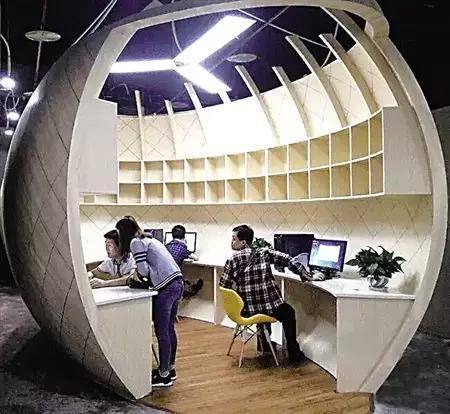
Incubators and makerspaces are somewhat similar. An incubator is often also a physical space, such as a very large park or a very large factory building. It prepares all kinds of corresponding supporting facilities for you. If your small or medium-sized enterprise or agricultural project wants to enter, you do not need to specially build a park, build greenhouses, or buy agricultural machinery. It has all of this ready for you. You only need to rent a piece of land in its park, a factory building, a shed, or a piece of equipment, and you can do the project. This is what is called an incubator. It should be said to bea very large facility or park with basic production conditions."
So, what types can incubators be divided into? Compared with foreign countries, what shortcomings exist in the development of makerspaces and incubators in our country?
Simply put, incubators can be divided into the following two types:
Entrusted-management incubators
Entrusted-management incubators provide entrepreneurs withthe infrastructure for enterprise survival, enabling entrepreneurs to devote themselves fully to product design and research and development. For example, many universities currently establish entrepreneurship parks to support student entrepreneurship. The parks rent workstations to student entrepreneurs at extremely low prices. This is a typical entrusted-management incubator with government support.
Planning-based incubators
Planning-based incubators generallyrely on large consulting and planning companies, and their target audience isentrepreneurs or small, medium, and micro entrepreneurs with a certain economic foundation. They provide one-on-one consulting services for enterprises, invest directly through their own funds, or connect with external investment institutions for investment. At the same time, planning-based incubators build enterprise resource platforms in the form of enterprise alliances, sharing resources such as the incubator's capital, consulting, and connections.
But we must also admit that for China, whether government-run or privately run, compared with developed countries such as the United States and Europe, there is still a fairly obvious gap. Whether entrusted-management or planning-based, incubators are relatively few in number, which means that in our countryentrepreneurs will face more difficulties and greater risks in the early stage of development.
What qualities are needed for entrepreneurship?
So, to become a qualified entrepreneur, what qualities do we need to possess? After having these qualities, what are our chances of success? What benefits can entrepreneurship bring us? Don't rush, just listen as the editor explains it for you.
In fact, the reason to choose entrepreneurship is first of all not to live an easy, unconstrained life, but to carrya very strong sense of mission,to change and overturn the worldand create demand and new value for consumers. This means that not everyone possesses the qualities of an entrepreneur, and not everyone can easily succeed in entrepreneurship.
Let's continue listening to the qualities Teacher Zhang Hui lists for farmers and friends to possess in entrepreneurship:
"I think the most important quality for entrepreneurs isto have resilience, that is, to be persistent and unyielding, not afraid of setbacks, and never give up. Simply put, it is resilience.
I once saw a case about soft-shelled turtles. This person did all kinds of startup projects over ten years, raising sheep, raising chickens, including various planting projects, and so on, but in the end none succeeded. Everyone laughed at him, but he always felt that even if I did not succeed, I am still better than you. He showed a particularly strong self-confidence and resilience, that is, he was determined to do this thing well, and in the end he finally succeeded in this matter by raising soft-shelled turtles. So I think this kind of persistent and unyielding spirit is something farmer entrepreneurs especially should possess.
If your land already has very good production capacity, then you do not need to go to an incubator to do it, butif you only have ideas yourself, you do not have land, and you still want to do an agricultural project, then at this time you might as well see whether there is a specialized agricultural incubator, and do it directly in the incubator. It will definitely be much easier than doing processing and production yourself and making production preparations yourself."
After possessing these qualities, what is our probability of success?
In fact, in any country, entrepreneurship is hard to guarantee a particularly high probability of success. The state encourages everyone to start businesses and innovate, not because it hopes everyone will become a CEO, but because it hopes to use entrepreneurship to drive employment. If, through the entrepreneurial success of a small number of people,more people are provided with entrepreneurial opportunities, that is also excellent! That is to say, entrepreneurial success is certainly gratifying, but if it fails, it does not matter. Let's summarize a set of data: in the first year of entrepreneurship,95%of entrepreneurs often fail because they encounter risks and crises, and ultimately end up with nothing. Although the only surviving 5% make it through the most terrifying first year, in the following five years, those who truly persist and achieve a certain level of results are10% of that 5%.
But it does not matter if the probability of success is small, as long as everyone cangrasp the direction and trendsand hone the one essential quality for entrepreneurs mentioned above, while also being good at borrowing external resources, then the probability of entrepreneurial success can be greatly increased.
Once we have the qualities and the probability of success, we then need to think about what benefits entrepreneurship can bring us. In addition to realizing our own life ideals, entrepreneurship, for the entire country's economic development, cansatisfy more consumer demand and create value for the whole society. Therefore, the state also encourages everyone to start businesses, because it can use entrepreneurship to drive employment. We all say that China's economy has entered the new normal. Many traditional industries face the tasks of cutting overcapacity and adjusting structure, and cannot absorb large amounts of employment as in the past. However, the process of urbanization is still advancing at high speed, and more and more young and middle-aged rural laborers are entering cities.How to drive employment has become a problem.
What business opportunities are there in rural areas for entrepreneurship?
For the broad masses of farmers and friends, in the vast countryside that everyone is very familiar with, are there any business opportunities that can let everyone stand at the outlet of entrepreneurship? Regarding the development opportunities contained in the field of rural e-commerce, we specifically interviewed an expert who has long paid attention to farmers' innovation and entrepreneurship,Chen Zhangliang, vice chairman of the China Association for Science and Technology. Let's hear what he has to say:
"Farmers' mass entrepreneurship and innovation, one part isreliant on Internet Plus. In the evaluation process, we saw that some young and capable farmers selling local agricultural products in rural areas did make money. For example, in the past everything had to be hauled by vehicle to the city to sell, such as selling mangoes, selling olives, selling Gannan navel oranges, selling **Hotan dates, apples, **Korla pears, and so on.
Previously, after the products were produced, farmers sold them directly to middlemen, the middlemen then resold them to another person, that person resold them to yet another person, and only after repeated rounds did they reach Beijing. The money the farmers actually earned was only a little more than cost. But now it is different.
On the Internet, this mass entrepreneurship and innovation work has been done beautifully. A few people set up a website, and just five or six people maintain it. A consumer in Beijing says: Can I buy only two mangoes? Online shopping is also fine. They really bag them, and really send them by express delivery. The money earned this way is very satisfying, because the money earned is much higher than in the city. In addition, they also avoid taxes. This is the most successful mass entrepreneurship and innovation I have seen,using the Internet to sell local agricultural products。”
Speaking of rural e-commerce being able to stand at the outlet of mass entrepreneurship and innovation, perhaps some friends will be a little unconvinced, and even quite a few farmers are doing it themselves but feel the results are poor. This seems somewhat different from what Chairman Chen Zhangliang just said, so what exactly is the reason behind this?
1. Lack of competitiveness
If your product has no competitiveness in reality, it will also be difficult to gain competitiveness on the Internet. This "competitiveness" includes many aspects. For example, take the **Hotan dates, Korla fragrant pears, and Gannan navel oranges that Chairman Chen Zhangliang mentioned. They have already gained consumer recognition and favor offline, so placing them online for sale naturally saves a lot of communication costs.
Competitiveness also includes one point, which is that for the agricultural products of quite a few farming households, the pain point lies inlow-end products, small scale, and decentralized operation, and this is also a common problem among most Taobao sellers. For example, some mandarin orange growers have a very small scale of fruit trees at home and can only sell as much as they have. They do not have the capacity for continuous supply, product grading, or fine packaging, so even if they sell online, it is hard to achieve strong sales. Therefore, in reality, if agricultural products want to sell well, they need exquisite packaging and brand awareness. On the Internet, the same principle applies.
2.Industrial chain problems
If you cannot solve the problems of the entire industrial chain, then the cost of Internet Plus will be very high. We need to clarify one issue: for traditional agriculture, what costs will the emergence of the Internet save and optimize? In fact, the costs that can be saved are only the cost of information dissemination, the cost of brand building, and part of the intermediate link costs. Costs in other aspects cannot be significantly reduced simply by adding the Internet. For many rural areas, because network coverage is still relatively insufficient and network speeds cannot keep up, opening an online store becomes relatively difficult. In some places, logistics in the village are inconvenient, and there are no sites for storage, distribution, and deep processing, making industrialized and branded production difficult.
So, are there any good fields for farmers to start businesses in? Let's continue listening toChairman Chen Zhangliang'sopinions:
"For example, set up a small agricultural machinery station. For example, when we went to the United States, we found that wheat harvesting there is done by a company. The company has many wheat harvesters, and at harvest time farmers hire the company to harvest, only needing to pay a service fee. It seems as if this service fee cannot compare with buying agricultural machinery, but do not forget, it is professional. Another family hires it too. Today it harvests yours, tomorrow it harvests someone else's, working like this every day, and it earns a lot of money.
China lacks this thing, so what I mean is that migrant workers returning home and these university graduates who go to rural areas shouldadapt to local conditions and carefully analyze what I can do in rural areas. Even something like some government epidemic prevention stations, if your level is high, you can turn it into your own epidemic prevention station, and you can still make money."
Chairman Chen Zhangliang believes that the business opportunities are mainly reflected inagricultural socialized services. If I myself establish an agricultural machinery professional cooperative, or I myself have a small animal husbandry and veterinary station, or I can provide specialized agricultural technical services to local farmers growing a certain crop, then it is equivalent toexpanding the scale of services, and the returns will naturally rise.
Of course, some friends may think that the purchase cost of agricultural machinery is very high, but if you lack money, you can take out a loan. The state is now encouraging agricultural machinery financial leasing business, and many enterprises are also providing financial support for the entire industrial chain to farmers. All of these will help us reduce the risks and costs of entrepreneurship.
"Wealth-Building Help" talks about entrepreneurship: the era we are in now encourages entrepreneurship, butabsolutely does not encourage blind entrepreneurship. We hope even more that everyone can base themselves on fields they are familiar with and jump out of mere production and operation. Perhaps you will then discover that the world outside is unexpectedly wonderful!
Intern editor: Wang Wanmei
Editor: Wang Juwei
Responsible editor: Wang Hui
Find us:
Both the Weibo and WeChat names are "Wealth-Building Help"
Listening to the "Wealth-Building Youth Help" radio program:
Medium wave listening: AM720 (parts of North China and East China)
Online listening: CNR (www.cnr.cn or county.cnr.cn)
Wealth-Building Help, helping you
open the door to wealth and light up life's dreams!