Walking into Yanlou to see the large oysters and experience the oyster farmers' way of life
In recent years, the overall marine environment has been changing, and the problems of domestic and industrial sewage discharge have become increasingly serious. In addition, the government has carried out large-scale unified requisition of oyster fields, and the domestic oyster supply has been declining day by day. Yet the oyster farmers at the Yanlou Wharf in Yanlou Village, Lianzhou Town, Beihai, the landing stall for Feicui oysters, remain constantly busy, immersed in the joy of a bountiful harvest.
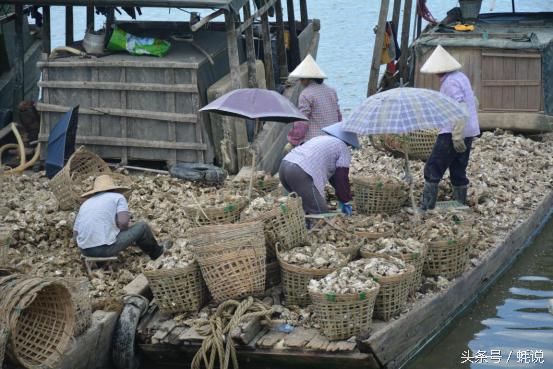
Yanlou Wharf is located in Yanlou Village, Lianzhou Town, Beihai. Standing at the wharf and looking around, the distant water and sky merge into one color. The oyster farmers steer their boats from the oyster fields and haul in boat after boat of oysters in strings, while the women on the shore swing iron cleavers to cut apart the connecting ropes and oysters. The clanging sound of knocking oysters and people's laughter tell us it is truly joyful.
Shacks stand in rows all over the wharf, and everywhere are the oyster farmers' motorcycles and stops where the oyster farmers rest and eat. Working and living at the wharf has long been an unchanging course in the oyster farmers' lives. Many chickens are also raised freely at the wharf. The oyster farmers mix some bits of meat attached to the oyster shells with leftover food and scraps and pour them together for these poultry to enjoy, which has produced many free-range chickens with glossy feathers and delicious meat.
Brother Qi, a major local Feicui oyster farmer, told us that oyster farming is very hard work, and almost every day one has to act according to the weather. In summer the ultraviolet rays are strong, and the oyster farmers' faces are all tanned very dark. Still, effort always brings rewards. Many local oyster farmers have made money from oyster farming, some have built houses, some have bought cars, and some have even married wives from the city.
The most important point is that the Abangding Feicui oysters we cultivate and raise have been tested by an authoritative department and meet the national pollution-free standards. Abangding Feicui oysters all grow in nature, entirely following nature, and do not need artificial feed.
Where in Beihai does 30% of the country's large oysters come from? It is Lianzhou Bay in Beihai. And where is oyster farming most famous in Lianzhou Bay? Most people will think of Yanlou Wharf in Lianzhou Town. It is understood that Lianzhou Town currently has 12,600 mu of large oysters under cultivation, and the total income from large oyster farming this year is expected to exceed 100 million yuan. Large empty baskets wait to be loaded onto trucks, and basket after basket of large oysters is loaded onto trucks for transport out.
Oysters are rich in nutritional value, containing 18 kinds of amino acids, glycogen, B vitamins, taurine, and nutrients such as calcium, phosphorus, iron, and zinc. Eating them often can improve the body's immunity.
In the past I also did not understand why people often asked me why the men and women of Beihai all look so fresh and radiant. Now I think I should know the answer. Growing up in an oyster town, how could one not be influenced by oysters at all?
Thanks to the oyster farmers in the sea waves under the blazing sun, the oyster harvesters who go to sea in the cold wind late at night, and the workers who clean and pack in the hot sheds. Abangding Feicui oysters, each one an oyster with simple, conscientious quality.