No need to worry about livestock weight, one trick in the countryside handles it easily
In the countryside, basically every household raises some large livestock. Even without large-scale farming, they will keep a plow ox, a New Year pig, and so on. Some families raise cattle or pigs not only for their own use but sometimes also sell one or two. When selling this kind of large livestock in the countryside, people generally take them to the local market to sell or contact an acquaintance to come and buy them. During the buying process, those traders mostly assess a price based on the size, height, and fatness or thinness of the pig or ox. In this kind of assessment process, farmers generally come off worse, because these traders are battle-hardened and can easily judge the weight of the livestock, work out an approximate price, and then offer a lowball price.
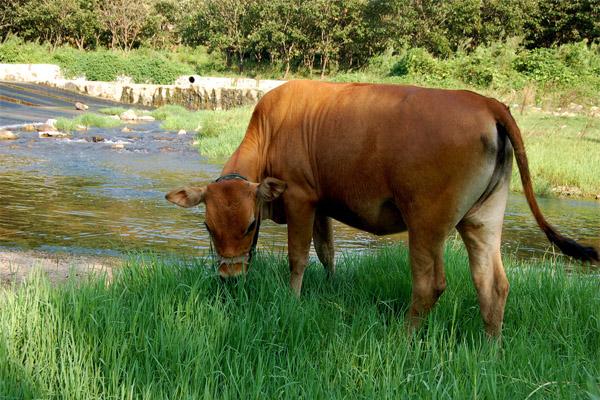
Besides needing to know the weight of livestock during the selling process, we also need to constantly assess the weight of livestock as they grow, to understand their growth and breeding conditions, and to work out due dates, market-ready dates, and so on.
But how to easily assess the body weight of livestock without going to great trouble seems to be a problem. After all, you can't put a several-hundred-jin or even thousand-jin animal on a scale! In ancient times there was Cao Chong weighing the elephant, but for us farmers, that way of weighing is what you'd call trouble! Even if you used up all your superhuman effort, it would still be hard to know the weight of the livestock. So without using superhuman effort, how to easily grasp the weight of livestock is very key.
Among the people, especially in our vast countryside, people have summed up a fairly useful method over the long course of raising large livestock. Just like estimating the weight of a pile of grain, you can completely measure its volume with a ruler and then know its weight. Large livestock are the same; you can also measure their body length and heart girth and calculate their weight under a specific formula.
With this method of using measured volume to calculate weight, the most basic thing is to know the constants for different species, different types, and nutritional conditions. This constant is equivalent to the density of a substance. You don't need to memorize too many, just memorize some commonly used ones. For example, the constants for cattle, horses, and sheep are 10800 and 11420; 10800 is for good nutritional condition, and 11420 is for average nutritional condition. The constants for pigs are 14200, 15600, and 16200; the larger the value, the poorer the nutritional condition.
After memorizing these few values, you also need to master a formula, which is that body weight equals the square of the heart girth multiplied by body length and then divided by the constant,that is, W=(C2×B)÷constant.
After mastering this formula, the most critical thing is to know how to measure body length and heart girth. Body length is measured from below the chest diagonally upward to the tail; heart girth is measured along the rear edge of the shoulder blade vertically downward around the chest for one full circle. During the wrapping process, the tape must not be too far forward into the front leg crease; keep it at around 5 cm. After measuring body length and heart girth, plug them into the formula and you can calculate the livestock's body weight.
For example: a cow in good nutritional condition is measured with a body length of 155 cm and a heart girth of 185 cm. How much does this cow weigh?
That is, (185×185×155)÷10800≈491 (kg)=982 jin
Horses, sheep, and cattle are measured in the same way, because their density is basically the same, that is, the constant is 10800, so no more examples will be given here. Below let us calculate the body weight of a pig.
For example, a pig in good nutritional condition is measured with a body length of 120 cm and a heart girth of 115 cm. How much does the pig weigh?
That is, (115×115×120)÷14200≈112 (kg)=224 jin.
In the estimation process, the constant value should be chosen according to the pig's nutritional condition, that is, fatness or thinness: take the small value for fat pigs, the middle value for pigs that are neither fat nor thin, and the large value for thin pigs.
In addition, this formula is not suitable for livestock under one hundred jin; using this formula for measurement gives a relatively large error. At the same time, livestock breeds differ in different regions, so when choosing the constant value, it should be determined according to the livestock's nutritional condition. Generally, this formula can be used to obtain a constant value that fits local conditions and local livestock breeds. The method is very simple: as long as you have mastered the constant value for livestock of one age group, you can keep using it from then on.
This calculation method has all been figured out by people through long-term practice. It is simple and applicable, and extremely easy to use. Of course, human wisdom is endless, just as people often say: masters are among the people, and among the people there is no lack of simpler ways and methods; it just depends on whether you like to explore them.
If you have a better method, why not speak up so everyone can learn from it together.
Text | Shanxiao
Welcome to subscribe to Nongji, a "big courtyard" that tells only the stories of us rural people
This article is original by the author of the Toutiao account. Without authorization, it may not be reproduced.