Do you know the legend about how Da Hong Pao got its name?
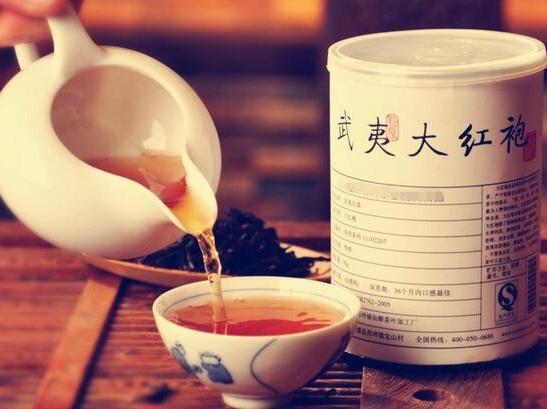
Da Hong Pao (one of China's ten famous teas) is a rare famous clonal tea of Wuyi rock tea (oolong tea) from Fujian Province. It is the finest quality among Wuyi rock teas, produced in the Wuyi Mountains in the southeast of Chong'an, Fujian. The tea trees grown in the Wuyi Mountains are of many varieties, including the "Four Great Famous Clones": Da Hong Pao, Tie Luo Han, Bai Ji Guan, and Shui Jin Gui. In addition, there are those named after the tea's growing environment, such as Bu Jian Tian and Jin Suo Shi; those named after the shape of the tea tree, such as Zui Hai Tang, Zui Dong Bin, Diao Jin Gui, and Feng Wei Cao; and those named after the shape of the tea leaves, such as Gua Zi Jin, Jin Qian, Zhu Si, Jin Liu Tiao, and Dao Ye Liu.
The legend of Da Hong Pao's origin is a good one. It is said that in ancient times, a poor scholar was traveling to the capital to take the imperial examination. Passing through the Wuyi Mountains, he fell ill by the roadside, but fortunately was seen by the old abbot of Tianxin Temple, who brewed a bowl of tea for him to drink, and indeed he recovered. Later, the scholar passed the examination with honors, became the top scholar, and was even chosen as the imperial son-in-law. One spring day, the top scholar came to the Wuyi Mountains to express his gratitude. Accompanied by the old abbot, with a great entourage before and behind, he arrived at Nine Dragon Ravine, where he saw three tall tea trees growing on the cliff, with luxuriant branches and leaves, putting forth clusters of tender buds that shimmered with a purple-red luster in the sunlight, most lovely to behold.
The old abbot said that last year, when you suffered from bloating, it was tea brewed from these leaves that cured you. Long ago, whenever the tea trees sprouted in spring, drums were beaten to summon a group of monkeys, who put on red jackets and trousers, climbed the sheer cliff to pick the tea leaves, which were then roasted and stored, and could cure a hundred ailments. Hearing this, the top scholar asked to pick and process a box to present as tribute to the emperor. The next day, incense was burned and candles lit in the temple, drums were beaten and bells rung, and all the monks, great and small, were summoned to set out for Nine Dragon Ravine. The group came to the tea trees, burned incense and paid homage, shouted in unison "Tea, sprout!" and then picked the buds and leaves, processed them with great care, and packed them into a tin box. After the top scholar brought the tea to the capital, it happened that the empress was suffering from stomach pain and bloating and was bedridden. The top scholar immediately presented the tea for the empress to drink, and indeed the illness was cured as soon as she took the tea. The emperor was overjoyed and gave a large red robe to the top scholar, telling him to go to the Wuyi Mountains on his behalf to bestow the reward.
Along the way, ceremonial cannons boomed and torches blazed brightly. Upon reaching Nine Dragon Ravine, the top scholar ordered a woodcutter to climb to the middle of the mountain and drape the large red robe bestowed by the emperor over the tea trees to show imperial grace. Strangely enough, when the large red robe was lifted, the buds and leaves of the three tea trees flashed with red light in the sunlight, and everyone said this was because they had been dyed red by the large red robe. Later, people called these three tea trees "Da Hong Pao." Someone even carved the three large characters "Da Hong Pao" on the stone wall. From then on, Da Hong Pao became tribute tea year after year.
For more tea encyclopedia, tea culture, and tea knowledge, please subscribe to us
[ WeChat service account: yuanlives-yzrx ]
[ WeChat public subscription account: yuanlaicha ]
[ Yuanlai website: www.yuanlives.com ]
Every day we will push the freshest and most interesting tea news to everyone