Citrus variety improvement gives Fengyu fruit growers in Sichuan their first taste of success
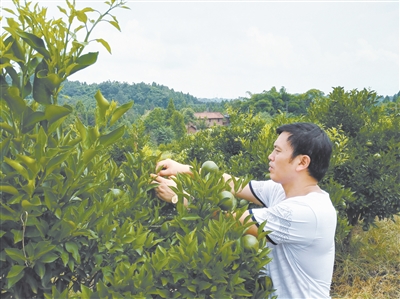
Wang Wengang is inspecting the growth of the fruit trees.
Graft survival rate reaches 94%; over a thousand mu of hybrid citrus bears fruit for the first time
On August 5, in Guihua Village, Fengyu Town, Yanjiang District, Ziyang City, the sun blazed down. Standing in his own orchard inspecting the growth of the fruit trees, bean-sized beads of sweat kept rolling down Wang Wengang's face, but he was very happy: "The Harumi trees have been successfully grafted, all of them have set fruit, and the heart I had been holding on to ever since I started improving the fruit trees has finally been set at ease."
In 2015, Fengyu Town's citrus industry covered more than 23,000 mu, with a total output of about 140 million jin and a total output value of 120 million yuan, and the town's per capita citrus income was 2,857 yuan. Although the annual output broke the 100-million-jin mark, as the town's pillar industry, the citrus industry entered a bottleneck period after many years of development: the varieties were mainly mid-season Satsuma mandarin, relatively uniform and aging, and the ripening period was too concentrated, with quality not high, resulting in low selling prices and small returns for farmers.
How could the citrus industry achieve breakthrough development? The town's Party committee and government believed that raising quality and improving varieties was the only way. In the words of Chen Long, director of the town's agricultural service center, in the past they won by quantity, but now they had to win by quality. Starting in 2014, Fengyu organized large citrus growers and skilled growers from the town many times to go elsewhere to learn from experience.
According to reports, this improvement was mainly reflected in two aspects: planting patterns and fruit tree varieties. The former citrus orchards were all dwarfed and densely planted, with a row spacing of 2 m and a plant spacing of 1.5 m, planting about 200 trees per mu. The newly planted fruit trees, however, have a row spacing of 3 m and a plant spacing of 3 m, planting 60-100 trees per mu, which is conducive to improving fruit quality. By top-grafting some of the existing mid-season varieties - the aging trees, low-yielding trees and poor-quality trees - to replace the varieties, the aim was to achieve a rational variety ratio of 3:3:4 across the town's citrus, namely extra-early-maturing mandarin, late-maturing hybrid citrus and mid-maturing mandarin each accounting for 30%, 30% and 40%. In this way, fruit could be produced in all four seasons, extending the fruit marketing period and lengthening the sales chain. At present, the varieties improved first in the town were mainly late-maturing hybrid citrus, covering more than 3,000 mu, including Qingjian, Harumi and Shiranui.
As soon as the town put forward the idea of improving citrus varieties, it won the support of Wang Wengang, Party branch secretary of Dongdongshan Village. Wang Wengang did some private calculations: "Mandarin sells for less than 1 yuan/jin, but planting hybrid citrus is different - one jin can sell for 4 to 5 yuan. The improvement raises both price and quality, which not only meets the market's high demands but also lets us earn more. This is definitely something worth doing." Last March, Wang Wengang invested more than 1.2 million yuan to contract 300 mu of land in Guihua Village to plant Harumi, while also spurring fruit growers in Dongdongshan Village to plant more than 200 mu of hybrid citrus, making him a major grower of improved citrus varieties.
At this time of year, Wang Wengang's fruit trees had already produced fist-sized fruit, with a circumference of about 6 cm. He casually picked one for the reporter to taste; it was sour with a hint of sweetness, and the flesh was very plump. Chen Long was delighted with this growth: "At first we estimated the graft success rate of this batch of trees at about 80%. After the new trees survived, they would bear fruit for the first time in the second year, and usually only in the fifth year would they enter the full-bearing period, when a larger fruit would grow to 8 to 9 liang, with a circumference of about 10 cm. But under Wang Wengang's meticulous management, all 300 mu of Harumi trees survived, and judging by size and quality they are all quite good. It is expected that by 2017 they will be in full bearing."
At present, Wang Wengang is thinning the fruit to keep each tree's yield at about 10 jin, which will increase to 50 jin in the full-bearing period. He said confidently that calculating at a price of 4 yuan/jin, once the orchard enters the full-bearing period next year, its annual output value could reach about 4 million yuan, recovering the cost in one go, with considerable returns.
According to Chen Long, the graft survival rate of the more than 3,000 mu of improved late-maturing hybrid citrus in the town reached 94%, much higher than the anticipated 80%. Apart from the portion of fruit trees that were grafted later and have grown for less than a year, the other half, which are growing well, have already borne fruit for the first time.