Why does a succulent turn black and rot within a single day?
More than a month ago, Ms. Tang, who lives in the urban area of Dezhou, Shandong Province, bought a succulent at a flower market and tended to it carefully every day. Early on the morning of August 17, she suddenly noticed that the plant had begun to turn black from the branches at the base, and the leaves she pulled off gave off a rotting smell. Ms. Tang, who had no experience growing flowers, did not know what to do; afraid that the hot weather and her failure to water in time were to blame, she hurriedly poured some water on the plant. Unexpectedly, when she looked at it again early on the morning of August 18, the whole succulent had turned completely black and rotted away, with no trace of life left.
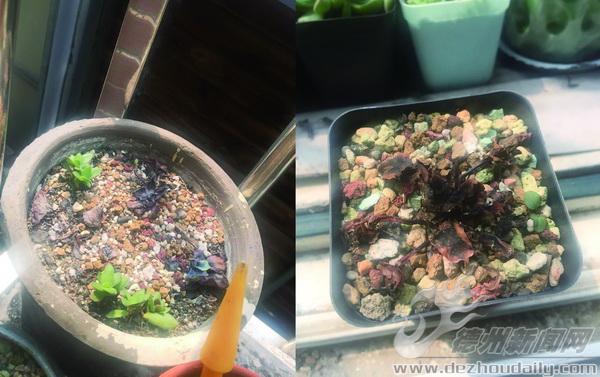
Succulent turns black and rots
Succulents also have a “dormant period”
“It grew well for a whole month, watered once a week, never in direct sun, so why did it suddenly die?” Ms. Tang was completely baffled by the succulent's sudden death. She had always heard that succulents are easy to keep alive, with a tenacity to rival cacti, but the inexplicable death of the succulent within a single day left her stunned. That day, Ms. Tang, who had no growing experience, photographed the plant's “corpse” and posted it on WeChat Moments asking for help, and she quickly got her answer: her plant had “black rot.”
“Succulents are drought-tolerant and have low soil fertility requirements. They are short in form and slow-growing, and the growing technique required is not demanding, so they are very well suited to being cultivated in a small home environment. That said, every summer succulents are extremely prone to dying.” Zhang Jinzi is a succulent-growing enthusiast with 4 years of growing experience. She grows more than a hundred varieties of succulents at home and is highly experienced. She says that in the minds of succulent growers, summer is a cruel season, because in this season succulents enter their “dormant period.”
Watering “dormant” succulents too much makes them prone to infection
It is understood that the dormant period refers to the self-protective measures different plants adopt to adapt to extreme climates caused by shifts in the weather, such as hot summers and cold winters. Generally there are two each year, one in summer and one in winter, each lasting about two months. But not all succulents go dormant; it still depends on the variety and the growing environment. “If you want your succulents to get through summer safely, you first need to work out whether they belong to the winter-growing type, the summer-growing type or the spring-and-autumn-growing type, and then arrange different care methods according to the different families and genera. Winter-growing and spring-and-autumn-growing succulents begin to go dormant once summer arrives, and these plants are the ones that need the most careful attention.” Zhang Jinzi told reporters that when a succulent is in its dormant period, the active tissues in its body function slowly, and its ability to absorb, synthesize, convert and release nutrients and water declines or even stops, so the plant stops growing. At this point, watering too much or keeping it in an overly humid growing environment will cause a fungal infection, making the succulent develop “black rot.”
Beginners should be cautious about buying succulents
“Winter-growing succulents basically stop growing in summer, so direct sunlight should be avoided, but they should not be placed in a dark spot with no light either, otherwise they may become leggy and their appearance will suffer. It is recommended to place them in a bright spot to the southwest, or somewhere out of direct sunlight, and to pay attention to ventilation. In addition, spreading a layer of white gravel on the surface of the soil in the pot to reflect sunlight can also help lower the temperature.” Zhang Jinzi explains that in summer, the most important thing to watch with succulents that have entered their “dormant period” is controlling water. “Succulents hate waterlogging above all. Especially in summer, growers feel that the water in the soil dries up quickly, so they water often, causing the roots to stay damp and rot over time. In fact, summer has a lot of rain and the air is humid; although the soil surface may look dry, the bottom has not dried out. For winter-growing succulents, watering should be strictly controlled in summer. Even when watering, you only need to moisten the soil surface around the plant, and that is what will get the plant through summer safely. At the same time, be careful not to splash water droplets on the leaves when watering. If obvious droplets remain on the leaves, they should be blown away, so that the droplets do not gather and focus strong light and scorch the leaves.”
Here, Zhang Jinzi reminds beginners at growing succulents that from around June to early September each year, beginners should absolutely not buy succulents; even if they do buy, they should not pick expensive varieties, but can choose some ordinary, cheap varieties to practise with. “The more expensive the succulent, the more prone it is to black rot. If you buy an expensive one, it may die before the summer is even over, and that is truly wasting something precious.” (Xia Yuyan)