Raising ducks, crayfish and koi in rice paddies
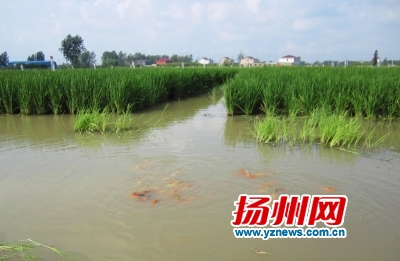
Koi are raised in the rice paddies.
A technician inspects pests in an insect trap lamp.
A patch of purple rice seedlings.
Yesterday the reporter learned from the Lixiahe Regional Institute of Agricultural Sciences that its experimental base at Songqiao in Gaoyou is currently trying out a "three-dimensional green control" technology that uses no chemical fertilizers or pesticides, instead preventing rice weeds, pests and diseases by creating a biodiverse environment combined with physical, physiological and biological methods. Among these, ducks, koi and crayfish play important roles.
How odd! Rice seedlings in all sorts of colors
Walking into the institute's experimental base at Songqiao in Gaoyou, the rice seedlings here are not all uniformly green; there are also light purple, dark purple and other colors; even among the green ones, there are variations in shade from dark green to light green. Project leader Zhang Jiahong explained that diverse rice is precisely the foundation of the "three-dimensional green control" technology: "This experimental base grows many rice varieties, and different rice varieties have different abilities to resist pests, diseases and weeds. We hope in this way to create a diverse environment and make the ecology as balanced as possible."
Raising ducks, koi and crayfish in rice paddies
The rice paddies at the experimental base are different from ordinary rice paddies; some have duck sheds, while others have a deep, wide ditch dug alongside them.
Zhang Jiahong explained that the rice paddies with duck sheds use the "rice-duck co-cropping" model, with 30 ducks per mu; ducks are omnivorous animals that eat both weeds and insects. The rice paddies with deep ditches are divided into two models, "rice-crayfish co-cropping" and "rice-fish co-cropping"; the former can raise at least 100 jin of crayfish per mu, while the latter can raise 100 fish per mu.
Tang Hejun, a technician at the experimental base, explained that under the "rice-fish co-cropping" model, all the fish currently raised in the water are ornamental koi, which eat not only aquatic weeds but also small insects; under the "rice-crayfish co-cropping" model, all the crayfish raised in the water are also omnivorous animals.
Pest control also relies on insect trap lamps and sex pheromones
Yesterday, the experimental base brought in several workers whose main task was to clear weeds from the fields. Tang Hejun said that under the "rice-crayfish co-cropping" and "rice-fish co-cropping" models, some older weeds are difficult to eat, so they need to be pulled out by hand.
In addition, there are two auxiliary "weapons" in the rice paddies -- insect trap lamps and sex pheromones. Sex pheromones release female insect pheromones to lure males in and eliminate them en masse, thereby reducing the number of pests in the next generation. Zhang Jiahong said that in terms of rice yield, after applying the "three-dimensional green control" technology the yield is 800 jin per mu. "Although the yield is somewhat lower, because no chemical fertilizers or pesticides are used, the market price is much higher, and the overall benefit is much better." Reporter Xiang Jiafu, text/photos