Demand for his sheep exceeds supply, and customers from Shenzhen come looking for Zhongkai's Huang Huancheng
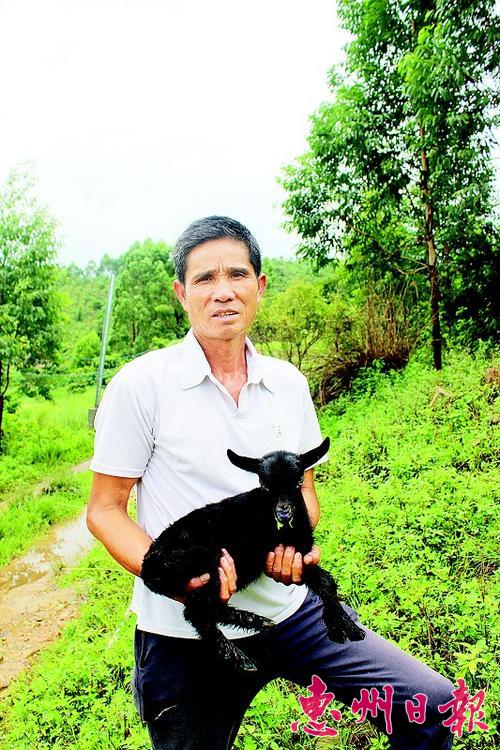
▲Huang Huancheng has figured out the habits of his sheep.
▲The sun is out, and the flock has come out to forage.
Huang Huancheng, a villager of Huangwu Village in Tonghu Town, Zhongkai High-tech Zone, once grew fruit trees and raised pigs, and a few years ago he finally chose sheep farming as his career. After 3 years of trial and error, he has figured out the habits of sheep, mastered sheep-farming techniques, and gradually expanded his operation, earning recognition from others in the trade. His sheep eat only grass, and their meat is quite tender. He does not promote himself, yet customers take the initiative to "advertise" for him on WeChat.
The sheep pen is raised and ventilated, with waste dropping straight to the ground below
After the rain, the air in Huangwu Village is especially fresh. Near the foot of the hill, waves of bleating from the young sheep ring out. Climbing a small slope, you come to Huang Huancheng's sheep pen, built on flat ground not far away. The pen is a wooden hut, raised more than one meter above the ground. The floor is nailed together from palm-wide wooden slats, with a gap of about 1 cm between each board, which allows for better ventilation, and the dung and urine the sheep produce can also fall through the gaps, making cleaning easier. Inside the pen there is a half-meter-high wall, and on top is a wooden roof, so both lighting and ventilation are good; with more than 300 sheep penned here, there is not much smell in the air.
The young sheep are shy of strangers, and when they see a visitor they all hide to one side. When Huang Huancheng arrives, the flock that knows him is not afraid of him. Seeing that the rain has been stopped for a while and the sun has come out, he opens the gate of the pen and lets the sheep go up the hill to forage. As soon as the gate opens, more than 300 young sheep leap out joyfully, trot nimbly along the path by the hill, soon climb the slope, and hide in the grass to eat, with only the occasional bleat of a lamb looking for its mother.
Setting up a "nursery" so ewes and lambs get better care
Huang Huancheng is now the only sheep farmer in the village. Previously, the village had several brick factories, and because of the heavy smoke and dust, the nearby lychee trees grew poorly or even died, so there was no future in growing fruit. Pig farming causes heavy pollution, and besides, local pig farms were no longer allowed. In this situation, in 2013, 46-year-old Huang Huancheng thought of developing a sheep-farming business.
He bought more than 100 local goats and raised them on the hill. He bought wooden slats and built a sheep pen himself, hammering and nailing it together. After 3 years of development, his flock grew from more than 100 to more than 300, and having figured out the habits of goats, he became more and more adept. He raises stud rams and ewes, and each ewe can give birth about twice a year. To care for the ewes and lambs, he also set up about 10 "nurseries" in the pen. When a ewe is close to giving birth, he brings her into a separate enclosure. After the lamb is born and its adaptability has grown stronger, it returns to the flock. This humane approach was Huang Huancheng's own idea, and it not only lets the ewes receive better care but also isolates the lambs from harm by the other sheep.
What he fears most is sheep eating artificial feed, so he drives them up the hill to eat grass every day
Although Huang Huancheng cares for the sheep very meticulously in terms of husbandry, he is also a "hard-hearted man." He only hangs some salt in the pen for the sheep to eat, and gives them no other food at all. He never feeds the sheep extra food, saying whether they eat their fill is the sheep's own business, and he does not concern himself with it. Every morning, after the dew on the grass on the hill has dried, he drives the sheep up the hill to eat grass, and by evening the flock returns to the pen on its own. If the sheep have not eaten enough, they have to wait hungry until the next day to go up the hill and forage for themselves. Looking at his sheep, they are not tall and look rather thin, and it is hard to find a plump one. But this is exactly what Huang Huancheng is proud of; he says that because the sheep eat only grass, their bodies and muscles are firm, and the meat tastes better.
From the very beginning, Huang Huancheng had never bought artificial feed for the sheep to eat, but who would have thought that on several occasions his sheep accidentally wandered into the duck flock at the fish pond at the foot of the hill, ate the ducks' feed, and within a few days the sheep died. "Sheep, like cattle, chew the cud. Normally when they eat grass, cud-chewing is very normal, but if they eat feed and fill themselves up, once they drink water the feed swells, and then they cannot bring it back up to chew, and they cannot pass it out either, and they are simply bloated to death." Huang Huancheng says that what he fears most is sheep eating artificial feed. After several such lessons, he keeps a close watch to stop the sheep from sneaking feed, to avoid this happening again.
Demand exceeds supply and he does not advertise, so customers advertise for him on their own
Huang Huancheng says that raising sheep is a bit easier than raising other poultry and livestock. After the initial investment in building the sheep pen, basically the only expense is labor cost, because raising sheep requires no bought feed, which saves a great deal of money. Because of this, some people saw that Huang Huancheng had succeeded in sheep farming and followed him into it, and Huang Huancheng supplied them with breeding sheep.
Several sheep farmers told him that because the sheep they had bought earlier were from other places, almost all of them died not long after being brought back, the reason being that they were not acclimated to the local environment. Huang Huancheng's sheep, however, are a breed that has been domesticated locally for more than 10 years, so they are adapted to the local environment and climate, and their survival rate is very high. Therefore, in addition to selling meat sheep, selling breeding sheep has become another money-making selling point for him.
In terms of sales, he has hardly ever deliberately promoted himself: "I don't dare advertise, I don't even have enough to sell." Although he does not advertise himself, customers all come to him on their own initiative, and those near Tonghu all like to buy sheep from him. Some customers, after buying, even help promote him on WeChat, which invisibly attracts customers from the surrounding area and even from Shenzhen.