How to control the lychee stink bug and what pesticides to use, is injecting the tree feasible
The lychee stink bug not only invades longan and lychee, even the Taiwanese goldenrain tree, a common street tree in cities, is a host plant for the lychee stink bug, but the Taiwanese goldenrain tree has not been dwarfed like fruit trees, making it difficult to spray pesticides from the air, and even if sprayed, 50%-80% of the pesticide disperses into the air. The Taiwan Forestry Research Institute of the Council of Agriculture suggests that, under expert guidance, an aqueous pesticide solution can be moderately injected into the tree trunk for control. The Taiwan Agricultural Chemicals and Toxic Substances Research Institute of the Council of Agriculture is currently working out a plan to cooperate with the Taiwan Tree Hospital to inject the Taiwanese goldenrain tree and evaluate the effectiveness of controlling the lychee stink bug.
However, Hong Qiaozhen, associate researcher in the Safety Materials Division of the Agricultural Chemicals and Toxic Substances Research Institute, reminds that injectable pesticides can be used to control the lychee stink bug on street trees and residential landscape trees, but it is strongly not recommended for use on lychee trees and longan trees used for agricultural production, because in addition to not being economically viable, pesticide residues also need to be monitored, otherwise there will be food safety concerns.
The lychee stink bug ravages lychee, longan and Taiwanese goldenrain trees across Taiwan, all suffer damage
This year the lychee stink bug has reproduced in large numbers, and damage has been reported one after another on lychee trees and longan trees in the country. Lychee trees and longan trees sucked on by the lychee stink bug develop symptoms such as withered tender shoots, flower drop and fruit drop. The bug crisis brought by the lychee stink bug not only appears in orchard areas, but traces of it can even be found on the common Taiwanese goldenrain tree in the country.
In May the lychee stink bug enters the adult stage, and on lychee trees, longan trees or Taiwanese goldenrain trees you can sometimes see brightly colored lychee stink bug nymphs, or adults that are similar in color to the tree. When startled, the lychee stink bug sprays a secretion, and human contact with it can cause skin allergies, stinging and burns.
Wu Mengling, deputy director of the Taiwan Forestry Research Institute, points out that the lychee stink bug mainly harms plants of the Sapindaceae family such as lychee trees, longan trees and Taiwanese goldenrain trees. It is specific in its hosts, and currently lychee trees and longan trees are affected most severely. In most cases, the lychee stink bug will not cause serious impact on the Taiwanese goldenrain tree, unless the number is too large, in which case affected branches may lose their water transport capacity and branch dieback may occur.
"Injecting the trees" can become a future control option for the urban lychee stink bug
How can the number of urban lychee stink bugs be effectively reduced? Most people's first thought may be to spray pesticides on the Taiwanese goldenrain tree. In the past, the Bureau of Animal and Plant Health Inspection and Quarantine of the Executive Yuan Council of Agriculture announced that pesticides could be used to control stink bugs on the Taiwanese goldenrain tree, including up to nine types such as chlorpyrifos, clothianidin, fenobucarb, cypermethrin, carbosulfan, thiacloprid, acetamiprid, flonicamid and imidacloprid.
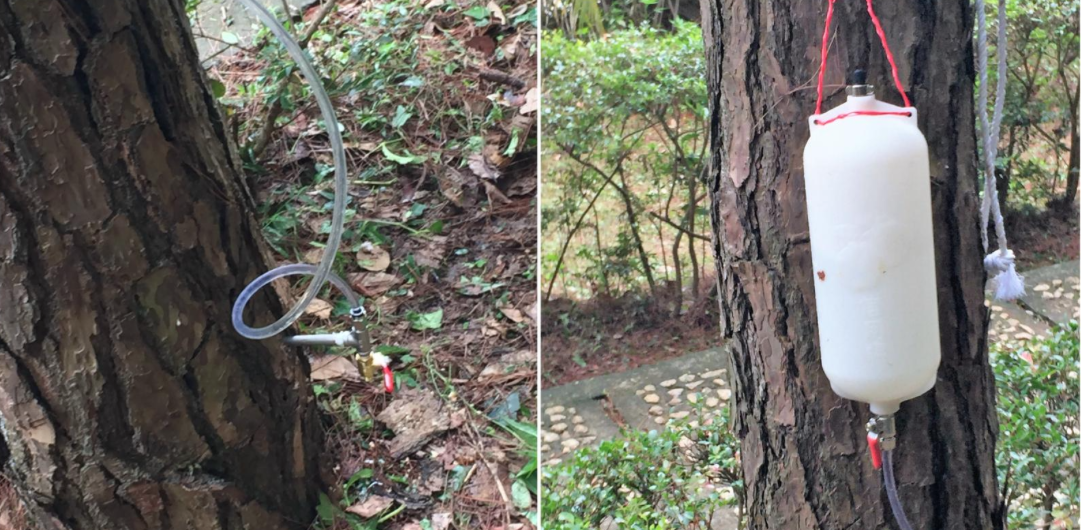
In the past, the Agricultural Chemicals and Toxic Substances Research Institute used injected pesticides to control tree pest problems, and at that time an IV drip was used for administration (as shown in the picture). Wu Mengling, deputy director of the Taiwan Forestry Research Institute, says that if pesticides are injected into the Taiwanese goldenrain tree in the future, this can be simplified to syringe injection, and there is no need to use an IV drip anymore.
However, Wu Mengling says that as a street tree, the Taiwanese goldenrain tree has not been dwarfed like fruit trees, so spraying pesticides from the air to control the lychee stink bug has limited effect, and even if pesticides are sprayed, 50%-80% of the pesticide disperses into the air. Spraying pesticides to control the lychee stink bug is not recommended in urban environments. In foreign countries, pest and disease control on street trees has gradually shifted from spraying pesticides to directly injecting pesticides into the trees.
Wu Mengling says that in the past, pesticides were sprayed on camphor trees to control pests. Because the tree body is larger, each tree might need 10 liters to 20 liters of diluted pesticide, but injection requires only 10 c.c. of pesticide to achieve the control purpose. At present, injecting one street tree on average takes about 5 minutes, but the pesticide used must not contain emulsifiers, so as not to reduce the control effectiveness.
The Agricultural Chemicals and Toxic Substances Research Institute plans to cooperate with the "Taiwan Tree Hospital," which has previously carried out pesticide injection on pine trees. Professionals will assess the trunk diameter to decide the dosage and how to administer it, while the Agricultural Chemicals and Toxic Substances Research Institute will investigate the effectiveness of controlling the lychee stink bug.
Hong Qiaozhen, associate researcher in the Safety Materials Division of the Agricultural Chemicals and Toxic Substances Research Institute, says that the lychee stink bug is a piercing-sucking pest. When pesticide is injected into the tree, the lychee stink bugs that suck the pesticide-containing sap will fall from the tree one by one and die, achieving the control purpose. Injectable pesticides can also solve the problem of sprayed pesticides drifting with the air, having less impact on people's lives and reducing ecological impact. This method can be applied to trees in non-agricultural areas and residential landscaping.