How to sell 100,000 yuan worth of farmed insects for 60 million
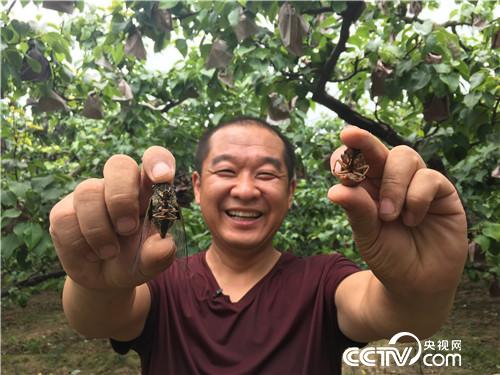
Have you ever seen a cicada shed its shell with your own eyes? And did you know that the golden cicada can burrow into the ground when young, fly up into the sky when grown, and be sold for money once farmed? Hu Yanhe from Yangxin County, Shandong Province, leads farmers in raising golden cicadas, with annual sales of over 60 million yuan. And this wealth of over 60 million yuan actually comes from these little twigs one by one.
In this small grove all is calm, yet beneath the surface, tens of thousands of golden cicadas are stirring. Summoned by instinct, they are plotting that on this very night, they will complete a transformation that lets them fly into the sky.
They have already dug their tunnels and reached their respective burrow entrances. For this moment, they have trained their arm strength underground for over 3 years, and in the most recent five or six days, working day and night, they have broken through a 30 cm thick layer of soil.
If tonight's transformation succeeds, they can live a different kind of life; if it fails, they pay with their lives.
Outside the small grove, Hu Yanhe and these visitors are also looking forward to the golden cicadas making an appearance. Tonight they have come specifically to catch golden cicadas.
Night falls. The time for the golden cicadas to emerge from their burrows has come. Only by climbing to a concealed spot on a tree in the shortest time do they have a chance to survive. But there are many difficulties along the way.
The main force had just climbed up the trees when Hu Yanhe and the golden cicada catchers arrived.
The golden cicadas are still struggling to run forward, but the catchers grow more and more enthusiastic as they catch them.
Visitor: Scared to death, scared to death.
The golden cicadas that climbed up the trees earliest met with a mass siege. And those that had not yet made it up the trees also risked being crushed underfoot.
Reporter: This one's squashed.
Pick-your-own orchard owner: This one's been stepped flat.
Reporter: Is this one dead?
Pick-your-own orchard owner: Stepped flat, stepped to death.
Only some survivors that escaped to concealed spots get to shed their shells as they wish. But even now there is still the risk of being caught. Only by completing the shedding as quickly as possible can they escape and fly into the sky.
In a natural environment without light, a golden cicada generally completes its shell-shedding within half an hour after emerging from the soil. But once affected by light, the shedding slows to two or three hours. Once the shedding succeeds, they become the cicada that everyone knows, whose scientific name is cicada.
This is the entire process of a golden cicada shedding its shell, filmed by camera over about two and a half hours.
When shedding its shell, the golden cicada first splits open a seam along its back and slowly pushes its upper body out. At this point the golden cicada's body is very delicate and has no defensive capability whatsoever, so it can only complete the shedding as quickly as possible.
After the upper body has shed its shell, the golden cicada's delicate body must perform a difficult sit-up.
It must lay its body down to horizontal, in order to spread out its cicada wings. After the cicada wings are spread out, it straightens up and pulls its tail out, letting its body completely shed the shell, while its two front legs grip tightly onto the head of the just-shed outer skin, allowing the cicada wings to fully spread and complete the emergence.
After the golden cicada sheds its shell, the scene before one's eyes is very deceptive. Even viewed from such a close distance, it is hard to tell which one is its actual body and which is its outer skin.
The golden cicada's shell-shedding not only fooled us; a thousand years ago at night, people of ancient times also stared, just as we do now, without blinking at the golden cicada shedding its shell, baffled by the scene before them.
In a flash of thought, the ancients learned from the golden cicada's biological instinct of shedding its shell a stratagem of using a false appearance to deceive others and make one's escape.
The stratagem of the golden cicada shedding its shell became one of the Thirty-Six Stratagems. Over a thousand years, this stratagem has been used to fight on the battlefield and cleverly defeat the enemy, and it has also become a commonly used idiom for playing petty clever tricks in daily life.
Shedding the shell is not an easy matter either. The cicada wings are the most easily damaged; once the cicada wings cannot take shape, the cicada loses its ability to fly, and at most it will live until the next morning before dying. Of the tens of thousands of golden cicadas that want to fly into the sky together tonight, no more than one tenth actually succeed in shedding their shells.
This small grove is a special golden cicada pick-your-own orchard.
Locally, people call raising golden cicadas "planting golden cicadas." They call catching golden cicadas "picking golden cicadas."
The golden cicadas in the small grove are all artificially farmed golden cicadas. In this season, for more than 20 days in a row, tens of thousands of golden cicadas try to escape and rise into the sky every night.
But for every golden cicada that escapes or dies, the owner of the small grove loses one yuan.
Tonight, a total of 5,700 golden cicadas were caught alive.
Each year the picking season lasts more than 20 days, and the golden cicada pick-your-own orchard can earn over 100,000 yuan.
Chen Yanli: Tonight's haul was 5,700 yuan.
Reporter: It seems raising golden cicadas is quite profitable.
Chen Liyan: Yes. This is all thanks to the wealth our Teacher Hu has brought us.
Hu Yanhe set up a golden cicada farming professional cooperative in Yangxin County, Binzhou City, Shandong Province, leading more than 1,000 farming households to raise golden cicadas and make money. The cooperative has annual sales of over 60 million yuan. Yangxin County has also formed a golden cicada wholesale market unique in the country. During the more than 20 days when golden cicadas emerge from the soil, the daily trading volume can reach 20-plus tonnes, and the daily trading value can reach over 3 million yuan.
Deep-fried golden cicadas are a famous delicacy in Shandong. Every summer, people catch wild golden cicadas and make deep-fried golden cicadas or steamed golden cicadas with pickles, serving them as a specialty dish to entertain guests at banquets. A plate of fried golden cicadas can sell for over fifty yuan in a restaurant.
But in the market, wild golden cicadas have suffered years of catching, their numbers are dwindling, and the price of golden cicadas has kept rising.
In 2005, Hu Yanhe was still a labor contractor taking on underfloor heating projects. On a business trip, Hu Yanhe saw a billboard advertising golden cicada farming. This discovery excited him greatly; he felt an opportunity to make a big fortune had come.
These flowerpots are the key site where Hu Yanhe tried raising golden cicadas back then. One life cycle of a golden cicada is three to five years. But unexpectedly, the golden cicadas were not as easy to raise as imagined. Hu Yanhe raised them for two years, and all the golden cicadas died.
Hu Yanhe: I think the direction of this thing is right; it's just that in the process there are one or another small difficulties that need to be overcome, that need us to explore through practice.
In 2007, Hu Yanhe stopped all his project contracting work and moved his family from Jinan City back to Yangxin County.
He took out all his savings of only 100,000 yuan and contracted 5 mu of land, intending to figure out golden cicada farming in the field. Hu Yanhe believed that as long as the golden cicadas could be raised, the money earned would surely be far more than doing engineering projects.
Hu Yanhe: I was bent on raising golden cicadas well. I gave myself the nickname Hu Big Bug, and I was determined to do this bug well, make it big and strong.
In 2009, Hu Yanhe got married and started a family, and in 2010 his son was born. But he had been raising golden cicadas all along with no job, and the family savings were about to run out. Just then, the golden cicadas he had raised for over 3 years emerged from the soil in batches.
Hu Yanhe: When I saw the cicadas emerging for the first time, I felt as if I had finally seen my child be born. In my heart, the heart that had been hanging, hanging for several years, suddenly settled.
In 2010, Hu Yanhe's technical conditions for raising golden cicadas had matured. One mu of land could produce over 1,000 cicadas per night, selling for over 500 yuan. Golden cicadas emerge for over 20 days each year, and on average each mu of land can sell for around 10,000 yuan per year. And it does not delay the growth of the fruit trees.
But Hu Yanhe had only 5 mu of land, not enough to raise many golden cicadas, and still could not make big money. But Yangxin County has ten thousand mu of pear orchards, which are exactly a good site for raising golden cicadas. Unexpectedly, though he talked until his lips were nearly worn out, not a single pear farmer was willing to cooperate with him in raising golden cicadas.
Hu Yanhe: It felt very hurtful. Every day I went out excited, and came back like a defeated rooster, because one negotiation failed, then another failed.
Nobody was willing to raise golden cicadas with Hu Yanhe, because the golden cicada Hu Yanhe wanted to raise was a pest that everyone locally knew about.
Villager 1: I said this is a pest, I don't dare raise this thing. I have so many trees in my field, I'm afraid they'll be killed.
The golden cicada has a mouthpart shaped like a straw. During its three years underground, it must cling tightly to tree roots and suck the sap from the roots. The pear farmers, afraid the pear trees would be damaged, resolutely refused to raise this pest.
Hu Yanhe: Very disheartened, but not discouraged. Because I believe this thing is right, I'll persist a bit more.
Hu Yanhe firmly believed that raising golden cicadas would definitely make money. Hu Yanhe said whether golden cicadas actually harm trees can be seen by digging them up.
Hu Yanhe: Dug one up, this really dug it out.
Reporter: You dug out its hole following this root. It's shrunk inside this hole.
Hu Yanhe: You're too lucky, see the shed skin?
Reporter: This skin is only this small piece.
Hu Yanhe: The mouthpart is still there.
Golden cicadas molt once every year as they grow. After a few scoops of the shovel, golden cicadas of all sizes were dug out. Although the dug-out golden cicadas were all clinging to tree roots, they were all very fine roots. They would not damage the main roots.
Hu Yanhe told everyone that as long as the number of golden cicadas is controlled well, they will not harm the trees.
And what truly harms trees the most is not the golden cicada living underground, but the adult golden cicada, that is, what everyone commonly calls the cicada.
In summer, when we suffer from the high temperature and dry heat, the cicadas also loudly clamor endlessly. Although cicadas are so noisy, they are actually mute and cannot call with their mouths. And not all cicadas can make sound.
Male cicadas have an extra pair of semicircular cover plates on their abdomen compared with female cicadas. The sound-producing muscles under the cover plates are like a tympanic membrane; male cicadas make sound by vibrating the muscles under the cover plates. When a male cicada makes sound, it vibrates its sound-producing muscles more than 10,000 times per second.
The male cicada's noisy torment of people in summer is actually it trying its utmost to court the female cicada.
And although the female cicada cannot call, it has the strongest destructive power against trees.
When laying eggs, the female cicada drills many egg-laying holes in the branches, cutting off the ducts that supply nutrients upward through the branch, causing the branch to wither.
In Hu Yanhe's warehouse, the reporter saw many withered branches.
Hu Yanhe: These two sides are both our secret weapons for making money.
Reporter: Branches are your secret weapons for making money?
Reporter: I've never heard of that.
Hu Yanhe: Of course, not just weapons, but gold bars. Take a look, densely packed, all of them.
In the reporter's view, withered branches are of no use. But in Hu Yanhe's eyes, every withered branch is a gold bar. Hu Yanhe said each little branch can generate 50 yuan of benefit.
Hu Yanhe: Would you say my little branches can be called gold bars?
Reporter: It can generate 50 yuan of benefit?
Hu Yanhe: Yes. Such a little thing produces 50 yuan.
Reporter: Then how much is this one branch worth?
Hu Yanhe: 5 jiao.
Hu Yanhe said this small room is his vault. In this small room, 1.8 million branches are stored, and after three years, if all goes well, they can grow into golden cicadas worth 90 million yuan.
In 2010, Hu Yanhe told everyone that raising golden cicadas could make money, and wanted everyone to raise golden cicadas with him. But no one had ever raised golden cicadas before, and only just over 100 farming households were willing to follow him in raising golden cicadas.
Locally there is a strange way of saying it: raising golden cicadas is called planting golden cicadas. At first the reporter thought it was a slip of the tongue. But later the reporter learned that the word "plant" in planting golden cicadas is not only vivid and fitting, but also holds a great secret.
The seeds of these golden cicadas are hidden inside these little branches.
Reporter: Are these insect eggs?
Hu Yanhe: Yes, these are insect eggs. To us these are gold bars; our eggs, one by one, finally become cicadas, one by one.
Female cicadas choose soft, flexible thin branches to lay eggs. The damaged spots on the branch are the cicada's egg-laying holes. A branch has roughly 50 egg holes, and each egg hole can contain roughly 7 to 8 eggs.
Hu Yanhe's unique skill is planting golden cicadas just like planting crops. But unexpectedly, planting golden cicadas not only makes money, but the operation is actually very simple. Farmers only need to throw the dry branches containing cicada eggs onto the ground and that counts as planting them. What is the trick to planting golden cicadas?
Hu Yanhe specially found a bundle of branches, intending to tell the reporter the secret of planting golden cicadas.
Hu Yanhe: In 20 minutes now, you will see insects crawling, an astonishing phenomenon.
Sure enough, 20 minutes later, the insect eggs had changed.
Under the camera's macro shooting, the larvae were very clear. In fact they are only half a sesame seed in size.
Newly hatched larvae are transparent all over. After hatching, the larvae first crawl around on the ground, and their bodies harden rapidly in the air. After ten-odd minutes, the two digging feet at the very front gain the ability to dig soil. The larvae must hurriedly dig holes and enter the soil. If they cannot enter the soil and find tree roots within the following half hour, the larvae will soon die. Of the 350 eggs in one branch, about 100 golden cicadas can finally enter the soil and survive.
Hu Yanhe discovered that egg hatching requires both temperature and humidity conditions to be met at the same time. First the cicada eggs are warmed to the point of imminent hatching, then the dry branches are transported to the cooperative members, and once watered they can hatch young cicadas. In this way, Hu Yanhe drove more farming households to raise golden cicadas and make money.
When the reporter was interviewing, it was the peak season for golden cicadas emerging from the soil. Hu Yanhe wanted to take the reporter to see just how much money raising golden cicadas can make.
The reporter saw that on these pear trees, every golden cicada was blocked halfway by tape.
Using smooth tape to block the golden cicadas makes them convenient to catch and also delays their shell-shedding time.
Local people like to eat fresh, live golden cicadas. As long as one has split open a seam, it basically cannot survive after being caught, and the price also drops. For one golden cicada, one without a split can sell for 5 jiao, while one with a split can only sell for two or three jiao.
Despite growing an extra pair of wings, its value drops by nearly half.
Some greedy people also catch just-shelled golden cicadas and fry them to eat, called deep-fried silver cicadas. But once a cicada has completely turned black, no one eats it.
In the pear orchard, the reporter also tried how to catch golden cicadas.
Reporter: There's one.
Hu Yanhe: These two are fighting.
Reporter: It fell.
Hu Yanhe: Take the one below.
Reporter: This will do?
Hu Yanhe: Yes.
Soon, after going around two trees once, the reporter had caught half a bucket of golden cicadas.
Reporter: When are there more?
Hu Yanhe: Generally around here it's from early July to the end of July.
Reporter: At the most, how many can emerge on one tree?
Hu Yanhe: At the most, one tree has had thirty or forty.
Reporter: Thirty or forty?
Hu Yanhe: Yes.
Reporter: Then how much does one sell for?
Hu Yanhe: One is now five jiao to five jiao five fen.
Reporter: 5 jiao to 5 jiao 5 fen, the market price?
Hu Yanhe: Market price.
One golden cicada sells for 5 jiao, and each night one mu of land can produce about 1,000 golden cicadas, so one mu of land can bring in five or six hundred yuan. Most of the golden cicadas raised by farmers are turned directly into money at the edge of the field right after being picked.
Reporter 4: Buying cicadas, right? How many have you collected? How many are these?
Hu Yanhe: More than 1,000.
Reporter: More than 1,000?
Vendor: How many is this? There are more than 2,000.
Reporter: You've already taken in more than 2,000 yuan?
Vendor: Right.
Seeing how profitable cicada farming is, even some farmers from Henan and Hebei came wanting to join the cooperative and raise golden cicadas.
Henan farmer: We have nearly 20 people around us, 18, joining our group, doing it together with us.
Driven by Hu Yanhe, the number of farmers in the golden cicada farming cooperative grew from 100 households in 2010 to more than 800 households in 2014.
In Yangxin County, Shandong Province, the large volume of golden cicadas emerging from the soil also spurred the creation of a large-scale golden cicada wholesale market. At the peak of summer trading, daily golden cicada transactions can reach more than 20 tons.
During the interview, the reporter saw a very unusual phenomenon: the golden cicadas in the market were all motionless, yet Hu Yanhe told the reporter that locals all like to eat live cicadas. What was going on?
It turns out the golden cicada has a remarkable ability: it is a master of disguise that plays dead. As soon as a golden cicada is soaked in water, it fakes death and will not shed its shell immediately.
The golden cicadas from Hu Yanhe's cooperative sold at this market have always used the traditional method of soaking in water to keep them fresh.
Woman: They'll come back to life in a moment. In a moment.
Reporter: They can come back to life in a moment?
Woman 5: They'll come back to life in a moment.
Twenty minutes later, the golden cicadas really did come back to life.
Woman 5: Alive, see, they're alive.
Reporter: They're alive.
Golden cicadas fake death when soaked in water. At first, Hu Yanhe's cooperative used the soaking method to transport golden cicadas all over Shandong. But the soaking method cannot be used for long-distance transport. If the time is too long, the golden cicadas will drown and rot. As the cooperative's golden cicada output grew year after year, Hu Yanhe also thought about how to sell golden cicadas to distant markets.
After repeated experiments in which more than 1,000 golden cicadas were soaked to pieces, Hu Yanhe finally worked out a clever trick for long-distance transport of golden cicadas. Soak the golden cicadas in water, add ice cubes, and use the low temperature to slow their metabolism. Then keep changing the water along the way to clean out the metabolic waste of the golden cicadas.
Hu Yanhe's golden cicadas also won recognition in markets in Guangdong, Fujian and other places. In Guangdong, Fujian and other places, golden cicadas even sold for twice the price they fetched locally in Shandong.
At present, in Hu Yanhe's cooperative, more than 1,000 farming households are raising golden cicadas along with him. The farming area has reached more than 8,000 mu.
Now, Hu Yanhe still wants to lead more people to make money raising golden cicadas, and he is bent on making his nickname "Hu the Big Bug" ring out even louder.
Leader: Golden cicada farming is a specialty farming project in Yangxin County. So far it has reached a certain scale, opening up a new path for fruit growers to increase production and income.