Growing Polygonatum under Chinese torreya forests; intercropping in bamboo forests works just as well
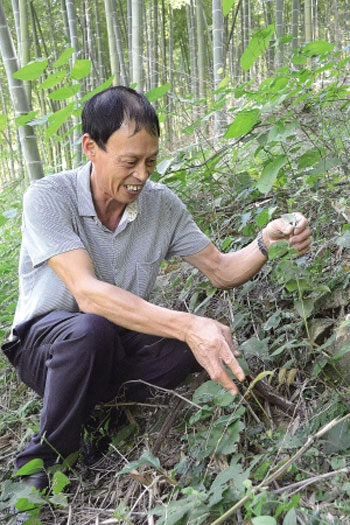
Yuan Yonghao shows the Polygonatum.
Intercropping Polygonatum under Chinese torreya forests.
In two months, quite a few Chinese torreya growers came to Wang Xiaojun in Shangliaogang Village, Huangtan Town, Ninghai County to "learn the ropes." It turns out he bought wild Polygonatum rhizomes and intercropped them in his own Chinese torreya base, innovating a Chinese torreya understory economy model and becoming the city's first experimental base for intercropping Polygonatum in mature Chinese torreya forests.
Polygonatum, popularly known as the "longevity hundred-year herb." Du Fu of the Tang Dynasty wrote in a poem: "Clear away the white hair, the Polygonatum is there; see his face of ice and snow in years to come." Polygonatum has high nutritional and health value and can be used to develop related products such as foods, health supplements and medicines. "Now, wild Polygonatum resources are gradually decreasing while medicinal demand is increasing, making it a best-seller. Artificial cultivation of Polygonatum has just begun, and the market prospects are quite broad," said Wu Yufen, a senior engineer at the Ninghai County Forestry and Special Products Station.
The "longevity hundred-year herb" settles in Chinese torreya forests
Can Polygonatum be artificially cultivated in mountain forests to raise the comprehensive benefits of woodland? In recent years, some forest farmers in Ninghai have tried growing Polygonatum to dig for "gold" and develop the understory economy, and Wang Xiaojun is one of them.
Wang Xiaojun began growing Chinese torreya in 2009 and set up a Chinese torreya processing factory. Considering practical problems such as the long time from planting to production, slow returns and difficulty in recouping capital, he decided to use the land resources of young Chinese torreya forests to intercrop Polygonatum.
"Polygonatum can be both eaten and used as medicine, and it has the characteristic of sustainable management. Last year, I began intercropping Polygonatum, and unexpectedly it succeeded at the first try. Now, all my 100 mu of Chinese torreya land is intercropped with Polygonatum, with Polygonatum cyrtonema as the main trial variety. In the future, visitors here can dig up Polygonatum and feel the fun of 'treasure hunting' in the forest!" Wang Xiaojun told this writer.
Wu Yufen said that Chinese torreya generally takes 8 to 10 years from planting to production, with large initial investment costs, high management costs and delayed returns, which has affected farmers' enthusiasm for developing the Chinese torreya industry. Intercropping Polygonatum under Chinese torreya can make full use of land resources and raise the multiple cropping index of the land, not only saving management costs but also achieving early economic benefits through Polygonatum output and increasing torreya farmers' income.
It is reported that Ninghai County currently has 12,000 mu of Chinese torreya planting area, of which more than 95% is young Chinese torreya forest. This year, the county has carried out intercropping trials on more than 100 mu of Chinese torreya forest, and it is expected to save more than 20% in management costs, raise woodland utilization by more than 50%, and increase the output of young Chinese torreya forest by more than 30%.
Artificially cultivated Polygonatum has a market
Another person optimistic about the Polygonatum market prospect is Yuan Yonghao, head of the Ninghai Dajiahe Guangshun Bamboo Shoot Professional Cooperative. The Polygonatum he cultivated with cooperative members three years ago has already begun to be harvested. Unlike Wang Xiaojun, Yuan Yonghao's Polygonatum "lives" in a bamboo forest.
Yuan Yonghao said that Polygonatum needs a shady, moist environment to grow. The village where the cooperative is located has stretches of bamboo forest, and the bamboo forest is tall and dense, while the understory is relatively shady and moist, suitable for Polygonatum growth. In the past, villagers could dig up quite a lot of wild Polygonatum in the mountain forests, but in recent years the quantity has become smaller and smaller. "Since there is an environment here suitable for Polygonatum growth, why don't we try artificial cultivation?"
In 2013, Yuan Yonghao began cultivating Polygonatum in 200 mu of bamboo forest. Through several years of cultivation, this year the fresh Polygonatum produced in the bamboo forest reached 1,500 kg. He told this writer that the Polygonatum used for seedlings was all wild from the mountains. Large rhizomes are processed directly, while small ones are raised as seedlings and then transplanted under the bamboo forest, which is the so-called understory wild-simulated cultivation. "Generally, Polygonatum can be produced after 3 to 4 years of cultivation. This year, we processed and made 250 kg of Polygonatum tea, which can sell for 800 yuan per kg on the market, showing obvious output benefits."
A relevant person in charge of the Ninghai County Agriculture and Forestry Bureau said that intercropping Polygonatum in bamboo forest is a management model of the understory economy. It can make full use of land resources, increase the multiple cropping index of the land and enhance forest farmers' economic benefits. Using bamboo forest plowing to plant Polygonatum and managing the bamboo forest by managing the Polygonatum saves labor and also "puffs up" forest farmers' wallets.