Small mushrooms in the remote mountains of Anqing, Anhui help farmers increase income and become wealthy
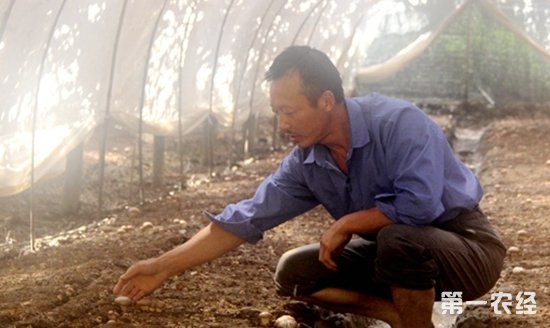
"This year our buried mushrooms can sell for more than 7 yuan per jin on the market, so the economic benefits should still be quite good." On August 30, during an interview in Huanglong Village, Huangwei Town, in the remote mountainous area of Yuexi County, Anqing City, Anhui Province, reporters learned that local villager Wang Changqin led several poor people to actively develop buried mushrooms, cast off poverty, and realized the dream of becoming wealthy.
Wang Changqin, a 58-year-old villager, lives in Xiangchong Group of the village. In the first half of 2009, while working away from home, he learned that buried mushrooms sold very well in vegetable markets in some large and medium-sized cities, and he developed the idea of returning home to grow buried mushrooms. After teaching himself some techniques for cultivating buried mushrooms, in the winter of the same year he returned to his hometown and used the abundant bamboo branches and miscellaneous wood in the countryside as raw materials to make 1,000 mushroom sticks for buried mushrooms (note: each stick cost 2 yuan) and cultivate buried mushrooms. In the summer of the following year, under Wang Changqin's careful cultivation, his buried mushrooms began to grow vigorously and gradually came to market, achieving annual income of nearly 5,000 yuan.
From 2011 to 2014, Wang Changqin's buried mushrooms gradually won the favor of residents in Lu'an, Hefei and other cities, but due to restrictions on the source of raw materials for mushroom sticks and funds for scaled development, they never achieved major growth. In November 2014, Xiao Qiang, a cadre stationed by Anqing Petrochemical in Huanglong Village, Huangwei Town, Yuexi County, to assist with poverty alleviation, learned during a visit to poor households that Wang Changqin had technology but lacked funds. Combined with the fact that three registered poor households in the village, Wang Zuyi, Wang Chang'an and Wang Zuqiang, also wanted to develop buried mushrooms, he publicized the government's relevant industrial support policies to them, affirmed their ideas from the perspective of market information, and encouraged them to cooperate as a group to jointly develop the market. At the same time, he actively recommended them to the village poverty alleviation mutual aid society and helped the four households each borrow 10,000 yuan in poverty alleviation mutual aid funds from the village poverty alleviation mutual aid society, effectively solving the difficulty of start-up funds for the project and helping them further develop buried mushrooms.
In 2015, under Wang Changqin's guidance, the three households of Wang Zuyi, Wang Chang'an and Wang Zuqiang each made more than 10,000 mushroom sticks for buried mushrooms, and the four households also jointly built a fresh-keeping cold storage room. According to statistics at the end of 2015, each household's income from the buried mushroom industry alone exceeded 50,000 yuan, and after deducting costs and the poverty alleviation mutual aid funds borrowed from the village, each household had a surplus of more than 20,000 yuan. Wang Zuyi, Wang Chang'an and Wang Zuqiang, three poor households, thus cast off poverty in one stroke, and everyone's path in industrial development grew broader and broader.
"In earlier years I did not have the courage to expand the buried mushroom industry, mainly because my energy and funds were limited. In the past two years, several fellow villagers, with the village's help, wanted to develop buried mushrooms together with me. I feel very happy, because group cooperation can reduce market risks." On August 30, Wang Changqin said in an interview at his home. "In order to resolve the conflict between raw materials for mushroom sticks and the ecological environment, Secretary Xiao and the village cadres helped come up with ideas and repeatedly helped contact the forestry station, determining to use miscellaneous tree branches from bamboo groves as raw materials for mushroom sticks, avoiding ecological damage caused by cutting other trees, and at the same time also helping the bamboo groves grow quickly and healthily."
"These past few days, Secretary Xiao and I have been discussing the reuse of mushroom stick waste. I find it very inspiring. I want to further study the cultivation techniques for buried mushrooms and, together with everyone, explore the in-depth development of related industries, striving to enable more fellow villagers to achieve common prosperity." Wang Changqin continued.