Experience and know-how for getting rich from a poisonous business
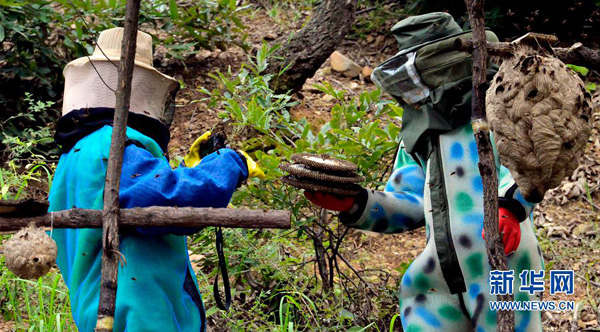
On August 25, in Yangjiaogou Group, Wangping Group, Wangping Township, Ruyang County, Henan Province, wasp farmer Zhang Qingmin and his partner Song Dashou put on specially made protective suits and prepared to harvest wasp pupae. "I just went over to look at the gourd nest and accidentally got stung on the hand by a wasp," Song Dashou told the reporter.
The honeycomb tray taken out of the hive
Wasp
In mountainous areas, there is a kind of wasp that habitually builds gourd-shaped nests on tall trees using aged bark, and it is called a "gourd nest." Even mountain dwellers keep their distance when gourd nests are mentioned, because this kind of wasp is large, long-bodied, highly venomous and aggressive. If stung, the pain can be unbearable in mild cases and fatal in severe cases.
Zhang Qingmin, 46 years old this year, is a person who deals specifically with wasps and works in the wasp farming industry. "A gourd nest can have its pupae harvested three times a year. Starting from around the 15th day of the 7th lunar month, one harvest is taken every 20 days, and each nest yields about 10 jin," Zhang Qingmin told the reporter.
Gourd nest insects, namely wasp pupae, are rich in protein and are a rare delicacy. Mountain dwellers take the risk of collecting them and, besides eating them, also sell them to the restaurant industry, with the price at around 160 yuan per kg. Zhang Qingmin, who lives in the mountains, saw a business opportunity in this and came up with the idea of farming wasps.
To raise gourd nests, you first need queens. In May this year, Zhang Qingmin and Song Dashou together invested tens of thousands of yuan to learn from other places and introduce more than 100 queens. After careful feeding, when the wasps had bred to about 5 and the nest had begun to take shape, they followed the wasps' living habits and chose hillsides near their own homes as farming sites, hanging the young nests in the trees. The two successfully developed more than 100 gourd nests.
That day, at the pupae harvesting site, when meeting these two "bold" men, Zhang Qingmin and Song Dashou, they put on thick protective suits like space suits and sealed the connections of each other's clothing to prevent wasps from "invading." They walked into Zhang Qingmin's gourd nest farming site, which has 28 wasp nests, and chose a relatively large gourd nest. Song Dashou carefully cut off a piece of the outer layer of the nest with a small knife, then used a homemade tool to cut the connection point between the comb bed and the hive, and took out 3 sections of comb bed. Around the cut gourd nest, thousands of wasps flew about madly, making the pupae harvesting work extremely difficult.
Zhang Qingmin explained: "Wasps have 'three treasures': wasp pupae, wasp venom and wasp nests. Wasp pupae can be served at the table, wasp venom can be collected with a special venom collector, and both wasp venom and wasp nests have high medicinal value. This gourd nest business is not bad at all."
Wasps feed on locusts, caterpillars, bean green worms and many other leaf-eating plant pests. In the farmland next to the farming site, the beans Zhang Qingmin planted were blooming with small flowers and growing green and promising. Zhang Qingmin pointed to the bean field and told the reporter: "My beans have not a single pest, and the nearby woods also have no pests. This thing is also a guard for crops and forests!"
Zhang Qingmin is full of confidence in his "gourd nest business": "To raise gourd nests, as long as you hang the young nests in the trees, you can relax. They gather their own food and build their own nests. The key is to guard them well so that people or large livestock do not enter the farming area and cause stinging accidents. Then you just wait for the harvest. With this year's trial farming success, next year I will expand the farming scale and gradually spread it to surrounding villages, leading fellow villagers to get rich."