Wenling, Zhejiang: Fig Farming in Chengnan Cultivates a New Path to Prosperity
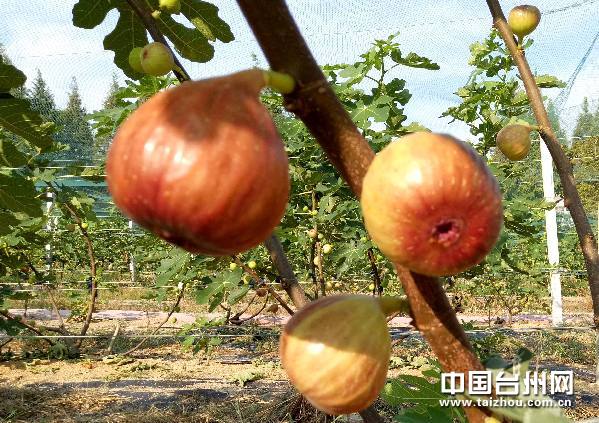
On September 3, tourists were picking figs at the fig planting base 500 m from the exit of the South Toll Station of Tengling Tunnel in Chengnan Town, Wenling City.
Once Beginning of Autumn passed, it seemed that overnight the fig suddenly released all its passion. The fruit had grown large, ripe and red. In Chengnan, Wugen and other places, many orchards' figs have entered the full-bearing period, hanging heavy with fruit, and the brisk sales have delighted the growers.
Figs from the United States have captured many people's taste buds
At the fig planting base in Chengnan, the fig trees are not very tall, and their branches are covered with fruit. A ripe fig is about half the size of an adult's fist, with a purplish-red skin and a small crack at the bottom revealing the red flesh inside. Squeeze it and the fruit feels soft, with thin skin and thick flesh; put it in your mouth and bite gently, and it is fragrant and sweet.
"With so much sunny weather lately and plenty of sunlight, the fruit's sweetness is very high." Lin Chuxiang, the person in charge of the orchard, told this writer that the fig variety they grow is "Masui Dauphine", introduced from California, USA, and characterized by large size, red color, high sweetness and high yield. At present, the vast majority of figs sold on the fruit market are of this variety.
Once the figs ripened, they attracted many local residents to come and pick them. "Figs are nutritious, and both the elderly and children can eat them." Taking advantage of the weekend, local resident Ms. Chen brought her child to the orchard to pick figs. Just as she was about to pick them with her bare hands, a grower came over to stop her: "You can't pick them like that; the liquid flowing from the branches will hurt your skin." It turns out that the fruit, stems and leaves of the fig all contain protease, namely the milky substance that oozes out. For long-term picking, rubber gloves should be worn to prevent skin redness, swelling and allergies. When picking, you should also carefully observe the color of the fruit and only pick it once it is confirmed ripe; only ripe ones will be sweet.
Retail price above 15 yuan/jin, yet still in short supply
In earlier years, the Shiqiaotou area once grew figs on a large scale, but for some unknown reason they stopped planting them. Lin Chuxiang said: "The fig variety there was not chosen correctly, and combined with the impact of pests and diseases, both the yield and quality of the figs were not very good, so they stopped planting them later."
"At present, in Zhejiang only Jiaxing and Jinhua grow figs in large quantities; not many are grown in our area, and no scale has been formed." Lin Chuxiang has contracted more than 20 mu of land in Chengnan Town to grow agricultural products, half of which is devoted to figs. The figs bore fruit less than a year after planting. "Last year, they were all picked out in less than a month of sales." Lin Chuxiang told this writer that this year, starting from mid-August, the figs entered their high-yield period, which is expected to last until the end of October.
"Usually the picking price is 25 yuan/jin; recently we held a promotion to attract customers, so the price dropped a bit." Lin Chuxiang said that currently the retail price of figs is above 15 yuan/jin, averaging 2 liang each, so one jin is basically only four or five figs. If the figs are larger, the price rises accordingly. Even though the price is not cheap, the figs at the base are still in short supply.
Because figs do not keep well and begin to spoil the day after picking, many figs shipped in from elsewhere are of poor quality. "Locally grown ones have a fairly obvious competitive advantage." Regarding storage, Lin Chuxiang said that cold storage can be used, extending the shelf life of fresh fruit to 10 days, and after low-temperature freezing it can be extended to one year. "I simply don't have enough to sell here, so I haven't built a cold storage facility." Lin Chuxiang said he has basically opened up the local market; besides supplying residents for picking, some figs also go to supermarkets and fruit shops for sale, with a daily supply to the urban area of around 200 jin. In addition, he has also tried making fig jam, dried figs and other products.
Open-air cultivation costs little, and cultivation management is relatively simple
This writer checked online and found that fig cultivation and management are relatively simple: fruit appears the same year, and there is a full yield in three years. Figs like an environment with plenty of sunlight, warmth and humidity; they are not resistant to waterlogging and are relatively drought-tolerant. "The growing conditions are similar to those for dragon fruit, but figs are more cold-tolerant." Lin Chuxiang said that figs are cultivated in the open air, so the investment cost is relatively low. The main cost of growing figs is labor, "and the cost of weeding alone each year is a very large expense." For this reason, he also made a special trip to Zhejiang A&F University to study, and now the orchard is covered with "weed-control ground cloth." A layer of plastic film is laid on the ground surface, and then rice husks are piled on top.
In addition, figs have the habit of ripening one by one day by day, so they need to be picked at any time to prevent a large amount of fruit from dropping. Lin Chuxiang also stretched large nets over the orchard. "This is to prevent birds from stealing a meal." He said he uses blue silk netting (a type of fishing net). "Last year I used transparent netting and found it was not very sturdy; it broke in less than a year." This writer found that some other fruit growers in Wenling also plant figs in greenhouses. Lin Chuxiang said this is not advisable: "Planting in greenhouses can extend the picking period, but the planting cost is also high, so it's not worth it." Driven by Lin Chuxiang, some farmers in Daxi, Ruoheng and other places are also growing figs.
What exactly are the market prospects for figs? Can they be grown on a large scale? "Figs have unique therapeutic food effects and great market potential, but the ripe fruit does not keep well or transport well, so the planting area should not be blindly expanded." In this regard, Wang Tao of the Wenling Municipal Agriculture and Forestry Bureau suggested that growers could combine with a WeChat business sales model, target the local market, and control the planting scale to around 50 mu to 100 mu per county (city, district).