Why can raising earthworms under trees achieve three benefits at once?
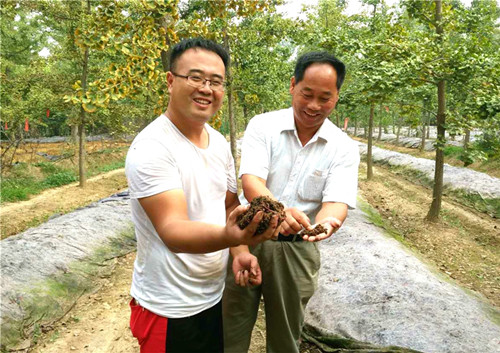
On September 3, the author met Zheng Qingchen, a young man who raises earthworms under trees, in Sheng Village, Matou Town, Tancheng County. He happily scooped out a handful of organic fertilizer containing earthworms to let everyone see how the "soft gold" earthworms were growing. Look, under the ginkgo trees are warm beds built one by one from cow dung and straw. When the surface layer of organic fertilizer is turned over, the earthworms are densely packed, hurriedly stretching and wriggling, and the earthworms that fear light desperately bore down into the lower layers.
Zheng Qingchen, the young man, explained that raising earthworms under trees can improve the compacted soil environment of the woodland. After being swallowed by earthworms, the cow dung also provides abundant organic fertilizer for the trees, which is more conducive to the growth of the trees, forming a three-dimensional complementary model of tree planting and earthworm breeding. In the past, most cow dung was sold to nearby farmers for use as compost at a low price. Now it is sold to earthworm raisers for 200 yuan per cart. After fermentation and harmless treatment by earthworms, it becomes organic fertilizer for growing vegetables in greenhouses, grapes, and fruit. Earthworms can be used as fishing supplies, animal extracts, agricultural and sideline product processing, animal raw medicinal materials, etc., and market supply falls short of demand. One mu of land can produce about 1 ton of earthworms per year, with a net profit of 10,000 yuan, and the earthworm castings produced can also sell for 600-800 yuan per ton. Throughout the entire cycle, energy is utilized layer by layer, which can not only increase farmers' income, but also make use of idle resources, providing favorable conditions for gradually improving the surrounding environment.