What are the four elements needed for large-scale modern agriculture? Liu Yonghao says this
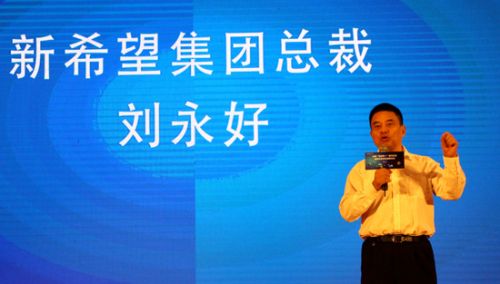
Liu Yonghao, President of New Hope Group, delivers a keynote speech
To implement the decisions and arrangements of the Party Central Committee and the State Council on implementing the "Internet Plus" action plan and promoting mass entrepreneurship and innovation, on September 6, the Ministry of Agriculture held the National "Internet Plus" Modern Agriculture Work Conference and New Farmers Entrepreneurship and Innovation Conference in Suzhou, Jiangsu Province, to summarize and exchange good practices and good experiences from various places in advancing the "Internet Plus" modern agriculture action, and to study and deploy the key work of "Internet Plus" modern agriculture during the "13th Five-Year Plan" period. Liu Yonghao, President of New Hope Group, said in his keynote speech that economic and urban development has driven and compelled the modernization and scaling-up of rural areas. Engaging in large-scale, modern agriculture requires four elements.
Liu Yonghao believes the first is people. Where do the people engaged in modern agriculture and large-scale agriculture come from? In the past, whatever grandpa did, I did; if grandpa raised pigs, I raised pigs; if grandpa farmed, I farmed. That model has gradually passed. Today, large-scale planting and breeding must be a modern agricultural system with knowledgeable people, or with organization and a service system. When you raise more than a thousand pigs, the pig breed, the prevention and treatment of pig diseases, what feed the pigs eat, market sales and so on are not things ordinary farmers can accomplish. This depends on organization and on a system; relying on one expert is not enough, it must be supported by an organizational system.
Liu Yonghao believes the second is money. The state encourages family farms, and now family farms are springing up like bamboo shoots after rain. Who are these family farm owners? Mainly two groups. The largest group is those who went to work in cities when they were young, worked for ten, fifteen, twenty years, and are now over 45 years old, and at this time they return to their hometowns. When they return, it is not traditional agriculture anymore. What do they do? They definitely do large-scale agriculture, modern agriculture, planting and breeding, livestock farming, processing. This is the main force of family farms. The second group is some young people who have graduated from university or high school and want to do something. They feel opportunities in rural areas have arrived, and they want to go to rural areas to start businesses and innovate. These two groups are called new farmers. "Mass entrepreneurship and innovation" - everyone thinks that Zhongguancun and high-tech are the only entrepreneurship and innovation, but that is not entirely right. In fact, engaging in planting and breeding in rural areas is also "mass entrepreneurship and innovation," and this is flourishing in rural areas.
Liu Yonghao believes the third is technology. Farmers who want to farm on a large scale and raise pigs on a large scale need science. Take pigs, for example: good pigs and poor pigs are very different. Our group may have more than two million pigs coming out this year. On average, we calculated that the survival rate of weaned piglets is 26.6%, more than 10 points higher than the national average. Why? Because of technology. We have the world's best experts, we have good breeds and good breeding methods. How do we teach these good technologies, breeds and methods to our family farms? This is the work we need to do. With one tap on our APP software it comes up: today you can see how much soybean meal costs, how much corn costs, what the national situation is, what it is in your area, updated every day. We also have how pig prices are, what the live pig price is. In addition, we have service teams of nearly several thousand people across the country to guide and serve them. I think this is the application of "Internet Plus" in rural areas. At the same time, we arrange plans for when pigs will be sent to market: Zhang San today, Li Si tomorrow, so there will not suddenly be a batch all coming to market at once. Everyone knows pig prices are sometimes high and sometimes low. Some say this is the pig cycle. We establish big data, gathering all kinds of data on China's rural planting and breeding industries, to serve farmers and enterprises in the future. In addition, we have the New Good Model, a new model for pig farming: the company, family farms and rural cooperative economic organizations, three parties linked in a brand-new model. In this process there is a large amount of Internet of Things technology, information technology, "Internet Plus" technology, market services, technical services including expert services, one-tap mobile phone extension services, logistics services and so on. These are the most important links in modern agriculture.
Liu Yonghao believes the fourth is the market. For large-scale and modern agriculture, where is the market? We must consider it with a global vision and perspective, and combine the international market with the Chinese market. Today the consumption power of ordinary Chinese people has upgraded. Under our supply-side reform, ordinary chicken, pork and fish are basically satisfied, but what is more needed? Lobster, prawns, beef, mutton - these high-end animal proteins. How can these high-end animal proteins be produced? We propose building another concept of a coastal grassland around Shanghai, China, hoping to create a bonded zone, an import and export processing zone, a modern industrial park and a free trade zone. I think we are fully capable and confident. In addition, we will establish a big data system. When our big data system is truly perfected, we will be able to avoid to a certain extent the losses to farmers caused by rent fluctuations.