What are the rural land transfer models? Read this article to understand
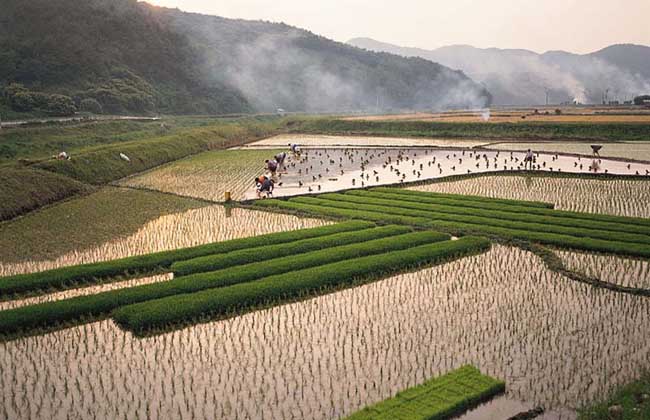
Rural land transfer actually refers to the transfer of land use rights, which means that farming households with land contract and management rights voluntarily transfer the land management rights (use rights) to other farming households or economic organizations, that is, retaining the contract rights and transferring the use rights. At present, the main types of rural land transfer are land exchange, leasing, shareholding, and cooperation.
Rural land exchange
Land exchange is a simple exchange of the contracted management rights of their respective land by farming households within a rural collective economic organization for the convenience of cultivation and their respective needs. It is the inevitable path to promote large-scale, industrialized, and intensive rural operations. Thirty years ago, China's rural areas implemented the household contract responsibility system with remuneration linked to output, and farmers received land. However, because the land varied in fertility, large plots of land were divided into strips and patches. The various drawbacks left by land allocation severely restricted the development of productivity and the increase of output. How to concentrate land into contiguous plots and achieve large-scale, intensive operations led the most primitive form of transaction, exchange, to enter farmers' field of vision.
Rural land leasing
Driven by market interests and guided by the government, farmers lease the management rights of their contracted land to lessees such as large households, proprietors, or enterprise legal persons. The lease term and rent payment method are agreed upon by both parties themselves. The lessee obtains land management rights for a certain period, and the lessor obtains land management right rent annually in the form of goods or money. Among these, there are large-household leasing, company leasing, and leaseback-then-subcontracting types.
Rural land shareholding
Shareholding, also called the "shareholding land system" or cooperative shareholding operation, means that on the basis of adhering to the voluntariness of contracted households, the management rights of contracted land are valued and converted into shares to establish a joint-stock company. In the process of land shareholding, a two-way choice in rural land management is implemented (after farmers put their land into shares in the company, they may either continue to participate in land management or not participate in land management). Farmers may hold company shares by virtue of their land contract rights and receive dividends according to shares. The greatest advantage of this form is that property rights are clear and interests are direct. It fixes farmers' land contract and management rights over the long term in the form of value, and farmers are both participants in company operations and owners of the interests. It is a new breakthrough in the current rural land use right transfer mechanism.
Rural land replacement
Taking Chongqing as an example, after it was approved by the state last year as a pilot zone for comprehensive coordinated urban-rural reform, it took the lead in bold exploration in the field of land reform and created the Jiulongpo model of land transfer, namely exchanging homestead land for housing and contracted land for social security. That is to say, farmers give up their rural homestead land, the homestead land is replaced with land for urban development, and farmers obtain an apartment in the city. Farmers give up rural land contract and management rights, enjoy urban social security, and a unified urban-rural public service system is established.
Land cooperative shareholding
Ningyang County in Shandong Province, China, explored a new mechanism for the transfer of land contract and management rights and established a "shares + cooperation" land transfer distribution method. In this model, farmers jointly establish a cooperative with land management rights as shares. The village guides farmers to contribute land contract and management rights as shares in accordance with the principles of "mass voluntariness, land as shares, intensive operation, profit dividends, and interest protection." The cooperative manages the land uniformly according to democratic principles, and farmers no longer operate it separately. The cooperative attaches itself to a leading enterprise for production and operation. The cooperative adopts the method of guaranteed minimum returns based on land and dividends based on benefits. During the annual distribution, it first pays members a guaranteed minimum land return of 700 yuan per share (mu), retains sufficient public reserve funds, public welfare funds, and risk funds, and then carries out a second round of dividends according to shares.
Further reading: Rural land transfer policy
The Measures for the Administration of the Transfer of Rural Land Contract and Management Rights was reviewed and approved at the 2nd executive meeting of the Ministry of Agriculture on January 7, 2005, is hereby promulgated, and shall take effect as of March 1, 2005.
Chapter I General Provisions
Article 1 These Measures are formulated in accordance with the Rural Land Contracting Law and relevant provisions in order to standardize the transfer of rural land contract and management rights, safeguard the lawful rights and interests of both parties to the transfer, and promote agricultural and rural economic development.
Article 2 The transfer of rural land contract and management rights shall, on the basis of adhering to the household contract operation system and stabilizing rural land contracting relationships, follow the principles of equal consultation, legality, voluntariness, and compensation.
Article 3 The transfer of rural land contract and management rights shall not change the agricultural use of the contracted land, the transfer term shall not exceed the remaining term of the contract period, and the lawful rights and interests of interested parties and rural collective economic organizations shall not be harmed.
Article 4 The transfer of rural land contract and management rights shall be standardized and orderly. Transfer relationships formed in accordance with the law shall be protected.
Article 5 The agricultural administrative departments (or rural operation and management departments) of people's governments at or above the county level shall, in accordance with the duties prescribed by the people's government at the same level, be responsible for guiding the transfer of rural land contract and management rights and contract management within their administrative areas.
Chapter II Parties to the Transfer
Article 6 The contracting party has the right to independently decide in accordance with the law whether to transfer the contracted land, as well as the transferee and method of transfer. No unit or individual may force or obstruct the contracting party from transferring its contracted land in accordance with the law.
Article 7 The proceeds from the transfer of rural land contract and management rights belong to the contracting party, and no organization or individual may misappropriate, intercept, or withhold them.
Article 8 Where the contracting party voluntarily entrusts the contractor or an intermediary organization to transfer its contracted land, the contracting party shall issue a land transfer letter of entrustment. The letter of entrustment shall state the entrusted matters, authority, and term, and shall bear the signature or seal of the entrusting party. Without the written entrustment of the contracting party, no organization or individual has the right to decide in any way the transfer of a farming household's contracted land.
Article 9 The transferee of rural land contract and management rights may be a contracting farming household or another organization or individual permitted by relevant laws and relevant provisions to engage in agricultural production and operation. Under equal conditions, members of the same collective economic organization enjoy priority. The transferee shall have agricultural operation capacity.
Article 10 The method, term, and specific conditions of the transfer of rural land contract and management rights shall be determined through equal consultation by both parties to the transfer.
Article 11 After the contracting party and the transferee reach an intention to transfer, if the transfer is by subcontracting, leasing, exchange, or other means, the contracting party shall promptly file a record with the contractor; if the transfer is by assignment, it shall submit an application for assignment to the contractor in advance.
Article 12 The transferee shall protect the land in accordance with relevant laws and regulations, and it is prohibited to change the agricultural use of the transferred land.