Crocodile farming is booming in Africa, with 80% ending up on Chinese dinner tables, and profits exceeding 100%
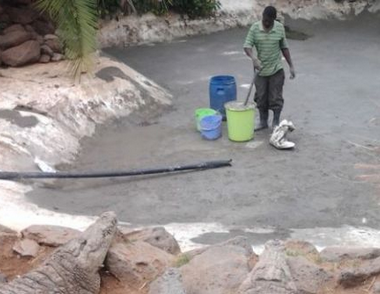
At Muck's farm, workers under the watchful gaze of crocodiles. (Image source: BBC website)
Reference News reported on September 12 that British media say: Have you ever eaten crocodile meat? Africa's crocodile farming industry is currently growing at an annual rate of 22%, with mainland China, Hong Kong and Taiwan together accounting for 85% of its export market. Where there are heavy profits, there are sure to be brave men.
The BBC website published a report on September 8 titled "Chinese Appetites Fuel Africa's Crocodile Farming Industry," saying that if you work in a yard full of crocodiles, remember, never turn your back on a crocodile while talking on your mobile phone!
Sadly, in May this year, at the Clinton Muck Crocodile Farm in eastern Kenya, a worker did exactly that foolish thing.
Mr. Muck, 62, said, "He was on the phone and had no awareness of his surroundings. He was later taken to hospital, but did not survive. He died."
"Another worker lost his index finger while handling a baby crocodile a few weeks old. This really can be a terrifying place, but there's no choice, you have to keep living, you have to keep earning money."
This is the highly profitable and perilous crocodile farming industry!
The report says that if you are timid by nature and easily nervous, perhaps you should not consider making a living farming Nile crocodiles.
The Nile crocodile is the largest species of crocodile in Africa and one of the deadliest predators in the world! Nile crocodiles can grow up to 5 m in length and typically weigh up to 750 kg, and are known for being fierce and highly aggressive.
In the wild, Nile crocodile attacks on humans happen frequently. Not all cases are recorded, so the exact number is unknown, but it is said that Nile crocodiles kill hundreds of people in Africa every year.
Muck's crocodile farm is located in Kitui County, about 180 km east of the capital Nairobi, and he keeps more than 33,000 crocodiles in total.
The report says that driven by demand for crocodile meat in the Chinese market, and along with growing sales of crocodile meat to restaurants and upscale tourist hotels within Kenya, Muck says his business is booming as never before.
Muck said, "Each crocodile... the meat can bring in about 5,000 to 7,000 Kenyan shillings (330 to 460 yuan)."
Crocodile meat is white and is said to taste very much like chicken. Muck says he can also sell crocodile skins, used to make shoes, handbags and belts, for 2,500 Kenyan shillings each (about 165 yuan).
Muck says that as a result, he slaughters 3,000 crocodiles each year, and the income from each crocodile is double the investment. "Farming crocodiles is indeed challenging, but the most astonishing result is the profit! You can make more than 100%."
The report says Muck's crocodiles are kept in deep pits, which contain both ponds and dry land. The crocodiles' feed includes fish, blood-soaked corn and other meats.
The walls of the pits are very steep to prevent the crocodiles from escaping. But the 246 workers at the crocodile farm must climb down the walls into the pits every day to catch those crocodiles whose meat is just right and are of the right age for slaughter, that is, 8-year-old crocodiles.
Workers also need to collect crocodile eggs so that the baby crocodiles can be hatched in a separate place, and they also need to do cleaning.
Veterinarian Ojamong says hygiene is very important to prevent the spread of disease. "You must check every day whether the crocodiles show signs of illness or injury. Injuries from internal fighting can cause fatal diseases, or can kill a crocodile immediately."
However, the most serious disease that farms must make great efforts to avoid is crocodile pox. There is no vaccine against crocodile pox, and an outbreak can kill all the crocodiles. So the best method is always to maintain good hygiene.
The industry estimates that the entire African crocodile farming industry is currently growing at an annual rate of 22%. Among them, South Africa ranks at the top, with total annual crocodile exports worth about 73 million US dollars (about 490 million yuan), followed by Zambia (65 million US dollars, about 430 million yuan), Kenya (62 million US dollars, about 410 million yuan) and Zimbabwe (30 million US dollars, about 200 million yuan).
The report says that mainland China, Hong Kong and Taiwan together account for 85% of the share of Africa's crocodile export market. The next relatively large export market is the Middle East.
The Kenya Wildlife Service reveals that Kenya currently has a total of 21 crocodile farms, but another 60 have already applied for operating licenses.
Wildlife Service spokesman Gathitu says that farming Nile crocodiles is not a problem, because they are not an endangered animal.
However, Ojamong warns that start-up costs are very high. He estimates that opening a crocodile farm in Kenya requires an investment of about 500,000 US dollars (about 3.33 million yuan) for purchasing land, crocodile hatchlings, expert consultation and so on.
Muck started his farm 10 years ago. He says, "There is a lot of expensive infrastructure investment, but the returns will certainly not make you regret it."