Rural Development and Regional Revitalization 10 / Entrepreneurship Cannot Be Like Gambling: Information Support for Japan's Regional Revitalization Policy - RESAS
Text / Chen Chieh-ting (Associate Research Fellow, Agricultural Policy Research Center, Taiwan Agricultural Research Institute)
The promotion of regional revitalization in Japan is the latest product built upon rolling reviews of many past policies. In order for this system to truly achieve the goal of regional revitalization, the Japanese government has proposed support systems in three areas: human resources, finance, and information. Following two previously published articles discussing human resource support (Regional Revitalization Cooperation Teams, human resource revitalization), this article will explore the powerful information aggregation platform for regional revitalization - RESAS - and its application cases.
RESAS Regional Economy Society Analyzing System: Supporting Regional Analysis and Development Strategies
"RESAS" is the abbreviation of "Regional Economy Society Analyzing System," an information aggregation platform established by the Japanese government in 2015. We can regard it as the "entrance" for utilizing regional revitalization data, a system that organizes diverse data related to regional economies (including both official and private) in a visualized manner into easily understandable maps or charts.
Local governments and administrative departments are the primary driving units of Japan's regional revitalization. How can they develop features that match the characteristics of their region? This cannot be achieved by making empty election promises, nor by simply chanting slogans like "sell goods abroad, bring people in" and expecting the region to develop naturally. Facing a bewildering array of regional development strategies, what we must ask is: On what basis are these plans and strategies proposed? There has to be some justification! This is where RESAS comes in - it can support each region in analyzing its own strengths, weaknesses, or key issues, and further serve as a tool for exploring relevant solutions.
User-Friendly Interface HelpsFormulate Evidence-Based Policy
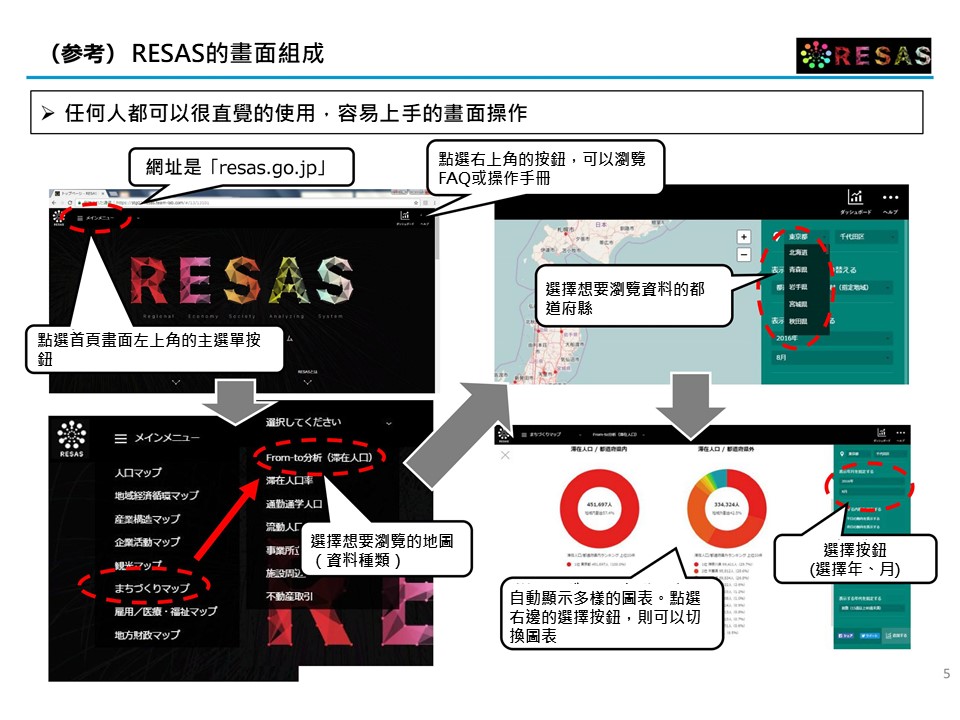
Simply put, the existence of RESAS means that policymakers no longer bluff their way through based on intuition, experience, or speculation, but instead move toward Evidence-Based Policy Making. And in order to achieve more user-friendly and widely utilized results, its interface is extremely user-friendly.
In terms of current usage, since RESAS was established in 2015, the number of users has grown from 420,000 to 690,000, and the visualized information registered in the system has grown from 25 databases to 81.
Entrepreneurship Cannot Be Like Gambling; It Must Be Built on Solid Foundation Data
From the RESAS system and its applications, we can draw a preliminary insight from the case of Ibaraki Prefecture: the accumulation of solid data is truly important. When discussing regional revitalization, encouraging entrepreneurship is certainly a major path, so discussing entrepreneurship is not wrong in itself - the question is: Where is the new blue ocean for industry? Where is the niche for entrepreneurship? When there is no supporting data whatsoever, or there is data but no one analyzes it? Isn't this kind of entrepreneurship just like gambling?
(To deeply grasp rural development and regional revitalization within Taiwan's real-world context, "News & Market" has partnered with the "Rural Development Foundation" to present the "Rural Development Special Series," using a series of articles to explore Taiwan's current situation and Japan's policy developments. To read the full series, please click here.)