Is Softened Asparagus Bad? Learn How to Pick Fresh, Tender Spears and Understand Their Nutrition
In Europe and America, asparagus is a highly iconic spring ingredient, and for many gourmands it is a top-tier delicacy that must be enjoyed in spring. For a long time, asparagus has been called the king of vegetables, and in the Shennong Bencao Jing asparagus was also listed as "above the top grade," because it contains relatively high fiber
In Europe and America, asparagus is a highly iconic spring ingredient, and for many gourmands it is a top-tier delicacy that must be enjoyed in spring. For a long time, asparagus has been called the king of vegetables, and in the “Shennong Bencao Jing” asparagus was also listed as "above the top grade," because it contains relatively high fiber and vitamins, the amino acid content and ratio in its protein suit human needs, it is rich in calcium, phosphorus, potassium, iron and other minerals the human body needs, and it contains relatively high selenium and antioxidant components. It not only has the title of king of anti-cancer foods, but also promotes urination and clears heat and boosts immunity, and it is also known as one of the ten famous dishes.
Teach you to quickly identify fresh asparagus
As for how to quickly identify fresh asparagus, there are 4 key tips. First, observe the cut end at the base; fresh asparagus needs to be bright green, and if it is shriveled or browned, it means the product lacked moisture retention or has been lying on the sales shelf for many days, and this is the easiest indicator to judge. Second, observe the tip; fresh asparagus needs to be plump and tightly closed, and if there are obvious gaps or branching, it may have been on sale for many days or stored at too high a temperature, causing it to keep growing. Third, observe the small scales on the tender stem nodes; fresh asparagus needs to be emerald green or bright pink-purple, and if they are yellowed or opened, it means its nutrients have been significantly depleted and it has aged; finally, you can carefully observe the skin on the upper half of the tender stem; fresh asparagus needs to be plump and glossy, because the upper half is the most tender, and if wrinkles appear, it means it has been left for many days or has already lost water and decreased in freshness, causing wrinkles, and in severe cases it may even become somewhat soft and droop at the tip. If you want to buy fresh asparagus, just use the first 3 tips in order and you can quickly pick at a glance, while the last tip lets you select fresh, good asparagus more precisely and more professionally.
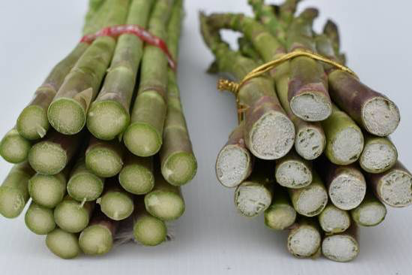
Quick-pick tip 1: Fresh green asparagus (left) has a bright green cut end at the base, while if the product lacks moisture retention or has been displayed on the shelf for many days (left), the cut end often becomes shriveled and brown and develops hollow spots.
Quick-pick tip 2: The tips of fresh green asparagus are plump and tightly closed, while if harvesting is too late or the product has been stored for many days, there are often obvious gaps at the top and branching appears.
Quick-pick tip 3 (version A): Fresh green asparagus has scales that fit tightly and are emerald green or bright pink-purple, while if the product has insufficient moisture retention or has been stored for many days, the scales easily turn yellow or their edges dry out.
Quick-pick tip 3 (version B): Fresh green asparagus has scales that fit tightly, while if the product has been stored too long, the scales also easily wither and open up.
Quick-pick tip 4: Fresh green asparagus has plump, glossy tender stems, while if the product lacks moisture retention or has been displayed on the shelf for many days, the tender stems easily develop wrinkles.