Where Do Farming and Grazing Interlace Go Under the Grain Price Barometer
--An Investigation of Planting Structure Adjustment in Hebei Agricultural Reclamation
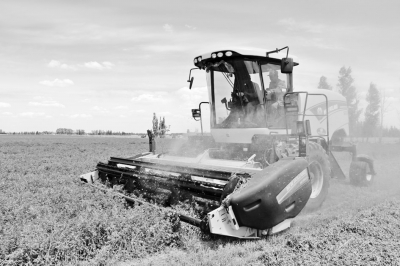
Gansu Agricultural Reclamation Bayi Farm is accelerating the development of the grass industry. At present, 4,000 mu of alfalfa grass have begun to be harvested one after another. They purchased self-propelled harvesters, which are fast; after cutting, the forage grass is neat, making mechanical turning and drying easier and benefiting the growth of the next crop of alfalfa grass. The photo shows the harvesting scene. Photo by Zhang Guozhi
The grass industry and the livestock industry are interrelated and form an important part of the structural reform of the agricultural supply side. However, China's grass and livestock industry has problems such as a single variety, low output, lack of competitiveness, prominent conflicts between livestock and grass, and loose integration of farming and grazing. In particular, places located in the "sickle bend" farming-grazing integration area, after reducing corn, face the question of what to plant, how to plant, and what kind of "substitute" to choose. But one thing is beyond doubt: for areas suitable for developing the grass industry and livestock industry, "grass where grass is suitable, grazing where grazing is suitable" is the core of the structural reform of the supply side. Grasping this point can accelerate the progress of "grain-to-feed" conversion and promote the balanced development of the meat industry, dairy industry, and other industries.--Editor
"Grain prices are the barometer for adjusting the crop planting structure. Corn prices remain persistently low, and corn-producing areas in the reclamation districts must find ways to adjust the structure, transform the mode, and increase benefits, guiding agricultural workers to switch to other crops." Du Yazhou, deputy director of the Hebei Provincial Agricultural Reclamation Bureau, is clearly very familiar with market conditions and the situation facing the reclamation districts. Speaking to the reporter, his introduction was quite professional.
Also in the "sickle bend" area, choices of "substitutes" differ
The Hebei reclamation district is located in the northern farming-grazing interlace area of the "sickle bend" region. This area is a transition zone connecting agricultural planting areas and grassland ecological areas, belonging to a semi-arid and semi-humid climate zone, with abundant land resources and good light and heat conditions, but scarce water resources and degraded and desertified soil. It is an area with many types of disasters, frequent occurrences, and severe disaster conditions, among which drought has the greatest probability of occurrence, the widest impact range, and the most serious degree of harm.
Du Yazhou introduced that in 2015 the corn production situation in the Hebei reclamation district was very severe. Since the corn harvest period, prices showed a cliff-like decline, falling from the 2014 market price of 2.20 yuan/kg to 1.60 yuan/kg, a drop of nearly 25%. The price decline alone reduced income by 150 yuan per mu. Meanwhile, production costs rose due to labor and seeds, chemical fertilizers, pesticides, machinery, and so on, reaching 50 yuan per mu. Because the floor of production costs rose and the ceiling of corn selling prices fell, the profit space for corn kernel production shrank by 200 yuan/mu, greatly dampening agricultural workers' enthusiasm for planting corn. The time had come when the corn planting structure had to be adjusted.
Based on the actual conditions of the reclamation district, in agricultural development Hebei reclamation adjusted the structure and transformed the mode, and determined three ways to reduce the planted area of grain corn. In the Bashang Plain spring corn planting area, the focus is on developing drought-tolerant coarse grains and beans, potatoes, forage grass, and silage corn; the main direction is to vigorously develop drought-tolerant coarse grains and beans and short-growth-period silage corn; develop sightseeing and leisure agriculture, promote the integrated development of planting and breeding, agricultural product processing, and leisure services, and improve agricultural production efficiency. In the central-southern Hebei Plain and eastern Hebei coastal summer corn planting areas, the focus is on developing forage grass, actively developing salt-tolerant and drought-tolerant forage grass and silage corn, supporting new agricultural operating entities in carrying out "grain-to-feed" conversion, developing modern herbivorous livestock husbandry, and promoting the integration of farming and grazing.
"In 2016, it is expected to reduce grain corn by 40,000 mu, and strive to reduce grain corn by more than 100,000 mu by 2020," Du Yazhou said.
"Grain barn," "meat warehouse," "milk tank"--not one can be missing
"Taking advantage of the opportunity presented by Benfang Livestock's newly added 18,000-head dairy cattle breeding operation, we planted 20,000 mu of silage corn and 6,000 mu of high-protein purple alfalfa, which both reduced the grain corn area and improved breeding benefits." Yu Lianzhi, deputy farm director of Cangzhou Zhongjie Friendship Farm, spoke fluently to the reporter, his expression full of pride.
"Zhongjie Friendship Farm," personally named by Premier Zhou Enlai, after fifty years of construction and development has ranked among the top in the country's agricultural reclamation in both economic aggregate and operational quality, and has become a national modern agricultural demonstration farm. In July 2003 it was restructured into a provincial-level development zone--Cangzhou Lingang Economic and Technological Development Zone.
The successful experience of Zhongjie Friendship Farm is precisely Hebei Agricultural Reclamation's active exploration in vigorously advancing the integration of farming and grazing, driving the optimization of the planting structure, and carrying out planting-breeding integrated adjustment, implementing consideration of both grain and feed, reducing grain corn, and developing silage corn wrapped a href=https://www.zhifujing.org/special/wa/ target=_blank class=infotextkey>frogZuo 5 people sent jin, with silage, turning the "grain barn" into a "grain barn" + "meat warehouse" + "milk tank."
Du Yazhou said that because the Hebei reclamation district spans a large area and involves many crop types, the reclamation district formulates technical plans for corn structure adjustment according to local conditions, recommends crop varieties that sell well and are high-yield and high-quality, guides the corn structure to take the initiative in optimizing, actively adjusting to special products, and striving to deepen adjustment, and, in conjunction with carrying out green yield increase model research, integrates a set of technical models for corn structure adjustment.
Once large enterprises arrive, "grain-to-feed" conversion has a new engine
Guyuan Pasture, located in Saibei Management District of Zhangjiakou City, made a big move this year: using the opportunity of adjusting the corn planting structure, it guided the forage planting enterprise Qiushi Grass Industry to expand the forage planting area by 10,000 mu.
Du Yazhou introduced that the corn structure adjustment in the reclamation district is not only a reduction in area, but also an industrial upgrade. Therefore, it is necessary to cultivate and support the development of large-scale livestock breeding and processing enterprises and forage enterprises, strengthen the benefit linkage mechanism of base + farmers, and drive "grain-to-feed" conversion and the integration of farming and grazing.
Soon afterward, a large number of cases like Guyuan Pasture appeared in the reclamation district. Guyuan, Chabei, and Kangbao pastures guided the potato industry enterprises Hongji, Xuechuan, and Zhongnongba Company to use the three-year crop rotation system for potato planting, reducing the grain corn planting area by 30,000 mu while carrying out rotation; Guyuan and Chabei pastures promptly seized the opportunity of large dairy enterprises such as Mengniu, Junlebao, Modern Farming, and Flag Dairy expanding their breeding scale by 20,000 head, and expanded silage corn by 20,000 mu.
In the summer corn production area, Dacaozhuang Farm reduced the grain corn area by 5,000 mu, switched to planting minor coarse grains, and sold them in small gift boxes to improve the economic benefits of agricultural products. Xu Huanqing, Party secretary of Hangu Farm, said that by setting plans and adjusting the structure, relying on the geographical advantage of being relatively close to Tianjin, and in light of Tianjin's suspension of rice planting due to insufficient irrigation water, it restored and expanded the planting of the long-famous traditional rice "Tianjin Xiaozhan Rice," renowned in North China, with a planting area of 10,000 mu. Using surface water to irrigate rice reduced input costs, and the yield per mu could reach 650 kg/mu, with net benefit per mu reaching more than 1,500 yuan.
"As the provincial team and vanguard of national modern agriculture, how to lead the way and set an example in modern agricultural development is a task before us," Du Yazhou said. If the breeding projects develop smoothly, the Hebei reclamation district is expected to complete the plan of reducing grain corn by 100,000 mu before 2018."