A single commercial peacock sells for 700-800 yuan, and the farming returns are considerable
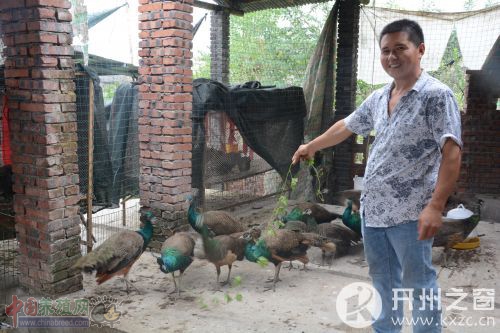
Wang Bo feeds the peacocks. By Xiong Chengcheng, this newspaper, text/photo
By a chance encounter, Wang Bo, a villager from Group 2 of Wanli Village, Nanmen Town, came into contact with peacocks and was deeply captivated by the beauty of a peacock spreading its tail feathers, so he began raising peacocks and became a leader in peacock farming in our district.
Giving up rabbit farming to raise peacocks instead
In 2008, Wang Bo, who had worked away from home for more than 10 years, returned to the village with more than 200,000 yuan in savings and hopes for a bright future to raise meat rabbits. Due to competition from Angora rabbits and rex rabbits, the price of the meat rabbits he raised was always unsatisfactory. After more than 2 years of farming, he not only made no money but also lost money on labor wages. For this reason, he disposed of all the rabbits and felt depressed for quite a long time.
At that time, Wang Bo felt discouraged and did not know where his future should go. Carrying a sense of loss, he traveled to Yunnan to relax. Unexpectedly, this trip to relax led him to form an indissoluble bond with peacocks.
Wang Bo said: "At the moment the peacock spread its tail feathers, its brilliantly colorful plumage amazed me and suddenly opened my mind. When I was confused, this was undoubtedly the best 'stimulant.' I believe I have a fateful connection with peacocks. So I hurriedly asked a friend to order 20 blue peacocks, ready to start the farming path again."
Constantly exploring farming techniques
After Wang Bo returned home, he put the peacocks into the enclosure where he had previously raised meat rabbits. Because the area nearby was all citrus trees and mixed woods, the environment was good and the space was broad, which was good for the peacocks' growth. Coupled with his careful care, after a year and a half, all 11 female peacocks laid eggs, and all hatched peachicks, which made him feel a great sense of accomplishment.
At that time, Wang Bo, who loved to "tinker," had the idea of expanding the scale of breeding. He not only learned farming techniques from the town's animal husbandry department, but also went to peacock farms in Hunan, Yunnan and other places to learn from masters. Through constantly exploring farming techniques, his farming path went very smoothly.
Speaking of his achievements in learning from masters, Wang Bo said proudly: "After years of farming experience and continuous learning, I have mastered the full set of blue peacock farming techniques, including incubation, brooding, disease prevention, and breeding, and I maintain technical and market cooperation contacts with many large blue peacock farms in China. At present, a complete set of modern farming equipment has been equipped, the base construction is becoming more and more complete, and the farming business is developing vigorously."
Promoting the farming project
It is understood that the peacock, as the king of a hundred birds, has the characteristics of a strong gamey flavor, high protein, low fat, and richness in various amino acids needed by the human body. It is a high-grade delicacy and a meat poultry species with great development prospects. Its peacock eggs have extremely low fat content and relatively high protein content, making them a good low-fat, high-protein food source. In addition, the content of zinc and sodium among mineral elements is relatively high, making them a good food source for supplementing zinc in the human body. Therefore, the development potential of peacocks and peacock eggs is infinitely bright.
Wang Bo told the reporter that peacock farming has low cost and high returns, and it saves time and labor. It does not require too much labor or occupy good farmland and cultivated land, and it is pollution-free, clean and hygienic. Generally, after about 10 months of raising, they can reach 6-8 jin. A single commercial peacock can sell for 700-800 yuan, and the economic returns of ornamental peacocks are even higher. In addition, the feed for raising peacocks is also extensive, mainly mixed feed such as corn, wheat bran, soybean cake, and fish meal, as well as green leafy plants.
At present, Wang Bo's farm has 1,000 blue peacocks of all sizes, with an annual output of 3,000 birds and an output value of several hundred thousand yuan. Driven by him, Wanli Village has increased the promotion of peacocks as an advanced farming project, integrating it into a modern agricultural park that combines sightseeing, environmental protection, ecology, and green development, with supporting tourism development, forming a peacock village with one village, one product.
Peacocks are "delicate" and need careful attention
The reporter came to Wang Bo's Nongfei Blue Peacock Farm. The dogs outside the gate kept barking when they saw strangers visiting, and then the peacocks in the pens also called uneasily. Wang Bo said that peacocks are very cautious and are easily startled. At present, the timing is not yet mature, so people are generally rarely allowed into the pens to view them.
Wang Bo said that peacocks are also a bit "delicate" and are very susceptible to bacterial infection and illness. In order to prevent this well, he has to remove manure and clean up every day. In addition, twice a year before and after the peacocks lay eggs, they must be given preventive injections, and deworming medicine must also be fed regularly.