Pig manure turned from waste into treasure: pig farmer sells over a million in 2 years
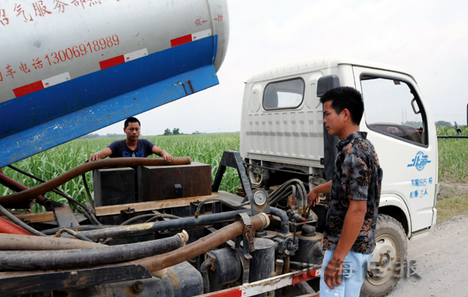
A blue body with a huge white oval tank mounted on top; at first glance it looks like a specialized tanker for transporting fuel——"What's inside is all pig manure," said Zhao Ping.
Early in the morning on September 7, Zhao Ping's 20 "manure trucks" set out together to "collect manure" from major livestock farms across Qionglai, Chengdu, Sichuan. After processing, the collected manure is spread onto farmland by dedicated workers, becoming top-quality farmyard manure. "During the busy farming season, the 'manure trucks' running back and forth are denser than buses," Zhao Ping said. In Qionglai, there are already more than 150 such "manure trucks."
Zhao Ping, once a specialized livestock breeder, is now the head of the Qionglai Jiehuan Livestock and Poultry Manure Collection Service Professional Cooperative. Two years ago, Qionglai, a major national pig-producing county, faced serious non-point source pollution. Under pressure from environmental protection, Qionglai tried "off-site recycling" for comprehensive utilization of livestock and poultry manure, forging a new green development model.
Aiming at the "manure pumping teams"
Zuo Dongliang, a backyard pig raiser in Heishi Village, Guyi Town, raised more than 50 fattening pigs, and how to deal with the pig manure had long been a headache for him. "Calculating at 10 jin of manure per pig per day, that's more than 500 jin of pig manure a day, and the manure pit fills up within a few days." With no other choice, Zuo Dongliang secretly discharged the manure into fields and ditches, and the overpowering stench often had villagers pointing at his nose and cursing him.
This was not Zuo Dongliang's problem alone. As a major national pig-producing county, Qionglai's pig farming scale is around 1.4 million head slaughtered annually; calculated at 1.08 tons of manure per pig, that means 1.51 million tons of pig manure produced each year. Non-point source pollution control was urgent. "We thought about closing some farms before, but how could we close them all?" said Ren Zhi, section chief of the Agricultural Construction Section of the Qionglai Agriculture and Forestry Bureau. By 2014, the city's thinking shifted: find a way out for 1.51 million tons of pig manure.
The way out was not hard to find: as a major agricultural county, Qionglai has more than 600,000 mu of grain sown area and more than 200,000 mu of oilseed sown area each year. It also has advantageous industries such as tea, fruits and vegetables, and Chinese medicinal herbs. Pig manure is undoubtedly the top-quality farmyard manure this land craves.
But how do you get the pig manure scattered across various farms to where it should go?
Starting in 2014, Qionglai launched a special campaign to control livestock pollution and explore comprehensive utilization of livestock and poultry manure. First, building manure storage pits was made mandatory, and dedicated measures were introduced to provide subsidies at a standard of 80 yuan per cubic meter. Second, to truly get pig manure onto the road out of the "farm," they set their sights on the "manure pumping teams" that had long existed locally.
That year, Qionglai decided to guide the formation of professional manure pumping teams. Subsidies for purchasing manure pumping equipment were very generous: manure storage tanks, electric pumps, manure storage bags and generators were all fully subsidized, with maximum subsidies reaching 20,000 yuan. "This is worth doing." It was then that Zhao Ping decided to join this team.
Not enough pig manure to go around
Zhao Ping himself also had a farm, with a farming scale of around 500 head. His original intention in buying a manure pumping truck was to deal with the 3 tons of pig manure his own farm produced each day.
"Unexpectedly, not long after buying the truck, business came," Zhao Ping said. At the time, the town was carrying out homestead land reclamation, which required soil fertility improvement, involving an area of more than 6,000 mu. At a rate of 3 cubic meters of manure per mu, Zhao Ping could not possibly "swallow" this business no matter what.
"To bite off this 'steamed bun,' the only way was to expand scale and set up a cooperative," Zhao Ping said. Over the past two years, as the business scale expanded, the cooperative's "manure trucks" increased from 3 to 20.
"This is a typical case of market-driven development and benefit-guided behavior," Ren Zhi said.
Now, Zhao Ping really can dig gold out of pig manure: during the busy farming season, each truck makes six or seven trips a day, and one truck can hold 6.5 cubic meters of pig manure. Under the operating model, Zhao Ping collects manure on site and neither side charges a fee; for spreading it on growers' fields, he charges 30 yuan per cubic meter. "As of now, we have sold 30,000 cubic meters of pig manure, with revenue in the millions."
It can be said that pig manure fertilization now covers 50% of the planting area in Ranyi Town." This figure given by Zhao Ping is corroborated by Ren Zhi: according to incomplete statistics, since the comprehensive utilization of livestock and poultry manure project began, Qionglai has used 300,000 cubic meters of pig manure.
However, for growers, the cost of using farmyard manure is higher than that of chemical fertilizers, and to truly get pig manure circulating, it cannot rely solely on the "one-sided enthusiasm" of Zhao Ping and others. To this end, Qionglai issued a dedicated subsidy plan to subsidize growers who use manure at scale, "with subsidies at a standard of 8 yuan per cubic meter," Ren Zhi said. Adding subsidies for manure storage pits and "manure trucks," over the past two years Qionglai integrated more than 20 million yuan in fiscal funds, leveraging 24 million yuan in social investment.
Zhao Ping, meanwhile, uses another method to attract growers: "Land watered with farmyard manure is completely different from land treated with chemical fertilizers. After many years, land using pig manure will become more and more fertile."
Recently, Zhao Ping has felt that pig manure is clearly in short supply, and the radius for collecting manure has gradually expanded to beyond 30 kilometers. "This year we served 11 clients, involving 17,000 mu of land. Can you imagine how big the scale is?"
(Original title: The road out of the "farm" for a truckload of pig manure)