Longsheng, Guangxi: A poor mountain village finds money, and a "rich business" appears in the terraces
In Duping Village, Longsheng Town, Longsheng Various Nationalities Autonomous County, the mountain terraces where generation after generation only planted rice have suddenly changed in the past year or two——
Thick green vines climb all over the hillside along the trellises, and duck-egg-sized fruits hang all over the vines. This poor mountain village, which was never a place where monk fruit (Siraitia grosvenorii) was grown, began planting 300 mu of monk fruit last year, and this year it suddenly surged to 1,200 mu. In the crisp autumn air, the golden rice and the green vines embrace in wave after wave, setting each other off, making one feel relaxed and joyful.
The terraces on another hillside have become something between fields and not fields: each small plot uses bamboo tubes or plastic pipes to channel in mountain spring water, the water in the fields is knee-deep, the rice is sparse, weeds are allowed to grow, duckweed floats on the surface, and schools of fat carp can be seen under the water. This is farmers slightly modifying the rice fields to develop mountain spring fish farming.
Guangxi Daily is paired with 6 villages in Longsheng for targeted assistance, and Duping Village is one of them. In early September, the newspaper organized its subordinate targeted assistance units to go there for visits and research, and was delighted to see that the first secretary stationed in the village, with the newspaper as backing, led farmers to develop "short, flat, and fast" projects that quickly changed the village's appearance.
The poor mountain village planted monk fruit on sloping land and unexpectedly found it had several advantages over growing it on flat land in its place of origin: first, the land use area is larger; second, the sunlight conditions are better; third, under the trellises, pollination, picking, and other work do not require looking up and raising one's hands, saving effort and reducing fatigue.
Monk fruit is planted in spring and harvested in autumn, which is easier than growing rice; the income from selling fruit per mu is 6,000-8,000 yuan, which brings in more money than growing rice. The whole of Longsheng Town planted nearly 10,000 mu of monk fruit this year, beginning to take shape at scale, and local brokers are responsible for purchasing, so sales channels are guaranteed. Of the 5 poor households paired for assistance by the newspaper in Duping Village, 4 grow monk fruit, the least 4 mu and the most 10 mu, 1.5 mu per person, and from this one item alone the per capita income from selling fruit this year is expected to reach 10,000 yuan.
Among these 5 poor households, Huang Weixing, who is over 50, does not grow monk fruit but takes a different path, transforming terraces to develop mountain spring fish farming. The mountain spring water is channeled from high mountains, has no energy cost, flows ceaselessly all year round, and is always naturally clean. Some rice is planted in the flooded fields so that the rice flowers fall into the water to feed the fish, supplemented with grass, rice bran, and the like, making it very authentic ecological fish farming. Last autumn, on small terraces totaling 1.5 mu but numbering about ten plots, Huang Weixing released 9,000 carp fry, which have now grown to seven or eight liang in weight, with very delicious flesh, good enough to be made directly into "sashimi" for eating raw as fish. After city people came to taste it, they offered 80 yuan/kg to buy in bulk. Based on this, a conservative estimate is that even if only 6,000 of the 9,000 fry are harvested, and by late autumn and early winter they grow to half a kilogram in weight, total fish sales income could reach 24,000 yuan, with a carp output value of 16,000 yuan per mu——not only far exceeding rice cultivation, but also exceeding monk fruit cultivation.
After representatives of the newspaper's targeted assistance units bought and tasted the fish on site, they immediately encouraged Huang Weixing to boldly expand production, and agreed to launch a "group buy" among their colleagues at a good price of no less than 100 yuan/kg for his ecological fish.
Huang Weixing, who is farming fish for the first time in his life, was very happy and said he had already bred 20,000 to 30,000 fry himself and was preparing to expand the farming area. In the next step, he also wants to encourage other farmers to vigorously develop terraced carp farming with flowing mountain spring water.
Chen Jianjun, the first secretary stationed in the village by the newspaper, introduced that the poverty alleviation task force members adopted methods such as seeking technical support for industry and providing financial support for purchasing production materials. On the one hand, Duping Village developed "short, flat, and fast" projects such as monk fruit, passion fruit, and mountain spring fish; on the other hand, it developed medium- and long-term projects such as lingzhi (Ganoderma lucidum), oil tea trees, and Chinese medicinal herbs, enabling poor households both to escape poverty quickly and to ensure stable prosperity.
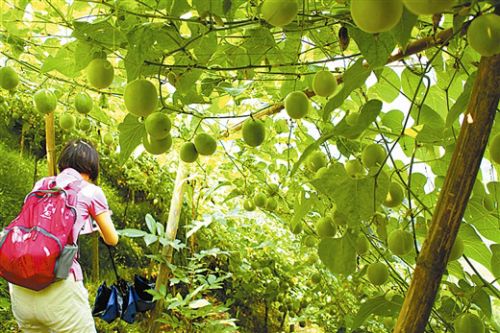
Under the thick green trellises, duck-egg-sized fruits hang all over the vines. This poor mountain village, which was never a place where monk fruit was grown, began planting 300 mu of monk fruit last year, and this year it suddenly surged to 1,200 mu.
This slope's terraces are something between fields and not fields: each small plot uses bamboo tubes or plastic pipes to channel in mountain spring water, the rice is sparse, weeds are allowed to grow, and schools of fat carp can be seen under the water. This is farmers slightly modifying the rice fields to develop mountain spring fish farming.