Once a poor mountain gully, now growing grapes and transformed into a beautiful grape valley
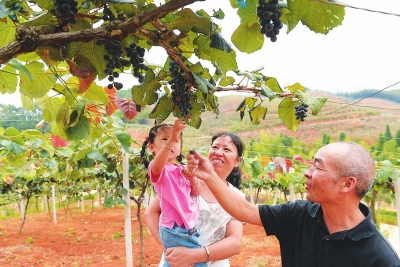
Visitors enjoy the fun of picking grapes.
Since the beginning of autumn, at the Chunqiu Farm in Fushan Village, Tangtou Township, Dehua County, clusters of dark red, translucent grapes hang all over the branches, within easy reach. Looking up, hundreds of mu of Vitis davidii (spiny grape) stretch across the hillsides, full of vitality.
A grape estate rises on red soil
"In recent years, a large number of people have moved to the cities, and after a long period of recuperation, Dehua's rural ecological environment has become superior," said Xu Changyi. When he returned home to start a business in 2008, he already had the idea of going into agriculture, and in 2013 he established Chunqiu Family Farm.
"The soil for growing grapes must not be too fertile. Grapes grown in fields grow fast, but their quality is poor and unsuitable for winemaking, while the red soil of Fushan Village is very suitable for grape growing." After several years of exploration, Xu Changyi summed up a set of "grape wisdom" rooted in Dehua's local conditions.
At the beginning, Xu Changyi found that the table grape market was not prosperous. When he was stuck in difficulty, a friend's remark inspired him. "I like drinking wine. A friend from Huaihua, Hunan, said to me, since you drink wine every day, you might as well grow and brew it yourself." This gave him a flash of inspiration, and he could not help but take action.
The main variety of grapes used for winemaking in China is Cabernet Sauvignon, but the rainy season in the south is too long, so it can only be grown in greenhouses. The problem is that grapes grown in greenhouses for winemaking find it hard to reach the required quality.
Later, he learned that Huaihua had a Vitis davidii valley, with Zhijiang being the most spectacular. So he and a friend went there for a tour, visited several planting bases, and found Vitis davidii all over the hillsides, growing naturally without needing rain shelter.
Afterward, he found there a variety called Ziqiu grape, with more moisture, the fragrance of wild fruit, and thick skins that can naturally form enzymes without externally added yeast enzymes. Its color is more beautiful than Cabernet Sauvignon, a deep ruby red, and other important elements such as tannins and anthocyanins are better than those of Cabernet Sauvignon, making it a premium variety for winemaking.
After returning from Huaihua with the know-how, Xu Changyi was greatly encouraged. After demonstrating the feasibility of growing Ziqiu grapes in Dehua, he contracted idle and abandoned hill-field paddies and mountain land in Fushan Village, Tangtou Township, transferred 2380 mu of land, and built a grape estate on Dehua's red soil.
Xu Changyi began planting Vitis davidii in the spring of 2014, nearly two hundred mu, but it was not smooth at first. It turned out that grapes are prone to downy mildew; Dehua's ecological environment is good, so as long as preventive measures are taken on time, there is no problem. Another reason was fertilizing. Xu Changyi wanted to make green food, so he refused to use urea, but the new soil lacked fertility, causing the grapes to grow poorly. Later he decided to use farmyard manure mainly of sheep manure, which both saved costs and ensured the grapes' growth needs.
After the problems were solved, the estate's grapes grew especially well this year. Because the saplings were rather small, Xu Changyi had the fruiting branches pruned. He said that small saplings have underdeveloped root systems and cannot keep up with nutrients; bearing too much fruit would affect quality and also damage the grapevines' vitality. So this year each grapevine bore only a few dozen jin of fruit. This year's harvested grapes have been sent to friends' wineries in Zhangjiakou, Hebei, Yantai, Shandong, and other places for trial production and to test relevant data.
"The altitude here is more than 850 m, with a large temperature difference between day and night, so the grapes produced are of very good quality, no worse than those in Hunan," Xu Changyi said.
"Make Dehua's green food"
"The newly grown grape leaves are red. In the spring three years from now, the hillsides will be a fiery red, highly ornamental." Xu Changyi is full of confidence in the farm's future development.
"The grapes that fruited this year are of good quality, which means that in terms of planting and growth, there is no longer a problem. Now the key is winemaking." Xu Changyi said he has very high requirements for the wine he wants to make, simply because he wants to make Dehua's green food.
He told us that the quality of wine depends on the quality of the grapes themselves. First is the variety, second is the vintage, depending on whether that year's rainfall, sunshine, temperature and so on are suitable for grape growth. At the same time, improper storage of wine can also make it too sour and change its flavor, and the winemaker's adjustments to the process also play some role. So good wine is like a work of art, requiring careful carving and patient nurturing.
He once knew nothing about winemaking, but out of his love for wine, he studied for three years and obtained qualification certificates as a winemaker and a wine taster. It is precisely his emphasis on the pursuit of wine quality that recently brought provincial and municipal green food experts to Chunqiu Farm's vineyard for testing and review.
"The best soil for growing grapes is sandy soil; the second is red soil. Dehua's ecological environment is richly endowed by nature. Within more than ten km of our base there is no industrial pollution, and around Fushan Village there are four to five thousand mu of primary forest. Add to that our high standards and strict requirements, and the green product title is within our grasp," Xu Changyi said.
Recently, the vineyard area has been stepping up the construction of supporting infrastructure to create a new model of agricultural leisure, striving to become a beautiful scenic line at Quanzhou's "north gate."
Fushan Village, once a poor mountain gully, is transforming into Dehua's most beautiful "grape valley."