Wu Haishan, Party secretary of Daochong Village in Qiongshan District, says the "money tree" bears sweet fruit
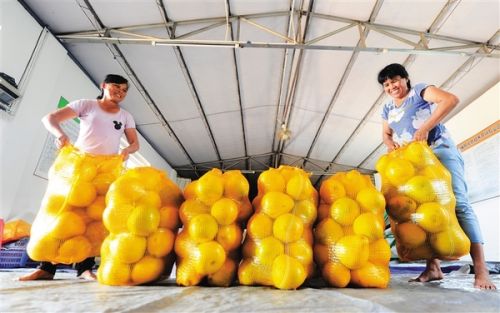
This autumn's bumper harvest of Haikou honey pomelo.
Recently, Wu Haishan, Party secretary of Daochong Village in Hongqi Town, Qiongshan District, Haikou City, has been especially busy. He has been shuttling between honey pomelo planting bases and sales markets in Haikou, Danzhou, Lingao and other places. In another year, the more than 2,000 mu of honey pomelo planted in Daochong Village will begin bearing fruit, and Wu Haishan plans to do his "homework" ahead of time to prepare for next year's bumper harvest.
In 2014, the super typhoon "Rammasun" swept across Hainan, and the more than 1,600 mu of rubber that the villagers of Daochong Village relied on for their livelihood was almost completely destroyed. To find a new alternative industry, Wu Haishan paid out of his own pocket to go out and investigate, hoping to find an industry more suitable for development.
"Mango, lychee, longan, lemon and others were all considered, but in the end honey pomelo was chosen," Wu Haishan said. He successively visited honey pomelo bases in Haikou, Danzhou, Lingao, Wuzhishan and other places, and found that honey pomelo is easy to plant and manage, has low technical requirements, strong wind resistance, stores well, enjoys good market conditions, and comes onto the market in Hainan about one month earlier than on the mainland, so its potential is great.
He looked online and found that Sanhong honey pomelo not only has a beautiful fruit shape and better quality, but is also more popular in the market, so he immediately went to Pinghe County in Fujian Province, which is rich in Sanhong honey pomelo, to investigate. "In just one county there, more than 1.3 million mu of Sanhong honey pomelo is planted, and even at a market price of 60 yuan each, there is no worry about selling them." Wu Haishan was very excited, and his confidence grew even stronger.
He did some calculations: Sanhong honey pomelo enters its high-yield period in the fifth year after planting, with a single plant yield of up to 200 jin. Calculated at an average of 50 plants per mu, the yield per mu can reach 10,000 jin, and at current market prices, the net income per mu can easily exceed 10,000 yuan. "Honey pomelo output will also increase as the trees age; it is truly a 'money tree'."
In October of that year, Wu Haishan organized village cadres and villager representatives to go to Pinghe for an on-site investigation. They took a large number of photos and videos, and brought back several hundred pomelo fruits to distribute to the villagers to taste.
At the end of November 2014, Daochong Village planted its first batch of 300 mu of honey pomelo trees. In order to promote standardized honey pomelo production, in June this year Wu Haishan also initiated the establishment of the Daodaohong Honey Pomelo Professional Cooperative, and all 48 farming households in Eryu Village of Daochong Village Committee joined the cooperative. Today, Eryu Village's honey pomelo planting scale has reached 1,250 mu, and the Eryu honey pomelo planting base has become a provincial-level agricultural standardization industrial park.
Today, Daochong Village's honey pomelo planting area has reached 2,500 mu. The villagers interplant short-term crops such as Chinese yam, pineapple, sweet potato, sand ginger and sesame between the rows of fruit trees, using short-term crops to support long-term ones. "In another year the honey pomelo can be harvested," Wu Haishan said. Although paying out of his own pocket for the investigation cost more than 30,000 yuan, looking back now, "that money was really well spent!"