Unsold Grapes Worry Over Finding a Market; Village Officials and Chamber of Commerce Drum Up Sales Far and Wide
"Boss Zhang? This is the Luzhou Wenzhou Chamber of Commerce. Pack me 50 boxes of Muscat Hamburg grapes; I'll drive over this afternoon to pick them up..." On the morning of August 23, Zhang Angui of the "Xiulinxiang" vineyard in Gaodong Village, Mianhuapo Town, Naxi District, Luzhou City, received yet another order call, and then happily headed off to the vineyard to get "goods" ready for the customer.
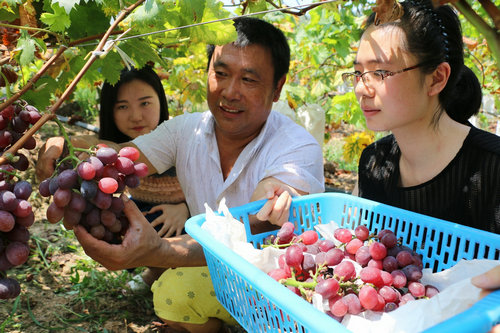
Little did anyone know that not long before, Zhang Angui had been staring at his vineyard full of grapes and "sighing." Because of the season, large quantities of grapes from the surrounding area were hitting the market, and his vineyard's grapes, due to poor market access, information and sales channels, had once fallen into a serious sales slump, leaving Zhang Angui so anxious he did not know what to do.
Expanding the Scale Worries the Grower; Grapes Face a Tough Sell
Walking into the "Xiulinxiang" vineyard just 4 km from downtown Naxi, rows upon rows of trellises are covered with grapevines. A gust of autumn wind blows, and the leaves roll and ripple in waves; many vines no longer carry grapes. In one corner of the vineyard, lifting off the white paper bags reveals ripe Muscat Hamburg grapes gleaming in the sunlight like translucent red agate. Purple Muscat Hamburg, creamy-white Cream Muscat, blue Summer Black, pinkish-red Red Milk...
It is understood that the "Xiulinxiang" vineyard is a family farm integrating fruit growing, leisure, sightseeing, picking and fishing. In 2011, Muscat Hamburg and Cream Muscat grapes were introduced from Shanghai. In 2012, the planted area was only just over 50 mu, and by 2016 it had expanded to more than 200 mu, of which just over 50 mu were in production and bearing fruit, with an annual output of nearly 150,000 jin of grapes. The varieties include early-maturing, mid-maturing and late-maturing types.
During the interview, Zhang Angui said his grapes are different from others: they are introduced high-quality new varieties. On one hand, the "Xiulinxiang" vineyard sits deep among surrounding mountains, far from the city, free of industrial pollution, with large day-night temperature differences, fresh air, lingering mist and excellent water quality; on the other hand, it uses modern agricultural production techniques such as pollution-free cultivation, rain-shelter greenhouses, precision drip irrigation, solar insect-killing lamps and insect-proof nets. It uses no reddening agents, growth hormones or swelling agents, and for topdressing it chooses higher-cost natural fertilizers such as farmyard manure and oil cake. The grapes produced have a fresh, sweet taste, pure color, rich aroma and a long finish.
"I heard your grapes weren't selling? There aren't many left now!" Seeing my puzzlement, a beaming Zhang Angui said, "Before, they sold at 20 yuan/jin, and with small volumes they sold fast. Now that the scale has grown so big, I fell into a sales slump. Seeing others selling so briskly made me feel stifled. Later, thankfully, the college-graduate village officials and the chamber of commerce backed me up, otherwise this year's grapes would have been a big loss! What a disaster that would have been!" Pointing to the bagged grapes in the field, Zhang Angui said only the last 1,000-plus jin remained now, and he was no longer worried.
Village Officials Help Bring Customers In, Happily Serving as Fruit "Image Ambassadors"
"The village officials took photos to show off the grapes, posted on WeChat and Weibo, packed and boxed them..." When mentioning how the village officials helped promote grape sales some time ago, Zhang Angui still feels grateful to this day.
During the "Go to the Grassroots, Listen to People's Voices, Solve Problems" activity, village officials such as Liu Jialin and Tao Wensi of Mianhuapo Town, upon hearing that "Xiulinxiang" grapes were not selling, immediately formulated assistance measures. They used their weekends to go into the vineyard and divided the work: some collected information on grape quantity, varieties and quality, while others handled picking and packing. By taking promotional photos, opening WeChat and Weibo accounts, and setting up online and micro stores, they served as "image ambassadors" for "Xiulinxiang" grapes and addressed shortcomings such as narrow sales channels.
"Leveraging the advantages of village officials and our specialized skills to 'show off' our hometown's beautiful scenery, 'display' our hometown's delicious food, and happily serve as hometown 'image ambassadors,' helping Mianhuapo build 'one village, one brand' -- it is my honor." Speaking of photographing his hometown's grapes and posting them on WeChat Moments to attract customers, the town's college-graduate village official Tao Wensi told me modestly.
The results were immediate. It is understood that in just the last week of July, several village officials in Mianhuapo Town published more than 100 pieces of grape sales information, contacted more than 30 customers, and helped sign more than 20 sales orders.
Chamber of Commerce Sets the Stage for a "Big Show"; Fruit Weighs Down the Branches but "Need Not Worry About Finding a Buyer"
Because of abundant rainfall and ample warm sunshine this year, grapes everywhere bore heavily. How could they find another way, open up the market, turn "unsold" grapes into "hot sellers," and turn little grapes into big "golden fruit," achieving both a bumper harvest and higher income?
There are always more solutions than difficulties. After learning that "Xiulinxiang" grapes were not selling, the Mianhuapo Town Chamber of Commerce promptly used the chamber's advantages of broad connections and wide information to help Zhang Angui plan and carry out various promotional activities, helping sell the grapes through methods such as holding a grape-picking festival, inviting members to taste for free, and offering member discounts.
In addition, the Mianhuapo Town Chamber of Commerce also organized e-commerce planning experts to perform "surgery" focused on brand packaging, e-commerce platform construction, marketing strategies, express delivery and logistics for the Muscat Hamburg-type and Cream Muscat-type grapes.
"First, the packaging boxes were redesigned. Previously the grapes had only a single box size holding 10-20 jin. Using that size made shipping expensive. Now they have changed the packaging boxes to different sizes such as 3-5 jin and 8-10 jin, to suit different consumer groups." Chen Yan, secretary-general of the Mianhuapo Town Chamber of Commerce, said that in brand building, a quality traceability system has been established, displaying Gaodong Village's resource environment and ecological planting process through e-commerce platforms, billboards and other means, so that city residents can buy genuine "reassuring fruit."
To solve problems such as grapes' short storage period and easy damage during transport, it is understood that: for large customers, the main approach is to use the town and village e-commerce platforms to promptly publish product information and have customers come to purchase on site; for general consumers, taking advantage of the village's rural tourism development, signboards are set up along the roads, and through the chamber's WeChat Moments, QQ groups and other channels, word spreads from one to ten and ten to a hundred, bringing more city residents to the vineyard to experience the fun of picking; for those requiring mailing, they connect with the district's centrally developed e-commerce express logistics for centralized delivery; in addition, methods such as farm-supermarket linkage and physical-store sales are used to let "Xiulinxiang" grapes fly out of Gaodong Village.
"To expand brand awareness, the next step will be to strengthen the quality certification system and enter the public brand of agricultural specialty products, striving to gain 'a place' in major shopping malls such as Huitong and Moore." said Yi Bin, president of the Mianhuapo Town Chamber of Commerce.
"There are more phone orders now. The largest single order so far is 2,000 jin, and the farthest orders are from Beijing and Shanghai. Moreover, the grapes' 'value' has risen, from 20 yuan per jin to 25 yuan." Zhang Angui said that currently, "Xiulinxiang" grapes have sold more than 140,000 jin, achieving sales revenue of more than 2.8 million yuan. The grapes that once could not be sold now spread their "sweet fragrance" far and wide again, and grower Zhang Angui is happy in his heart as well.