Okra planting fulfills the dream of prosperity of Zheng Haijun, a post-80s college graduate from Qianxi, Hebei
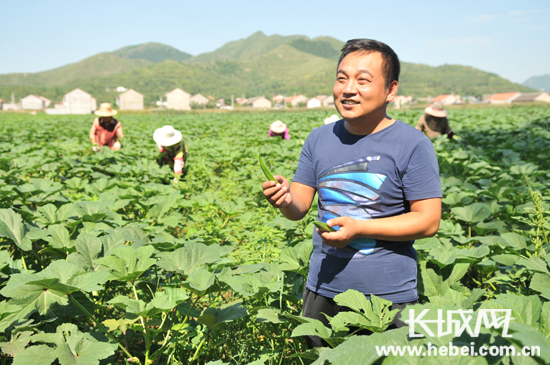
Zheng Haijun
In a person's life, one always faces many choices. And the outcome of those choices often determines the height a person's career can reach. Zheng Haijun, a post-80s college graduate from Xiaoxiying Village, Santunying Town, Qianxi County, Hebei Province, encountered two important choices on his entrepreneurial path.
In 2008, after graduating from North China Coal Medical College with a degree in clinical medicine, Zheng Haijun became a doctor in the medical office of Jinxi Co., Ltd. A year later, Zheng Haijun made a decision that surprised many people - resigning to go into business. The flourishing modern agriculture of Qianxi County greatly inspired Zheng Haijun's entrepreneurial spirit. He believed that Qianxi possessed unique natural endowments, and that developing agriculture with mountain-area characteristics had broad room for growth. Only by doing a good job with this article on distinctive agriculture could his entrepreneurial path go further.
In early 2016, a crop called okra caught Zheng Haijun's attention. He made up his mind to become the first person to grow okra in the Tangshan area.
In the spring of the same year, Zheng Haijun invested 300,000 yuan to transfer 60 mu of land in Nanzhuang Village, Xingcheng Town, and built Tangshan City's first okra planting base. In line with the green, organic and pollution-free development philosophy of modern agriculture, Zheng Haijun established at the very beginning of the base a management rule centered on the "three prohibitions and three alwayses": strictly prohibit the use of chemical fertilizers and always use organic fertilizer; strictly prohibit the use of pesticides and always promote physical pest control; strictly prohibit the use of herbicides and always adopt manual weeding. He has consistently carried it out ever since.
In his first intimate contact with the land in his life, Zheng Haijun came to appreciate the importance of scientific knowledge, and even more so the hardship and difficulty of developing the planting industry. He seized time and squeezed out time to learn about planting from the internet, from books, and even by traveling far to the Hebei Academy of Agriculture and Forestry Sciences.
Afterward, Zheng Haijun took samples of okra flowers and okra pods produced at the base to promote them in many places. Zheng Haijun quickly opened the doors to sales with the Tangshan City Rural Cooperative Union and the headquarters of Jinkelong Supermarket in Fengrun District, and through this the base's okra products entered major supermarkets in Tangshan City and began advancing into the large Beijing-Tianjin market.
In August, as the market expanded step by step, Zheng Haijun added drying equipment and set up a small processing plant in a farmhouse courtyard beside the base, starting to process small packages of okra pods and dried products. Zheng Haijun said, "Now our daily shipment volume is around 1,000 jin. Fresh products are picked one day and delivered directly to the Jinkelong Supermarket in the county seat the next morning, while the roughly processed dried pods are sent elsewhere for sale. Calculated at 6,000 jin of fresh pods per mu, it should be no problem to recover the investment within the year."
During the construction and development of the base, he came to understand more and more deeply the farmers' boundless longing for a happy life, and felt more and more profoundly the great significance of the base to the villagers' path to prosperity.
For several months, the base hired more than a dozen villagers every day for planting and picking work, with the largest number of hired workers reaching more than 40. For Nanzhuang Village, a small mountain village that had never had an outside enterprise, it not only provided villagers with extremely valuable employment opportunities, but also opened a door to ideological emancipation for them. Li Xiaochun, a rural woman who had been working at the base all along, said happily, "For so many years, apart from running the household, we women just tended those few mu of family land. After the okra base was established, more than a dozen of us women came here to work together, earning dozens of yuan every day, and we feel our days are fuller!"
Speaking of the base's impact on the villagers, base manager Song Baoquan had much to say. "When the base was first established, most villagers had no idea what okra was. Only after coming to work at the base did people learn that okra is a plant vegetable with very high nutritional value, and truly understand that on this same piece of land, different crops can produce vastly different economic returns. Now many people in the village want to grow okra and develop modern agriculture!"
The villagers' expectations and the villagers' aspirations kept striking Zheng Haijun's young heart. On the basis of paying attention to the base's economic benefits, he also gave more thought to the base's social benefits. He said, "Looking at it now, I was right to choose the okra project, because it is not only a good project for personal prosperity, but also opens up a new path to prosperity for the broad masses of farmers." The continuous strengthening of his sense of social responsibility imperceptibly elevated Zheng Haijun's outlook on life, making his steps in pursuing his dream firmer and more powerful.
"Next year, I plan to establish an okra professional cooperative, and while further expanding the scale of production, introduce advanced equipment, develop deep processing of okra products, and step by step build the okra industry into a new highlight of the county's agricultural development, leading more people onto the path to prosperity." Standing in the okra field rippling like green waves, envisioning the base's future from afar, Zheng Haijun was full of confidence.