How can corn production cut costs and boost efficiency? These technologies lend a hand
Original title: A profound technological transformation is brewing in corn production
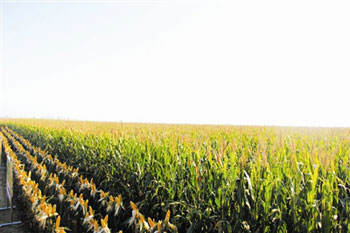
The 100,000-mu high-yield demonstration zone in Wucheng County at harvest (web image: Dezhou Daily)
Comprehensive report by Sannong Zhitongche: With a planting area of 550 million mu and dual use for grain and feed processing, this is corn, China's number one crop. Facing a trough in corn prices, how to rely on scientific and technological progress to lower costs and increase farmers' incomes is of great significance to safeguarding national food security.
"China's corn production technology has already approached the world's advanced level. With this kind of production technology and management approach, the efficiency of corn production is already internationally competitive." From September 26 to 27, the on-site meeting of the Chinese Academy of Agricultural Sciences on the integrated model of green yield- and efficiency-enhancing technologies for corn was held in Wucheng County, Shandong Province. At the meeting, Chen Mengshan, Party secretary of the academy, pointed out that China's corn production mode is brewing a profound technological revolution, which could change the fate of China's corn industry.
Cost-cutting and efficiency-boosting technologies come to the rescue of corn production
"The integrated technologies selected in the past two years mainly focused on high yields, while this year the emphasis is mainly on cutting costs and boosting efficiency." Huang Changling, a researcher at the academy's Institute of Crop Sciences, introduced this to a China Science Daily reporter.
The technologies integrated and promoted this year in the Huang-Huai-Hai corn production region include "eight supporting measures for agricultural machinery and agronomy, six integrations for scientific sowing, and four combinations for green prevention and control."
The reason for such a change stems from the sharp decline in corn prices this year.
At the beginning of this year, when experts formulated the integrated technology model for Wucheng County, they made a forecast regarding the overall situation of declining corn prices. If they continued to pursue a high-input, high-output model as in the previous two years, the input-to-output ratio would ultimately only be roughly break-even.
In light of this situation, experts improved the integrated technology model, that is, shifting toward "cost cutting and efficiency boosting." Huang Changling introduced that through 8 technologies and their application, "three reductions and one increase" are achieved, namely reducing fertilizer, reducing pesticides, and reducing labor, while increasing efficiency. The specific measure is to carry out industrial adjustment and compress the corn planting area, but because local people are unwilling to give up planting corn, of the 600,000 mu in the entire Huang-Huai-Hai region, less than 70,000 mu was shifted out.
Through the green yield- and efficiency-enhancing production model, fertilizer use was reduced by more than 10%, pesticide application was reduced by more than 10%, labor was saved by 1 person/mu, and efficiency was raised by more than 10%, while ensuring a yield of 700-800 kg per mu. According to calculations, farmers can save 120 yuan/mu in costs. When widely promoted on plots with better soil fertility, saving 120 yuan/mu in costs and increasing efficiency by 100 yuan means an additional income of 220 yuan.
Putting "green" first
"In 10 days, the moisture content of these corn plants will be even lower, and the kernels can be harvested directly by machine." Looking at the corn in the demonstration zone, Huang Changling told a China Science Daily reporter that this year multiple green prevention and control technologies were integrated, emphasizing one control, two reductions, and three basics.
First, disease-resistant varieties are provided to achieve agricultural control; second, means such as solar energy and insect induction are provided to achieve physical control and reduce the number of chemical applications; third, Trichogramma is used to prevent the damage of corn borers and achieve biological control; and chemical control is also used to reduce pests and diseases.
Among them, three green technologies attracted the reporter's attention.
The plant immune protein inducer Atailing, developed by the academy's Institute of Plant Protection, does not act directly on plant pathogens, but instead enhances resistance by inducing plant immunity, enabling plants to grow healthily, reducing disasters, and increasing yields. At the same time, it can reduce pesticide use and protect ecological security and agricultural product safety.
Wang Weiwei of Anhui Agricultural University told a China Science Daily reporter that the intelligent thermal fogging pesticide application technology they developed uses a crawler robot to enter farmland and apply pesticides in the middle and late stages of corn production, and can spray pesticides onto the backs of leaves where drones cannot apply them. One thermal fogging machine is equivalent to the work efficiency of 15 laborers, reducing labor costs while also avoiding health damage to operators from the chemicals.
Huang Zhiqiang, a researcher at the academy's Institute of Crop Sciences, developed the growth regulator "Jindele" based on the principle of hormone regulation. Spraying it on the leaves at the 6-leaf stage of corn achieves the effects of increasing root mass, improving plant architecture, and raising yield.
Moving closer to world standards
"China's corn has generally developed very quickly, but its innovation capacity is relatively weak and needs support from excellent varieties and systematic institutional innovation." Li Xinhai, deputy director of the academy's Institute of Crop Sciences, pointed out at the meeting that the development of processing industries for corn feed, energy, and high-value-added products requires support from high-quality corn and processing technology as well as transformation and upgrading.
However, after inspecting the demonstration site in Wucheng County, Chen Mengshan believed that China's corn production technology has already approached the world's advanced level. With this kind of production technology and management approach, the efficiency of corn production is already internationally competitive.
In the Wucheng project demonstration zone, the 300,000-mu corn demonstration field reached a yield of 667 kg per mu, close to the U.S. national average of 690 kg, while the U.S. corn industry represents the world's advanced level. In terms of input, the actual cost of production factor inputs was 300 yuan/mu. Adding land use and labor costs, the total was 1,000 yuan/mu, and the production cost per kilogram of corn was 0.75 yuan.
"This technological path has laid the foundation for our agricultural production competitiveness." Chen Mengshan said. (Reporter Li Chen)