Corn planting areas are scattered, and cross-regional mechanical harvesting is mainly short-distance
Original title: Henan encourages short-distance cross-regional mechanical harvesting
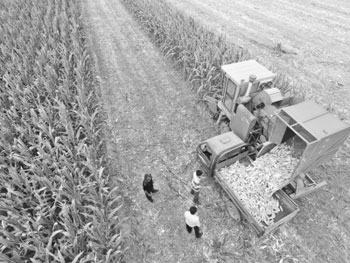
In the golden autumn season, more than 700,000 mu of corn in Chiping County, Liaocheng City, Shandong Province have ripened one after another. Local farmers are busy harvesting, drying, and storing it. Fields and courtyards are golden everywhere, presenting a scene of bustling agricultural activity. The photo shows farmers driving corn harvesters to harvest corn in the farmland of Houlou Village, Jiazha Town, in the county recently. Photo by Zhao Yuguo and Dong Xueke
San Nong Express comprehensive report: In 2015, China's corn planting area was 572 million mu, the mechanical harvesting area reached 360 million mu, and the level of mechanical harvesting reached 63%. Among them, more than 99,000 corn harvesters in major corn-producing areas participated in cross-regional mechanical harvesting, completing nearly 70 million mu of operating area, accounting for 19.6% of the total mechanical harvesting area, with the proportion of cross-regional mechanical harvesting clearly low. With the accumulation of practical experience in cross-regional mechanical harvesting of wheat and rice, as well as the demonstrative promotion and application of large-scale corn mechanical harvesting, the conditions for promoting cross-regional corn mechanical harvesting are already in place. However, the corn harvest period spans a relatively long time, and at present local operations are mostly the main form. This is largely because farmers have not yet recognized the benefits of appropriately delayed corn harvest. If appropriately delayed harvest is vigorously promoted, then the corn harvest time span will be greatly shortened, and cross-regional corn mechanical harvesting will become another “gold-mining field” in China's agricultural mechanization sector. ——Editor's note
“Harvesting corn with machines is much easier, and you don't have to fear the autumn tiger heat.” said Shang Shuiwang, a farmer from Shangzhuang Village, Chencao Township, Xuchang County, Henan Province. More than 40 mu of corn at home were harvested in less than two days, saving labor and effort without spending much more money. 80% of the villagers in the village use machine harvesting, and only those relatively small plots are still harvested by hand. Corn mechanical harvesting is definitely the direction of future development.
1
Mechanical harvesting helps appropriately delayed corn harvest
It is understood that corn harvesters currently used for field operations are mainly divided into snapping-type corn combine harvesters (ear harvesting) and corn grain combine harvesters (grain harvesting). Hu Jinbo, director of the Agricultural Machinery Management Division of the Henan Provincial Agricultural Machinery Bureau, introduced that the province has more than 65,000 corn harvesters, among which snapping-type corn combine harvesters account for a relatively large proportion. These machines can fully meet the province's corn harvest needs.
“Corn grain harvesters developed relatively late and were upgraded from snapping-type corn harvesters. The moisture content of corn after direct grain harvesting is relatively higher, so corresponding grain drying equipment must be matched.” Hu Jinbo said.
For large planting professional cooperatives, choosing grain harvesting is relatively suitable. The more than 2,000 mu of land transferred by the Huanyong Farmers' Planting Professional Cooperative in Hua County are all planted with corn. “Because the step of threshing after ear snapping is relatively labor-intensive, more than half of the cooperative's plots choose direct grain harvesting. But 90% of farmers in surrounding villages adopt direct ear snapping, then go back to dry and thresh.” said Du Huanyong, chairman of the cooperative.
Du Huanyong introduced that most farmers now relatively approve of mechanical harvesting. Generally, farmers planting three to five mu use machines to harvest, while large grain growers need drying equipment. For example, after harvesting more than 2,000 mu of corn, we have no place to spread it out for drying, so we can only use machines for drying. Although costs have risen, the input for manual drying has decreased, so relatively speaking it is still quite cost-effective.
Du Huanyong also did a calculation for the reporter: one laborer working 8 hours a day can harvest 1.5 mu, while mechanical operation can harvest at least 40 mu in 8 hours; hiring workers to complete ear snapping, peeling, bundling and hauling for 1 mu of corn requires more than 120 yuan, while mechanical harvesting costs about 70 yuan per mu. It can be said that corn mechanical harvesting has high efficiency and low cost, and in the future it will be applied on a large scale like wheat harvesting.
“Corn mechanical harvesting can also achieve appropriately delayed harvest, improve yield and quality, and not hinder the sowing of the next crop of winter wheat.” Hu Jinbo said. According to experiments, for summer corn from the dough stage to the full ripening stage, for each day of delayed harvest, the thousand-grain weight increases by 3~4 grams, and the yield per mu increases by 6~8 kg. If harvest is delayed by 7~10 days, the yield per mu increases by 50~80 kg.
2
Cross-regional harvesting is mainly short-distance
The Dongfanghong Agricultural Machinery Cooperative in Wuyang County has 4 snapping-type corn harvesters and 6 corn grain harvesters. “Autumn grain is not like wheat. Some places plant more corn, and some places plant more soybeans and peanuts. Corn planting areas are not concentrated, and the maturity period is also scattered. We only have two machines participating in cross-regional operations, generally harvesting for large grain growers who make appointments in advance, and we almost never go to other places to harvest.” said Yan Yuedong, chairman of the cooperative.
The reporter learned during interviews that the overall time span of autumn corn harvest is longer than the “three summers” wheat operation time. As long as there is no continuous rain, there is no need for rush harvesting, and it is not the case that it can all be harvested from south to north within a short time. Therefore, the corn harvest time is relatively flexible, so one machine also covers a relatively large local area. Most corn harvesters carry out short-distance cross-regional operations after finishing local harvesting.
“This year Henan Province organized more than 4.3 million units (sets) of agricultural machinery to be put into ‘three autumns’ production, striving to make the corn mechanical harvesting rate reach about 75%, an increase of 2 percentage points over the previous year.” Hu Jinbo said. According to the time differences in operations within the region, a machine scheduling plan suitable for small-range mobile operations should be formulated in advance, coordination of operation supply and demand, technical guidance, information guidance services, and other work should be done well, and machinery surpluses and shortages should be adjusted in a timely manner to maintain a balance between machinery supply and demand.
Based on practical considerations, the Henan Provincial Agricultural Machinery Bureau requires county-level agricultural machinery departments in all localities to actively organize agricultural machinery cooperatives and other socialized service organizations to sign full-process or single-item operation contracts with surrounding villages and groups and local farmers, encourage cross-regional operations in corn mechanical harvesting, mechanical plowing and mechanical sowing and other projects, improve operation efficiency, increase machine operators' income, and accelerate the progress of autumn grain production.
3
Corn mechanical harvesting urgently needs machinery-agronomy integration
“Although the efficiency of mechanical harvesting operations is relatively high, overall it is not as clean as manual harvesting, and there are relatively many dropped ears. If corn lodges, the mechanical harvesting effect is even less ideal.” Shang Shuiwang pointed out the weakness of corn harvesters.
Yan Yuedong, who has driven harvesters for many years, is equally helpless in the face of lodged corn. “If the lodged area is too large, the impurity content of mechanical harvesting is relatively high. What the machine needs to improve now is to allow lodged corn to also be harvested normally.” Yan Yuedong said that in actual operation it was found that some corn varieties are still not suitable for grain harvesting.
For Du Huanyong, who has relatively more experience in mechanical harvesting, when operating agricultural machinery to snap corn cobs, the first thing is to ensure that the gap for the harvesting machine to peel corn husks is reasonable, and at the same time adjust the stalk crushing rate to reduce the probability of stalks blocking the machine. “Although corn mechanical harvesting is basically mature, its popularity and technical level are still not as high as wheat mechanical harvesting.”
Machine operators also encounter some problems in actual machine operation, such as novices being unable to operate the machine proficiently, and some deviations in operation adjustment during harvesting, causing machine failures. “This requires manufacturers to keep up in a timely manner in after-sales service. Every year during ‘three summers’ and ‘three autumns’, we require every county and district to have a manufacturer after-sales service point, so that problems with machines can be guaranteed to be solved in a timely manner.” Hu Jinbo said.
The Henan Provincial Agricultural Machinery Bureau adopts methods such as subsidy policy leverage, administrative organization promotion, typical demonstration-driven guidance, and agricultural machinery-agronomy integration to improve the level of corn mechanical harvesting. In agricultural machinery purchase subsidy funds, priority is given to meeting the needs of corn harvesting machinery, all levels of finance are encouraged to implement cumulative subsidies for farmers purchasing corn harvesters, the practice of implementing corn mechanical harvesting operation subsidies is actively promoted, and drawing on the experience of cross-regional wheat operations, cross-regional corn mechanical harvesting is carried out. (Our reporters Zhang Peiqi and Fan Yaxu)